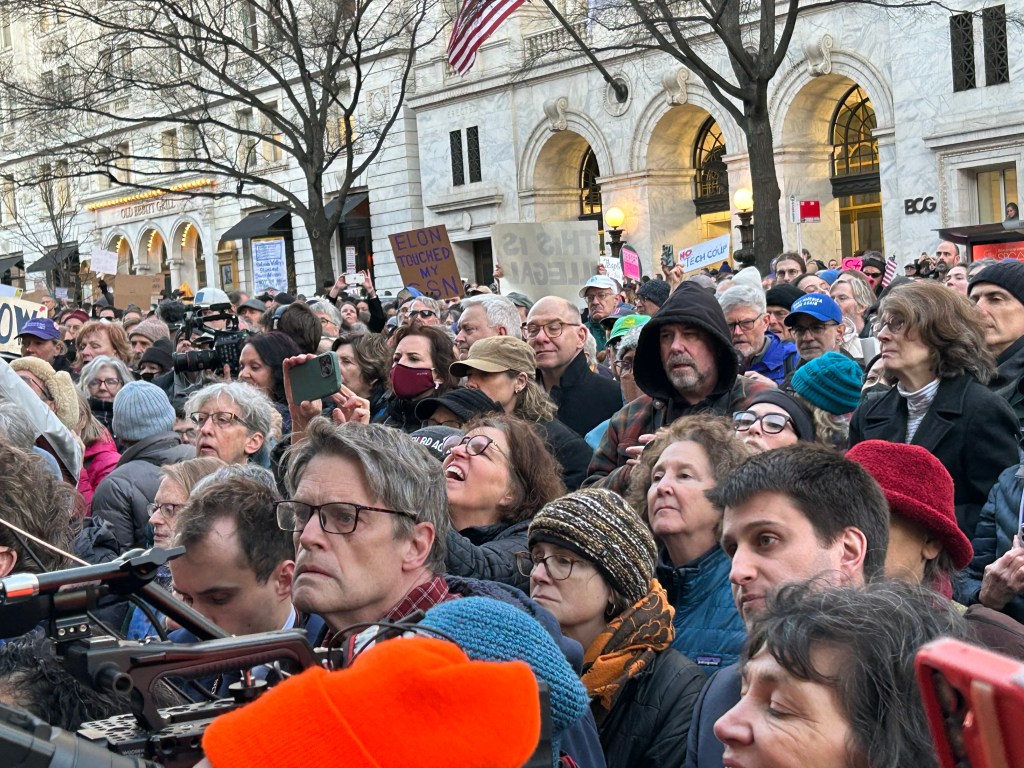
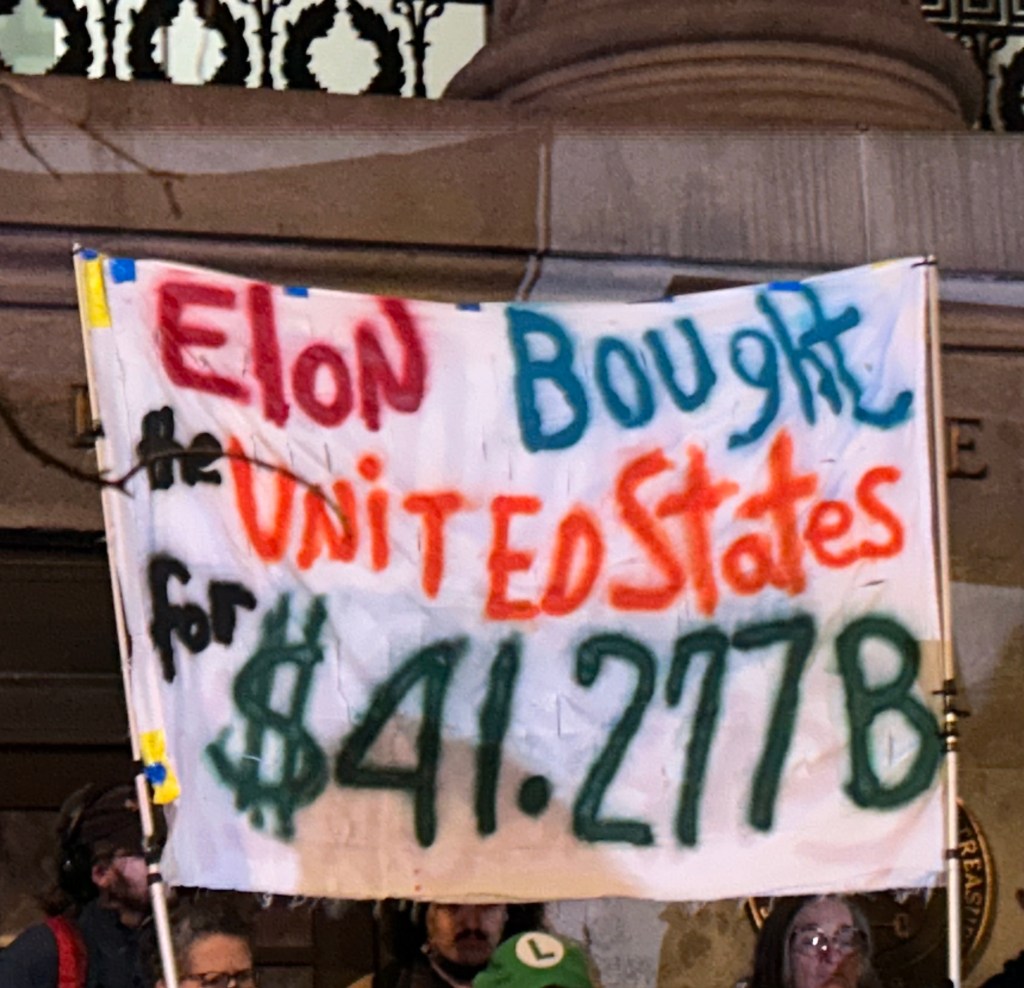
I just returned from a rousing resistance rally at the U. S. Treasury building in downtown Washington. The rally was organized by the MoveOn and the Indivisible organizations after Elon Musk’s egregious invasion and takeover of the U.S. Treasury and its sensitive computer systems over the weekend.
A crowd of thousands thronged the sidewalk and street in front of the building on 15th Street, NW. A contingent of Democratic U.S. Congresspersons, Senators and Representatives, many of them on Government Oversight Committees, had been turned away from entering the building
The rally featured over a dozen members of Congress as well as leading spokespersons for MoveOn and Indivisible. My fellow Indivisible member and friend Raj Gupta joined me for the Metro ride downtown. We arrived early enough to get prime standing positions just behind the official video cameras of the event.
We were both inspired by the energy and enthusiasm of the speakers and the crowd. The speakers’ list included Senators Elizabeth Warren (MA), Chris Van Hollen (MD), Chris Murphy (CT), Ron Wyden (OR), Richard Blumenthal (CT), and Democratic Minority Leader Chuck Shumer (NY). From the House side were Rep. Maxine Waters (CA), Ayanna Pressley (MA), Jaime Raskin (MD) and a number of others.
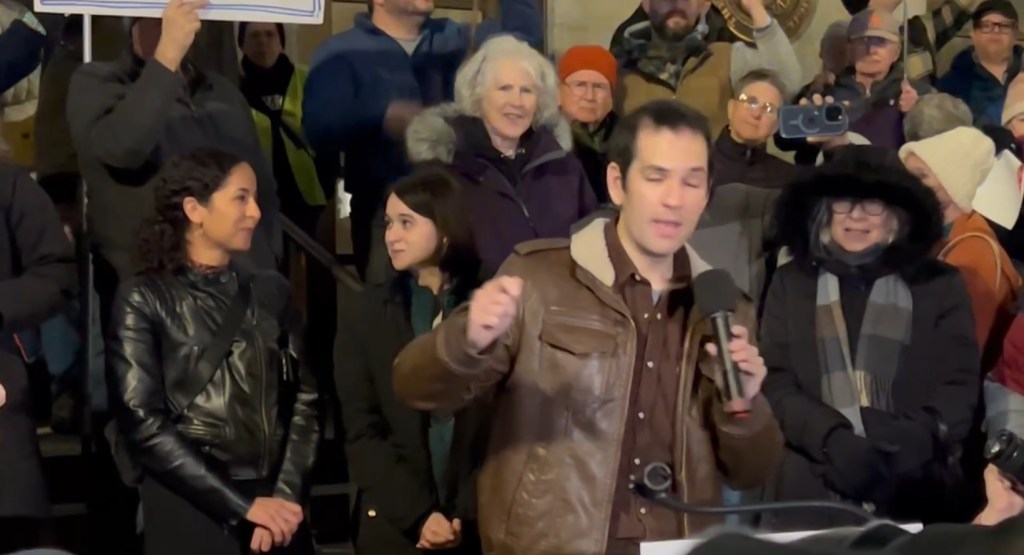
Ezra Levin of Indivisible gave a rousing speech, forcefully calling on the Senators to shut the Senate down in protest of the outright coup at the Treasury. Rahna Epting, the Executive Director of MoveOn, deftly facilitated the event after giving her own stirring call to action.
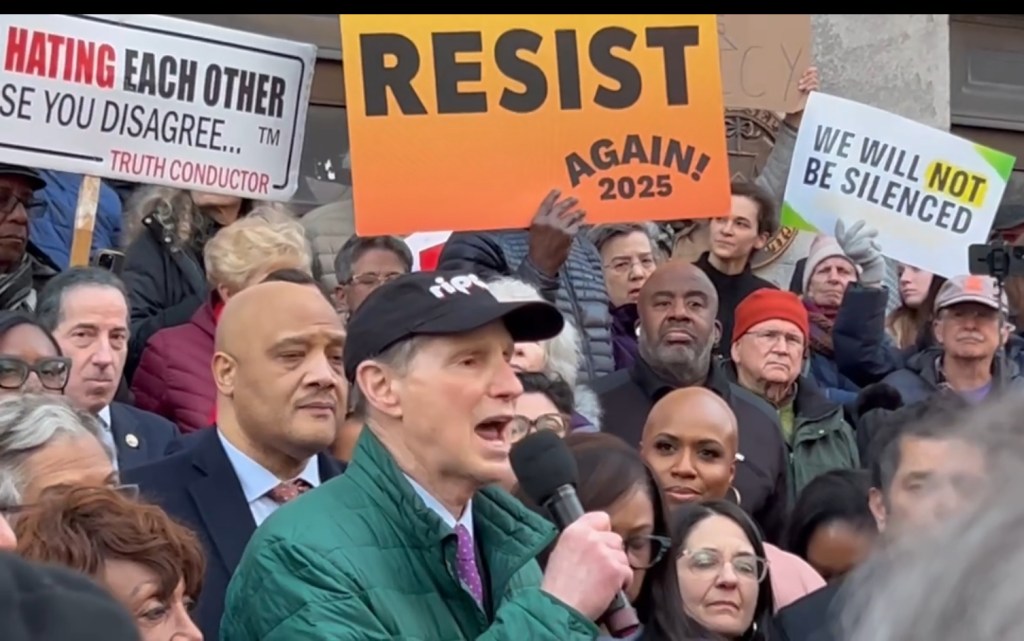
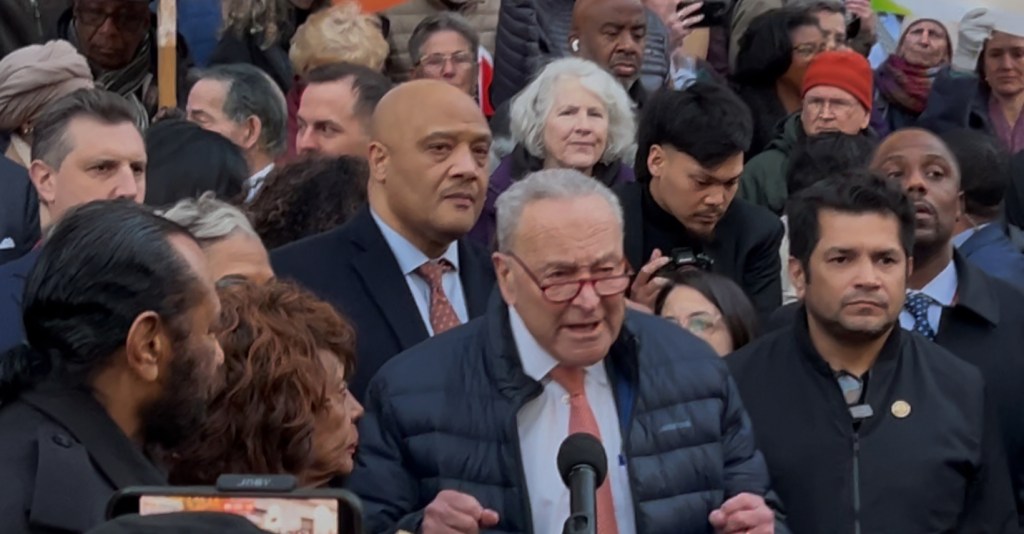
I took some photos and have posted a few of them below.
John Bayerl, 2/4/2025
Sen. Elizabeth Warren address the crowd, with Rep, Jaime Raskin smiling his approvalRep. Maxine Waters (D-CA) offers a vehement attack on the lawlessness of Elon MuskSen Ron Wyden (D-OR)Senate Minority Leader Chuck Shumer (D-NY)Sen. Chris Van Hollen (D-MD) flanked by Sen. Richard Blumenthal (D-CN)Ezra Levin of Indivisible calls for the Senate to shut down. On his far left is Rahna Epting, Exec. Dir. of MoveOn, with Leah Greenberg, Exec. Dir. of Indivisible
I read of an intriguing idea recently: that a list of the books we read is a kind of autobiography reflecting our deepest interests. For what it’s worth, I decided to compile my list from last year and post it here. I was surprised to find that I had equal numbers of fiction and non-fiction. The seven titles with a preceding asterisk are ones I read as part of a Bayerl Family book group that is entering its ninth year.
I’ve already posted blog reviews of three of last year’s books, as follows:
“Killers of the Flower Moon” as Book and Film, book written by David Gann, film directed by Martin Scorsese, 1/22/2024
“Anything Is Possible” by Elizabeth Strout, 5/27/2024
What’s My Excuse?, a review of Viktor Frankl’s “Yes to Life in Spite of Everything”, 6/24/2024
NON-FICTION
1 *Killers of the Flower Moon, David Gann
2. The Gospel According to James Baldwin, Greg Garrett
3. Uncle Tom’s Journey from Maryland to Canada – The Life of Josiah Henson, Edna M. Troiano
4. Yes to Life, (translation of Viktor Frankl’s essays called “In Spite of Everything”). Daniel Coleman (ed,)
5. Proof of Heaven, Eben Alexander
6. *Democracy Awakening, Heather Cox Richardson
7. A Year to Live, Stephen Levine
8. * Beautiful Country, Quian Julie Wang
9. A Passionate Mind in Relentless Pursuit – the Vision of Mary McLeod Bethune, Noline Rooks
10. In Search of Stones,M. Scott Peck
11. The Road He Travelled – The Revealing Biography of M. Scott Peck, Arthur Jones
FICTION
1. *American Savior, Roland Merullo
2. *The River We Remember, William Kent Krueger
3. Anything Is Possible, Elizabeth Strout
4. *Goodnight, Irene, Luis Alberto Urea
5. Olive Kitteridge, Elizabeth Strout
6. The Little Liar, Mitch Albom
7. The Next Person You Meet in Heaven, Mitch Albom
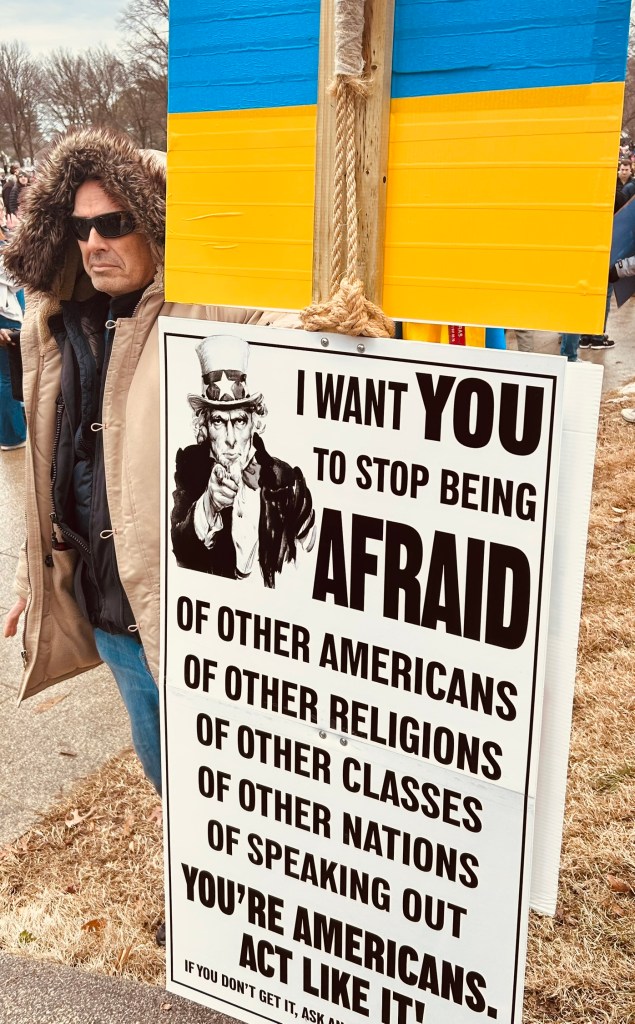
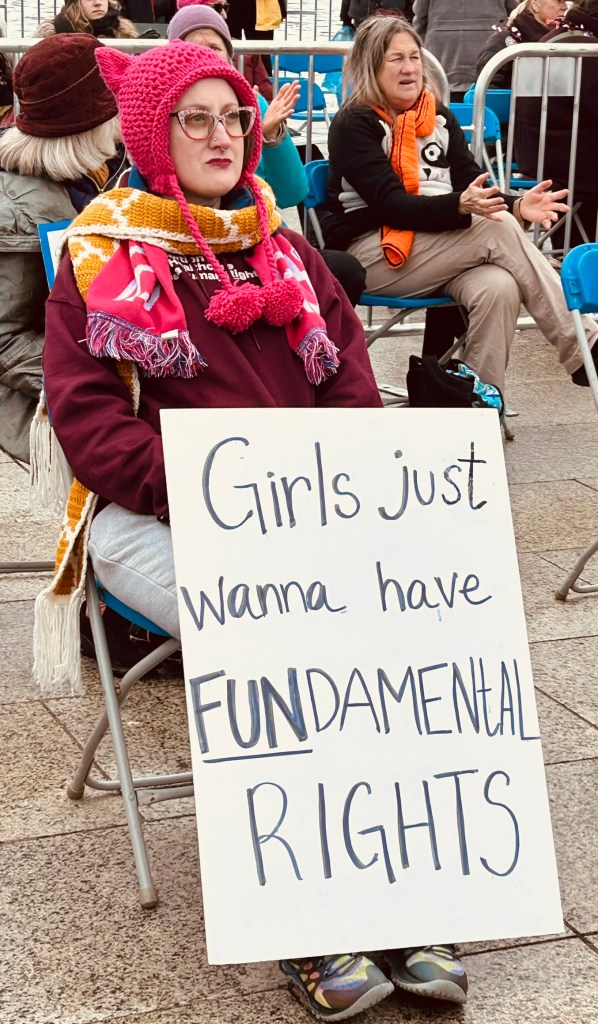
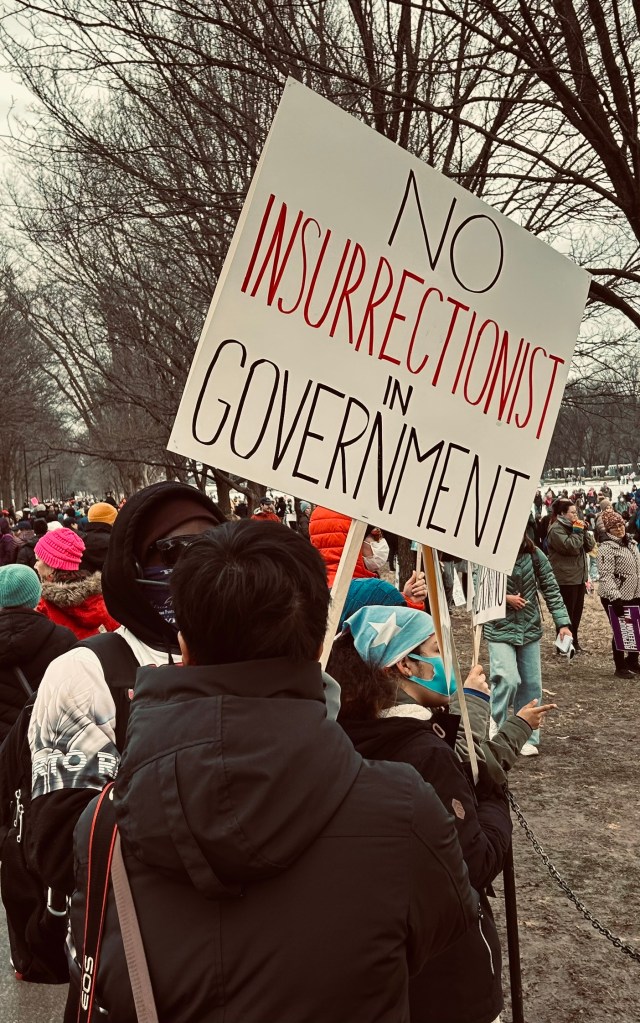
I just returned from the People’s March on Washington, an energetic affair of some tens of thousands who marched from three different sites in downtown DC to the grounds of the Lincoln Memorial for a lively rally.
Andrea and I had attended the memorable Woman’s March of January, 2017, which was a different order of magnitude, with many hundreds pf thousands showing up in DC to protest Trump’s first inauguration.
The Trump 2.0 protest was every bit as creative, energized, and lively as 8 years ago, but at a much lower volume. I took the Metro downtown from Rockville by myself this time, Andrea being down with a bug. Instead of marching, I walked directly to the Lincoln Memorial grounds from Foggy Botton Metro station, a commute I knew well from my 15 year career at the GW Medical Center there.
Some people from the rally, laden with their political signs and creative attire, were walking back up to Foggy Bottom from the rally already. There was a festive feeling in the air. The marches had started at 10am and I was only arriving at the rally after 1pm.
Being on my own, I was free to follow my nose, allowing me to focus on taking photos with my smart phone once I arrived after about a mile walk down 23rd Street to the Washington Mall. Without the huge crowds of 2017, I was able to relax more and really take in the sights and sounds. Below are some of the photos I took.
We made our second visit to the OMMA today on a gloriously clear autumn morning. We had visited it a year ago with our friends and hosts, Joan Jacobs and Larry Drake of neighboring Portsmouth, NH. We had fond memories of its Maine seaside locale and the charming village of Ogunquit, widely recognized for its rich arts, crafts, and theater offerings. The museum is on the edge of town fronting a dramatic seascape.
Andrea and I spent much of our time in the outdoor sculpture garden that surrounds the sleek, low to the ground, building. The garden features great natural vistas, as well as a sculpture called “Luna” in the background of the next photo, and many others tastefully arranged to reflect the natural beauty of the setting.
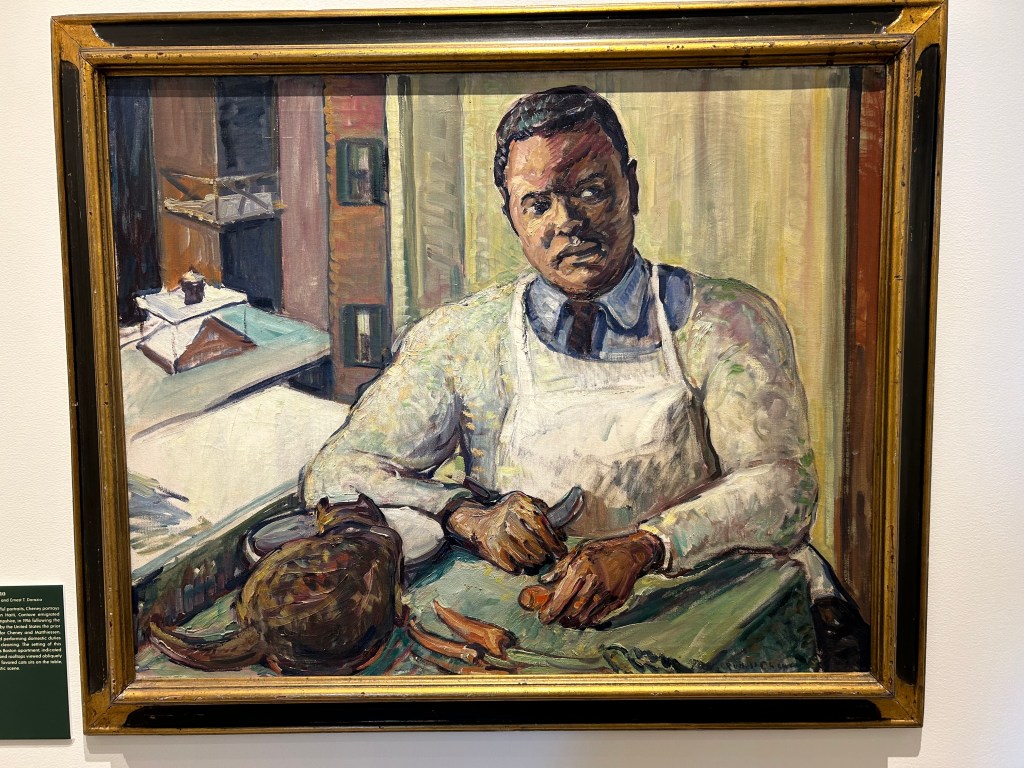
Inside the gallery, there were special showings of two mid-20th century American artists: Russell Cheney and Lee Kramer.
Cheney was a New Englander who lived and worked in Portsmouth, NH and neighboring Kittery and Ogunquit, ME. He painted in a somewhat traditional realist style with great sensitivity to the humanity of his portraits and a poetic rendering of light and space.
Cheney was a gay man who lived quietly with his life partner, the Harvard professor and author F.O. Matthiessen, for decades. He is much celebrated in Ogonquit by the large gay community there who have long lived in peace with their neighbors. The painting below is a self-portrait of Cheney (l.) and Matthiessen.
Lee Kramer is one of the important originators of an abstract movement in late 1930’s America. She was inspired by the Dutch artist Piet Mondrian’s style of precise, geometric abstractions.
Kramer was the spouse of the more celebrated artist Jackson Pollock. Personally, I much prefer her own contained, visually pleasing abstract creations to the wild expressionism of her alcoholic husband.
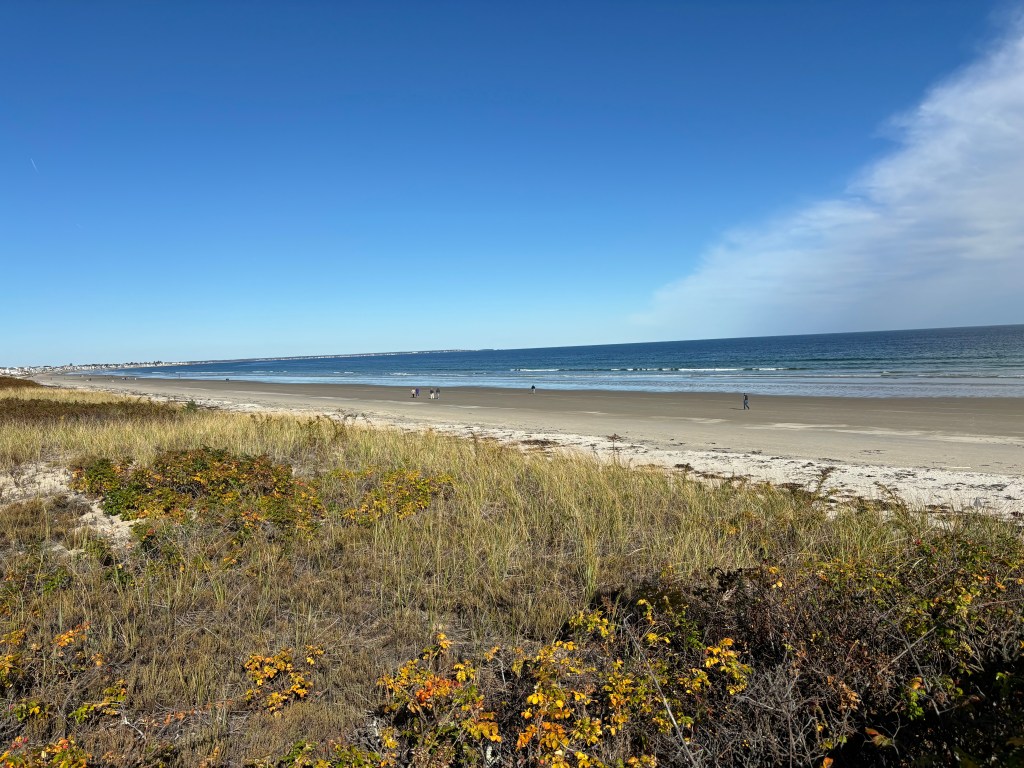
We took a second stroll into the adjoining sculpture court before driving into town for lunch and a long, energizing walk on the expansive Ogunquit Beach.
The term “sacred geometry” has become commonplace in New Age culture. According to Wikipedia, “Sacred geometry ascribes symbolic and sacred meanings to certain geometric shapes and certain geometric proportions.” It is associated with the belief in a “divine geometer/creator” from which the physical universe is unfolding in inherently coherent and orderly ways.
One form of sacred geometry that I’ve been working with for many years is the mandala. It is defined simply as a geometric configuration of symbols. Mandalas are used in many spiritual traditions as a means of focusing attention on the inherent order and beauty of the universe. They can be used as an aid to meditation and for establishing sacred space.
My own work with mandalas has primarily involved adding color to existing mandala forms as presented in adult coloring books. I’ve described this work in detail in two of my previous blog pieces:
More recently, I’ve become interested in generating my own mandala templates using simple geometry. For guidance and inspiration in this process, I’m indebted to the book Islamic Geometric Patterns by Eric Broug. More than an aesthetic study of Islamic graphic motifs evident on many mosques, shrines, and other holy places, Broug’s book is an instructional guide for constructing complex Islamic-inspired designs using simply a ruler, compass, and pencils (ordinary and colored).
First Attempt
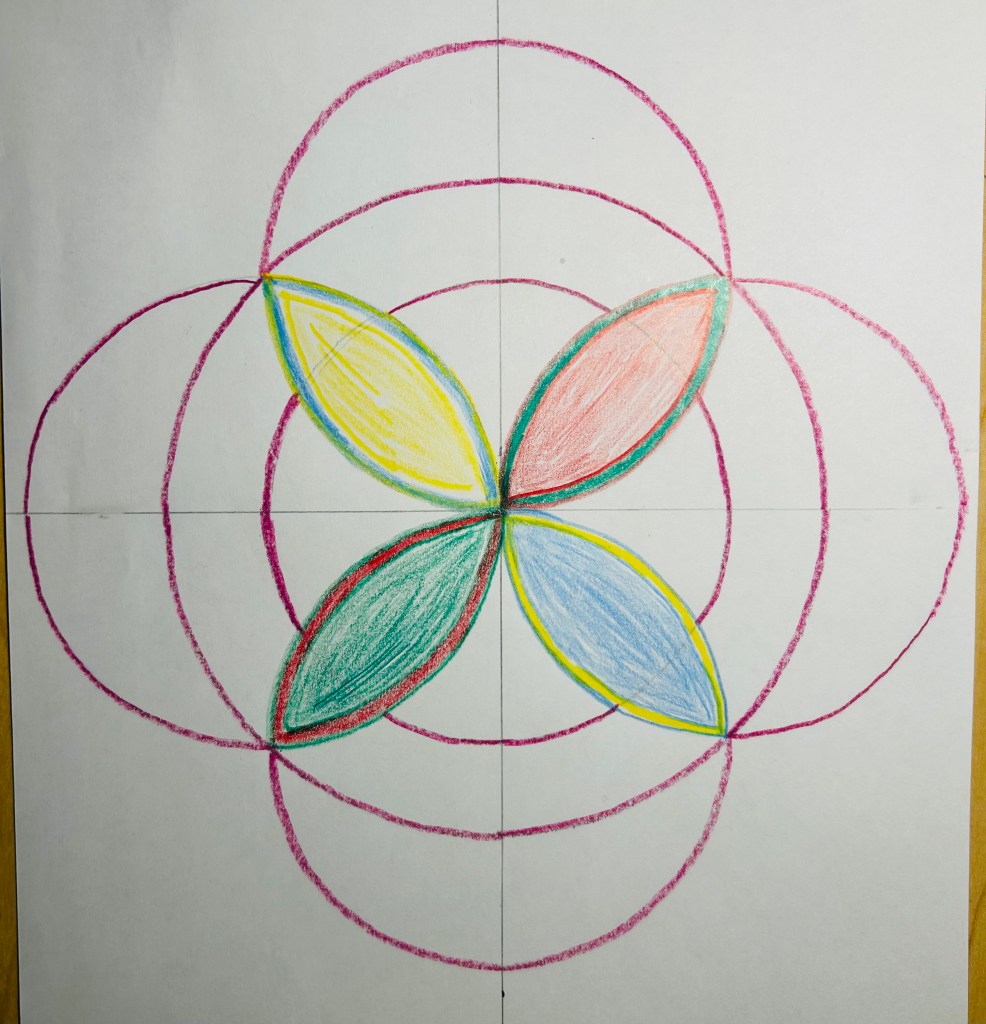
The figure below is my first attempt to create a mandala. Its geometry is relatively simple. It starts with drawing a circle with horizontal and vertical lines running through the center point. The circle intersects the vertical line above and below the center point. And the circle intersects the horizontal line to the left and right of the center point. Each of those four intersecting points then becomes the center of another circle of the same radius as the first.
A sixth circle can then be drawn using the four intersection points of the four outer circles. I used the center of the first circle and measured (with a compass) the distance to the four outer circle intersection points. This sixth circle has a larger radius than the other five circles and is concentric with the original circle.
It took me a few attempts to get a satisfying result. After meditating on it for a bit, I decided to color in a four-petal flower pattern that emerges. I also used a red pencil to highlight the circumferences of all six circles. I was pleased with this first foray into creating a mandala.
Flower of Life
My second foray was a bit more challenging. It involves 6 same-sized circles surrounding an interior circle of equal size. I’m not going to go through the geometric steps involved in creating this here. But like the first figure, it uses intersection points created by previous steps to become the center point for the next circle. All the design is done with compass and straight edge, with no linear measurement required. The finished work is shown in the figure below.
I learned later that the basic template of this figure has been used universally since the time of the ancient Egyptians (6,000BC). It is usually referred to as the “Flower of Life”. There are various interpretations of the symbol across cultures, but a common thread is that it represents “the interconnectedness of all things, the cycle of life, and universal creation”.
This symbol also provides the basis for drawing a perfect hexagon in the center of the central circle.
Concentric Hexagon Mandala
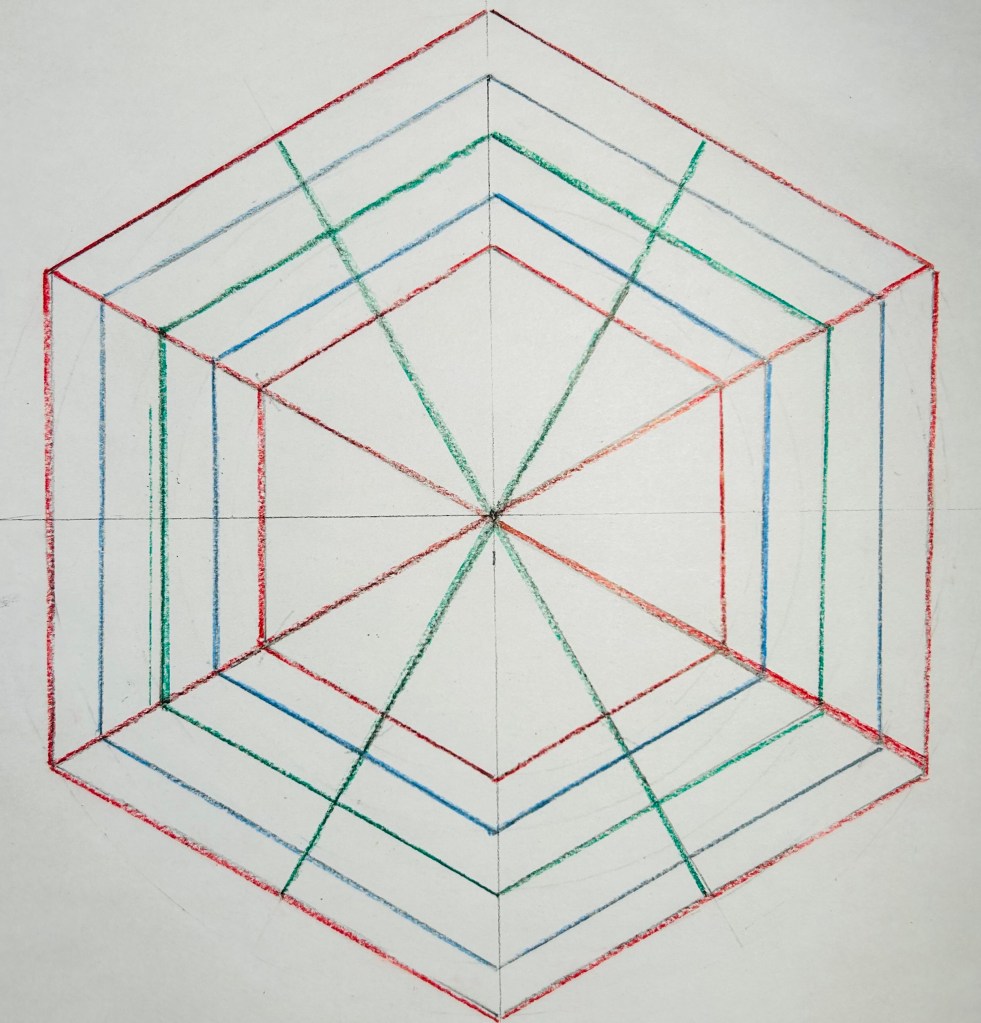
Using what I learned from creating the “Flower of Life”, I was able to easily construct a pattern of 5 concentric hexagons. It involved simply using a compass to draw four concentric circles around the central circle. Then the directional lines used to create the first internal hexagram are extended outward to intersect the concentric circles. The six intersection points on the circumference of each circle become the six points of the hexagon. I added a little color to highlight its mandala character.
The Great Mosque of Cordoba design template
The first real world example of an Islamic geometric pattern that I explored is based on the next complex figure.
The figure’s central motif is an 8-pointed star. The basis of the design is a circle within a square. Horizontal and vertical lines are drawn through the center of the circle, and then diagonal lines are drawn connecting the opposite corners of the square. The intersection points of the four lines crossing the circle become the points of connection for the rest of the pattern. Once the pattern is complete, some of the construction lines can be erased, yielding the following:
Tessellation
Eric Broug teaches that many of the ornate patterns of design used in the world-famous Great Mosque of Cordoba are simple repetitions of the figure given above. This repetitive process is called tessellation. The formal definition of the term is: “an arrangement of shapes closely fitted together, especially of polygons in a repeated pattern without gaps or overlapping.”
Per Mr. Broug’s suggestion, I made 9 photocopies of the figure above and assembled them together to witness the effect, shown below.
As you can see, the repetition of the original figure yields more interesting and complex patterns. Of course, the actual rendition of this in the Cordoba mosque is much more ornate.
I’m obviously still a novice at this, but I wanted to share my initial enthusiasm at discovering the fascinating realm of sacred geometry.
At left is our personal guide, Basil Arendse, former administrator of the museum, who now lives in our community of The Village At Rockville. At right is my spouse, Andrea DiLorenzo. This was my first visit to this fabulous institution.The Kreeger building is modeled on Middle Eastern architecture.Nighttime lighting provides dramatic relief to these Henry Moore sculptures.Moore’s famous “Three Piece Reclining Figure No. 2: Bridge Prop”, 1963“Prayer” by Constantin Antonovici, 1961
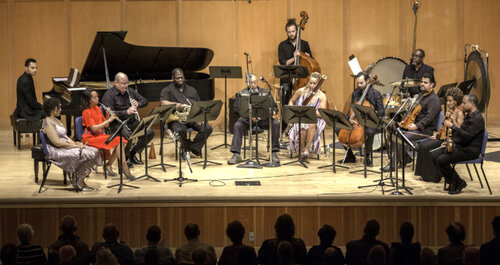
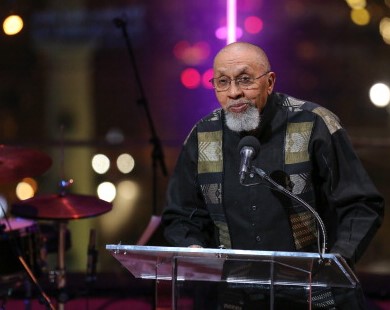
The Imani Winds and Harlem Quartet with jazz pianist Alex Brown, A. B. Spellman at the microphone, Edward Perez on bass, Neil Smith on drums
I attended a memorable concert this week in the intimate Terrace Theater of the Kennedy Center in DC. It was given by two primarily classical music chamber groups, the Imani Winds and the Harlem Quarter, joined by three talented jazz musicians and an “orator”, the well-known jazz music critic and prolific poet, A. B. Spellman.
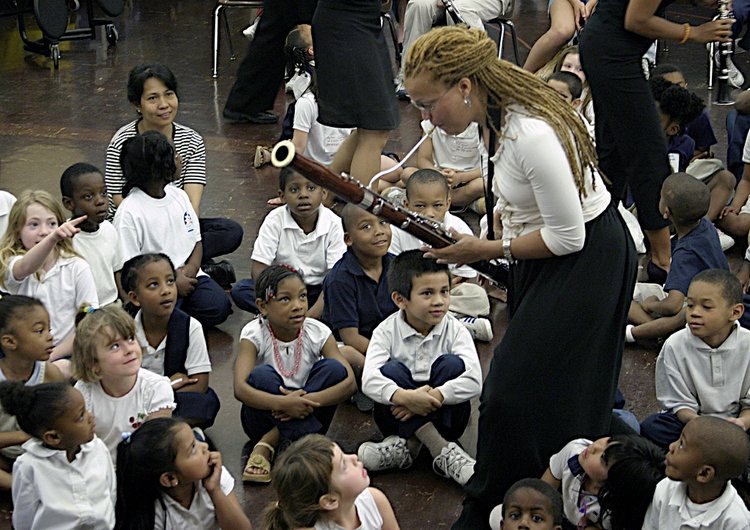
My spouse, Andrea Dilorenzo, had encountered the Imani Winds while she was working as a school therapist at a local public school many years ago. They are a classical woodwind quintet who were bringing their music to kids in disadvantaged communities in the DC area. Andrea introduced herself to the musicians back then and happily discovered that they were graduates of Oberlin College where she had graduated. When she read about their upcoming performance at the Kennedy Center, she was quick to buy us tickets.
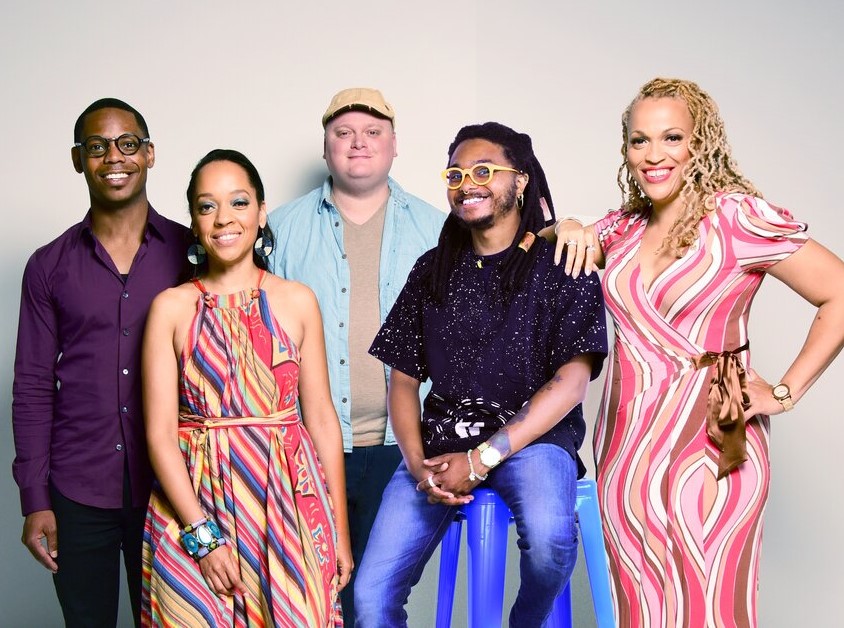
Bassoonist Monica Ellis of Imani Winds plays for kids Members of Imani Winds, left to right: Brandon Patrick George (flute), Mekhi Gladden (oboe), Mark Dover (clarinet), Kevin Newton (French horn), Monica Ellis (bassoon)
Little did we anticipate the sublime experience ahead of us.
The concert consisted of one extended musical work, “Passion for Bach and Coltrane”, by the Oberlin music professor and composer Jeff Scott. The composition was inspired by a collection of poetry, “Things I Must Have Known”, by A. B. Spellman, the father of Mekhi Gladden, who is the oboist of Imani Winds.
Scott’s work is a brilliant integration of Spellman’s spoken poetry together with classical and jazz music. Both the 5-piece Imani Winds (flute, oboe, clarinet, French horn, bassoon) and the Harlem Quartet (two violins, viola and cello) have outstanding reputations in the classical arena. They were joined by a talented jazz trio on piano, bass, and drums. A. B. Spellman himself, now 89 years old, was the “orator” for selected poems from “Things I Must Have Known”.
A. B. Spellman reciting his poetry, the glue that holds the performance together.
Another draw for us was the Harlem Quartet which we had traveled to Winchester, VA to hear in concert about 5 years ago at Shenandoah University. The lead violinist of the quarter is Ilmar Gavilan, a Cuban native who has a brother, Aldo, still living in Cuba, who is a first rate classical pianist. Andrea had seen a TV documentary about the two brothers and their cherished musical reunions both in Cuba and here. Aldo had joined the Harlem Quarter for an unforgettable performance of Schumann’s Piano Quintet at Shenandoah U.
The Harlem Quartet at the White House with Barak and Michelle Obama. Musicians from left to right: Ilmar Gavilan, Melissa White, Felix Uansky, Jaime Amado
Thursday’s concert was the second musical event that Andrea and I had attended at the Kennedy Center within the week after not having gone to one there in some years. We were pleased to be among the younger, racially mixed audience at the Terrace Theater after our usual experience of older, white audiences. We’d invited a younger friend to join us for the concert as well.
Over the years, I have written a number of concert reviews for my blog. Although I love music of all genres, I always find it challenging to attempt conveying the felt quality of a live musical experience. Part of my inspiration to write this came from the first poem recited by Spellman, “Dear John Coltrane”. In it, the poet describes a musical reverie induced by listening to diverse radio broadcasts in a hotel room late at night. Specifically, he writes of a sublime feeling while listening to the slow movement of a Bach keyboard concerto. Switching stations, he later hears a recording of the jazz legend John Coltrane playing solo saxophone on his own composition, “Slow Blues”. Again, the poet is transported to a transcendent inner state. He reflects on the commonality of feeling evoked by the two radically different musical forms used within the 17th-century baroque tradition and the free jazz form of the 1960’s. I’m including the full text of “Dear John Coltrane” as an appendix.)
The piece starts with Spellman reciting the first stanza of “Dear John Coltrane”. The musicians then come in with the melody and variations of Bach’s F minor concerto. The arrangement is such that each of the woodwind players has a chance to solo. The piano then comes in, followed by the quartet of strings. It was as interesting and beautiful arrangement and rendition of Bach’s well known melody as I’ve heard. Spellman then comes back in, reciting the second stanza of the poem, this one about listening to Coltrane’s “Slow Blues” and experiencing the same kind of fluid transcendence as he’d experienced listening to Bach. The words help to guide the audience into the ensuing musical piece in a languid way.
The next session is entitled “Psalm” and begins with Spellman reciting the poem “After Vallejo” (the Peruvian writer Cesar Vallejo is regarded as a tragic giant of 20th century poetry). It includes the poignant lines:
i’ll be writing when i go, revising anotherhopeful survey of my life. i will die of nothingthat i did but of all that i did not doi promised myself a better selfthan I could make & i will not forgive
J. S.Bach composed two large choral works about the passion and death of Jesus Christ – the Saint John Passion and the Saint Mathew Passion. Composer Jeff Scott uses the double meaning of “passion” in his “Passion for Bach and Coltrane”, referring to Bach’s works as well as to the musical passion expressed by A.B. Spellman in his poetry. Two sections of Scott’s work use Spellman’s poems “Out of Nazareth, Pt. 1” and “Out of Nazareth, Pt. 2: Manual for a Crucifixion”. In the latter one, Spellman references a Roman manual on how best to enact the gruesome torture of a crucifixion. Spellman’s portrait of Jesus is as a highly compassionate and selfless man of God. The musical sections here reflect that spiritual purity and integrity, as well as the cynical barbarity perpetrated on him by the Romans.
The entire concert was about 90 minutes long, and the last third consisted of some high powered, driving jazz. The jazz trio provided the rhythmic framework for each of the musicians on stage to showcase their extraordinary improvisational skills. I sat in utter amazement at the sophisticated jazz riffs played by each of the classically trained musicians of the Imani Winds and the Harlem Quartet.
When the musical intensity became a bit challenging for me to stay with, a slower, bluesy interval brought in a welcome lyrical calm. Spellman read from his poem “Groovin’ Low” at that point:
my swing is more mellowthese days: not the hardbop drivei used to roll but more of a coolfoxtrot. my eyes still closewhen the rhythm locks; i’ve learnedto boogie with my feet on the floori’m still movin’, still groovin’still fallin’ in love, buti bop to the bass line now.
I happen to be 75 and do most of my bopping to the base line, too. My real amazement was that Spellman, at 89, could still speak with such passion, expression and volume.
The last section of the concert, “Acknowledgment”, is an extended recapitulation of major themes from John Coltrane’s magnum opus, “A Love Supreme”. It begins will Spellman reading his inspired lines of meditation on the nature of life, death and love: that the highest purpose of living is to love and be loved. he concert ends with everyone on stage chanting the words “A Love Supreme” over and over again, tapering off to a whisper.
There was a rousing standing ovation as the concert ended, and many rounds of applause for the individual musicians and for the whole ensemble. Jeff Scott was in the audience and was invited to come on stage to partake in the well deserved acclaim for these consummate musicians.
John Bayerl,11/24/2024
APPENDIX:
Dear John Coltrane
by A. B. Spellman

dead night has me writing poetry
in another hotel room. j.s. bach
is on the radio. the keyboard concerto
in f minor: the one you also hear
on oboe or violin, the largo
second movement begins
& the book in my hand drops
the room fades
& I put my reason down
to trail the bach of endless line
along this earthless path, each note full
& bright, a brilliant footprint on the dark
through beauty, past knowledge, into
the state that shines too much
to be wisdom, is too transparent
to be art. i catch a fear of that place
where he will lower me when
this transporting melody closes
then it closes on itself & here I am
dear john, back at the beginning, better

later, different station, cold room dimming
it’s you, john, trane’s slow blues
now it’s your line that opens, & opens
& opens, & i’m flying that way again
same sky, different moon, this midnight
globe that toned those now lost blue rooms
where things like jazz float the mind
this motion the still & airless propulsion
i know as inner flight. this view
the one I cannot see with my eyes
open. i hear the beginning approach, &
i know the line i traveled was a horizon
the circle of the world, another freedom
flight to another starting place
if I believed in heaven I would ask
if you & bach ever swap infinite fours
& jam the sound that light makes
going & coming, & if you exchange maps
to those exclusive clouds you travel thru
& do you give them names?
I just returned from a magnificent performance of the Washington National Opera’s “Macbeth” at the Kennedy Center. The music reviewer for the Washington Post wrote an excellent account of the many masterful elements of the production after it opened last week:
Rather than discuss the performance itself, I’d like to share some strong feelings that arose in me while watching it.
I first encountered Shakespeare’s classic play, “The Tragedie of Macbeth”, as a sophomore at my Catholic boys’ high school in Buffalo, NY. My English teacher, Rev. Claude Bicheler, had us read much of it aloud in class, stopping frequently to explain some of the arcane Elizabethan English. Rev. Claude was an avid theatergoer and also the director and producer for all our school plays and musicals. He had a way of making the story of Macbeth come to life and encouraged us to persevere even when we were feeling lost. Like many, I was most taken with the scenes of the witches who foresaw and steered the infamous, homicidal direction of Macbeth’s thirst for power.
I had seen some stage versions of the play later in life. I appreciated the keen psychological rendering of the character Macbeth and Lady Macbeth given by Shakespeare, but never felt deeply affected by the story. It all seemed a bit melodramatic to me.
I became an opera fan during my college years (1967-1971) at Fordham University in the Bronx. A friend in my dormitory would listen to the live radio broadcasts of the Metropolitan Opera on Saturday afternoons. I overheard the music and asked him about his interest in opera. He invited me to join him the following Saturday to listen to something called “The Barber of Seville”. He had a copy of the libretto (text) of the opera, and he helped me follow along as we listened to the live singing. My friend was a native New Yorker who had been attending live opera performances at the Met and the New York City Opera for many years. His enthusiasm was contagious. And being able to closely follow the story line of the opera while listening to the Met broadcast drew me in. My friend regularly attended both of the opera theaters at Lincoln Center in midtown Manhattan and I started to accompany him. I was soon hooked.
The nineteenth century Italian Giuseppe Verdi is a giant among opera composers. Over the years, I had listened to recordings and attended performances of many of his most famous operas, including: La Traviata, Il Trovatore, Rigoletto, Aida, Don Carlo, Otello, Nabucco, La Forza del Destino, and Simon Boccanegra.
When I met and married my spouse, Andrea DiLorenzo, in the mid 1980’s, one of the strong common passions we shared was for music of all genres, but opera in particular. We’ve attended dozens of operas together over the years in venues including the Kennedy Center Opera House in DC, the Wolf Trap Summer Opera, the Met in New York, the Pittsburgh Opera, the Charlottesville Opera, Covent Garden in London, and the Mexico City Opera. It became a tradition for us to get opera tickets for Andrea’s birthday every year, and it just so happened that “Macbeth” was being performed in November, her birthday month. We got the tickets some months ago and were eagerly anticipating the performance, which we’d be attending with another couple.
Neither of us had ever encountered Verdi’s “Macbeth”, which is an earlier work of the composer and not often performed. I had learned from my Fordham dorm-mate the importance of becoming familiar with an opera before attending. So a few weeks ago, I began listening to a recording of the opera via a streaming service, following along with a libretto that I easily downloaded.
The story of “Macbeth” is dark and menacing. It’s about a Scottish warrior and his wife, Lady Macbeth, who become addicted to political power by any means necessary. The witches provide a dark supernatural element, a kind of black magic, which convinces Macbeth that he can rise to kingship by killing off the king himself and all potential rivals. He does so in a cold, calculated way and soon gets the coveted kingship. Lady Macbeth eggs him on, scorning her husband at any sign of hesitation. Eventually, their heinous crimes, which include the murder of innocent women and children of their rivals, begin to take a toll on their psychological wellbeing. They both start drifting into a guilt-ridden madness. Lady Macbeth commits suicide, and Lord Macbeth throws himself into one final battle against the king of England’s army and is fully vanquished by Macduff, a former aide whose entire family was murdered by Macbeth’s minions. Macbeth’s last aria laments that he is utterly alone in death, unloved, even hated by his people.
The part of the opera that most moved me this afternoon was a choral piece about the suffering and oppression suffered by the Scottish people during Macbeth’s short, bloody reign. It is called “Patria Oppressa” (Oppressed Homeland) and laments the dire suffering of so many victims of Macbeth’s onslaughts. A translation is as follows:
Oppressed homeland of ours!
You can no longer have the sweet name of Mother
Now that you’ve become a tomb for our sons and daughters.
From the orphans, from those who mourn for husbands and children
A cry of outrage goes up to heaven at each new dawn.
To that cry heaven replies, moved by pity for the oppressed land,
And proclaims our grief forever.
The bell tolls constantly for death,
But no one is so bold to even shed a vain tear
For the suffering and the dying.
The “Patria Oppressa” chorus affected me so deeply because I was still feeling traumatized in the aftermath of the American presidential election last week. I was anticipating a great deal of chaos and suffering that this chorus gave voice to.
Throughout the unrelenting treachery and deceit of the Macbeth story as sung so masterfully by the outstanding singers, I’d been feeling queasy inside, as if the opera was depicting a kind of political dystopia that I feared our country had already entered. The chorus also evoked in me an identification with the peoples around the world suffering under the weight of violent oppression in the Ukraine, Palestine, Lebanon and elsewhere.
In the case of the American election, I realize that the oppression I was anticipating was brought about by the American electorate. In some ways, that realization made the situation even more painful.
When Verdi revised “Macbeth” for a new production in Paris in 1867, he added a number of important elements that remain in the version that has been used since then. In Shakespeare’s tragedy, the play ends with Macbeth’s last words after having been mortally slain: “I sink – my soul is lost forever.” But in 1867, Verdi added a final chorus that followed the death scene. It is the rousing “Inno da Victoria” (Hymn of Victory) which celebrates the death of a tyrant and gives glory to the liberators:
Victory! Victory! Where is Macbeth? Where is the usurper? The God of Victory has struck him down with a breath. He (Macduff) is a valiant hero who killed the traitor. He has saved our homeland and our king. Honor and glory to him! Our gratitude rises to the great God of vindication! Let us sing hymns of glory! The new dawn will bring us peace and glory!”
I was relieved to vicariously experience the victory so triumphantly celebrated as the opera ends. Verdi himself was emphatically committed to the cause of Italian independence during his lifetime. Many of his other operas have hidden allusions to that quest as well. When Italy finally did achieve independence, Verdi was elected and served for four years in the first Italian legislative body.
Andrea and I have been active politically since the 2016 presidential election. We have formed two political groups since then, both of them meeting monthly, both committed to sustaining a strong democracy. We were heartbroken that Kamala Harris failed to convince enough voters to elect her, despite a high energy campaign, and her winning persona.
Many of us are justifiably wary of the kinds of oppression that the current president-elect is capable of. Watching the masterful production of Macbeth yesterday elicited some of my darkest fears of what’s in store for our country over the next four years. But Verdi’s triumphant closing statement, a Hymn to Victory, served to buttress an underlying belief that all is not lost, and that the forces of Good will ultimately prevail. As the story of Macbeth shows, the forces of evil often sow the seeds for their own ultimate destruction.
My younger brother Tom died two weeks ago at his home outside of Buffalo in Elma, NY. Tom had been seriously ill with Lewy Body Dementia (LBD) and had been in home hospice care for almost a year. His wife Karen was a devoted and loving caregiver for Tom since the onset of his symptoms over five years ago. Their three adult children, Michael, Greg, and Kristen lived close enough to help out, but the brunt of Tom’s 24-7 care rested on Karen and his devoted healthcare aides.
Origins
Tom was the 6th of 10 children born to our parents, Irene and Joseph Bayerl, both lifelong residents of Buffalo, NY. There were 5 girls and 5 boys in our Baby Boomer brood, whose birth-years extend from 1947 to 1964.
I was the second oldest (born 1949) and remember some of the circumstances of Tom’s birth. Our family of five kids had moved into our own house the year before after spending the preceding years in a small flat above our mother’s parents’ home just two blocks away. I was almost 7 years old when Mom was pregnant with Tom, and I well remember Mom being rushed to the hospital to have her appendix removed while she was well into that pregnancy. I remember whispered fears from the adults that our mother might lose the baby. But mother and child survived, and Tom proved to be a healthy, happy baby. Children weren’t allowed to visit in hospitals back then, but I recall our Dad packing us all into the family car one evening and parking outside our Mom’s hospital room so she could come to the window and wave to us with little Tom in her arms.
Tom followed the same initial educational track as his older sibs: a year of kindergarten at nearby P.S. 43 followed by eight years at Visitation Parochial school, just two blocks from home. We were taught by an order of nuns called “The Little Servant Sisters of the Immaculate Conception.” The nuns brooked little tolerance for misbehavior, and most of us recall at least one episode of being slapped on open palms by a ruler-wielding nun. Like the rest of us, Tom was a smart, mostly well-behaved student, graduating from “Vis” in 1969 and then attending two different boys’ Catholic high schools.
Tom is on far right, with our sister Marian in middle, me on left
High School Basketball Star
I had left home in 1967 to attend Fordham University, a Jesuit run institution in the Bronx. But I kept up on Tom’s, and his next older brother Larry’s, high school athletic prowess during those years. Tom became a star basketball player on a championship team at St. Francis High School while Larry starred in football at Bishop Ryan High. My older brother Martie had gotten the ball rolling in the athletic direction by starring in football at Bishop Turner High School, where we had both attended. I liked to play sports too, but my own athletic abilities were limited, and I ultimately chose to focus on academics. I was always proud of my brothers’ athletic accomplishments.
I can’t say that I had much influence on Tom as he came into his own as a student-athlete in his high school years. I do remember, however, some pretty competitive games of one-on-one basketball we used to play in our backyard during my summers home from college. By his early teens, I could clearly see that Tom was going places with his smooth, artful basketball shooting and his aggressive defense.
Entering Adulthood
After graduating from Fordham in 1971, my own early adult life had some significant challenges of my own making. I floundered in my work life as well as my attempted relationships. Tom meanwhile was doing well at Buffalo State University, graduating in1976 and going on to marry his high school sweetheart, Karen Hojnacki, two years later. Tom and Karen were eminently compatible. They even shared the same birthday. They soon bought a house and started a family while I was still driving cab and taking sporadic graduate classes in American Studies at SUNY Buffalo.
I had little contact with Tom or the rest of my family for about a decade while I attempted to find a meaningful direction for myself in Savannah, Atlanta, and then Washington DC. The next real connection I remember occurred in 1986 when Tom and Karen hosted a big, outdoor 40th anniversary party for our parents in Buffalo. I had just gotten divorced and was ready to make a fresh start with my family of origin. I still remember Tom’s generous, playful spirit at that party, setting up horseshoes and other games for the kids, and interacting seamlessly with everyone. I truly admired Tom’s many virtues as a family man and realized I had things to learn from him.
My next significant connections with Tom occurred almost twenty years later. During that time, I had married my current spouse, Andrea DiLorenzo, and had entered into a period of personal and professional fulfillment. Andrea and I adopted two children in 1998, and I finally had the opportunity to become the kind of “family man” I admired in Tom.
Tom and I had always enjoyed an easy back and forth at the occasional family affairs I was able to attend back in Buffalo. When my sister Kathy lost her 19-year-old son Byron to muscular dystrophy in 2007, both Tom and I felt distraught and were able to share our grief together. That led to a regular phone relationship with Tom in which we were both able to share some of the challenges we were facing in our lives. I had studied to become a counselor and had learned how to listen attentively and compassionately, without judgment, and without the need to give direct advice. During those years of phone conversations, we were both able to open up about our ongoing struggles with depression.
The Bayerl Brothers at a wedding in 2016: from left in order by age — Martie, me, Larry, Tom, Bob
Illness and Decline
Tom started manifesting disturbing physical and mental symptoms around the time of his retirement over five years ago. A lifelong athlete and still avid golfer, he was then finding himself regularly fatigued, debilitated, and mentally foggy. Karen quickly picked up on this and helped Tom on a long medical search for what was wrong. Clearly, this was beyond the garden-variety depression that we had both experienced. Tom began experiencing acute anxiety on a regular basis.
Tom and Karen had been loving, hands-on grandparents but his inability to sustain his energy and motivation now made this difficult. I remember a family vacation to Rocky Mountain National Park in 2019 in which Tom was not able to keep up. I remember his confessing to me how bad he felt about this, and about his guilt for occasional angry outbursts towards family members. Finally, some in-depth neurological testing came up with the Lewy Body Dementia diagnosis.
Very little was known about LBD until the suicide death of the actor Robin Williams in 2014 at age 63. Williams had been diagnosed with Parkinsons Disease (PD), but his wife Susan Schneider knew that the PD diagnosis didn’t explain the aberrant mental and emotional disturbances she was noticing. None of his doctors or therapists seemed to know exactly what the problem was. The diagnosis only came from an autopsy which revealed Lewy bodies infiltrating Williams’ entire brain stem. Lewy bodies are abnormal clumps of protein that gather in brain cells, and which are now thought to be responsible for 10-15% of dementia cases.
Ms. Schneider pursued the reason for her husband’s suicide partly because she wanted to protect him from the innuendos about Williams’ past drug addiction. Her persistent efforts to find out about LBD led to the creation of the 2018 HBO documentary film about Williams’ death called “Come Inside My Mind”. By telling the story of Robin Williams’ illness in detail, Schneider succeeded in creating a film that is now being recommended to all the families of patients suffering from LBD.
Last Years
I began making trips home to Buffalo to visit Tom shortly after the LBD diagnosis was given, and after watching the film “Come Inside My Mind”. The first of these visits was in March 2023 when Tom was still able to sit down to a marvelous breakfast Karen had prepared for a tableful of visiting family members. At that time Tom still had moments of clarity and recognition. But most of the time he was just staring out into space, his body semi-paralyzed. I visited again that December to find Tom spending the greater part of each day either in bed or laying back in a recliner. Karen had requested hospice care to help her to attend to Tom’s many physical needs. On that visit, I remember a few moments of eye contact with Tom and a feint smile.
In June of this year, Andrea and I drove to Buffalo to spend a day with Tom and Karen. Karen was firm in her wanting to keep Tom at home, even though she was getting worn down by the 24-7 nature of Tom’s required care. We were mightily impressed with the care and commitment being provided by Karen and also by two aides who Karen had employed to help her: Linda came in each morning to bathe and feed Tom, and Jim every morning and evening to get Tom in and out of bed. In addition, hospice was providing a weekly nursing visit and regular visits by a healthcare aide and a massage therapist. Karen was also very grateful for the significant assistance she was getting from all three of her adult children: Michael, Greg and Kristen.
Tom died peacefully in his sleep on September 25 after having stopped eating and drinking twelve days earlier.
Andrea and I have just returned from the funeral in Elma. There was a very beautiful Funeral Mass at their neighborhood Catholic Church followed by a brunch at a local restaurant. There was also a wake the night before, providing great opportunities to connect with family and friends and share stories about Tom’s life. The highlight was Tom and Karen’s eldest son, Michael, a public high school teacher, delivering a heartfelt eulogy for his father at the Funeral Mass. In it, Mike praised his Dad’s big heartedness, which manifested most strongly in his lifelong enthusiasm for sports and his love in sharing that enthusiasm with his wife, kids, grandkids and everyone else who knew him. It was the same quality I had admired in Tom at that anniversary party he and Karen had hosted for our parents so many years ago.