Fire in the Belly: On Being a Man — Reflections on Sam Keen, 1931-2025

My spouse, Andrea DiLorenzo, showed me a Washington Post obituary of the author Sam Keen while we were on a plane to Alabama last week.

https://wapo.st/4lKlCyC

I read it with great interest, and returned to it on the way home yesterday, inspired to write out my thoughts and feelings.

I had read Keen’s book on masculinity when it came out in 1991. I was 42 years old, recently married for a second time, and was very involved in a burgeoning men’s movement in the Washington, DC area. Keen spoke to issues much on my mind, specifically how to live a life with creative and empowered integrity while married to a staunch feminist, and espousing feminist ideology myself.

Keen’s main theme was the necessity for all of us to find our true passion for life, our “fire in the belly”. As a would-be liberated man, this meant finding a way to manifest my creative passion in ways that served my God-given soul as well as the soulmates in my family and community.

Joseph Campbell was another inspiration to me during that time. His encouragement to “follow your bliss” helped to steer me back to my deeper soul issues after spending a decade focused on developing a career in IT.


Keen had been a respected academic, like Campbell.  He pursued advanced degrees in religious studies and theology and was a university professor before having a mid-life transformation while visiting San Francisco in the late 1960’s. The counter-culture was in full bloom and Campbell wanted to find his own place within it. He did so by devoting himself to writing about the practical application of spiritual experience and insight to his own life and those of his contemporaries.

The venerated TV interviewer, Bill Moyers, interviewed Keen after Fire in the Belly had found its audience in the early 1990’s.  I remember that Andrea and I watched that interview with great interest, and shared appreciation.

The following is my own remembrance of Keen’s teaching from Fire in the Belly and from the Moyers’ interview:

“This is about writing your own story, what is most important about your journey. It’s recognizing and letting go of cultural archetypes about masculinity. It’s consciously becoming your own person, so that your daily life reflects what is most important to you. Your life becomes your personal mystical journey.

“You wake up each day with “fire in your belly” because you know what you are seeking and you have a fresh, new day to seek it, and to find it.

“Whatever the ‘content’ of your daily life, whatever your genuine responsibilities are, each day can be an intuitive, creative adventure, in which you can learn by going where you have to go next.”


Sam Keen brought a “keen” spiritual perspective to the topic of masculinity. He knew that a growing man had to continually call upon his deeper, intuitive awareness to meet the demands and the creative possibilities of daily life. He cannot shirk his healthy warrior priority to remain vigilant to the difficult challenges of a meaningful life.

M. Scott Peck had an important message to those of us in the 1980’s who “followed our bliss” at the cost of not attending to the real social and financial demands involved in becoming a mature, grounded, generative adult. “Life is difficult” was his mantra, and it was a truth I really needed to internalize in the middle of my adulthood.

From 1988 well into the new millennium, I actively participated in the “mythopoetic men’s movement” as led by the poet Robert Bly, archetypal psychologist and storyteller Michael Meade, and the English Professor Robert Moore. These three paragons of creative expression structured their teachings about masculinity by articulating four essential male archetypes: King, Warrior, Magician, Lover.

Their “mythopoetic men’s movement” was ridiculed by some critics as a quaint distraction. But to most of us who were involved in it, it was a source of inspiration and of deeper connection with ourselves and other men. It came at a time when my father had been diagnosed with a fatal oral cancer, and it helped me to forgive the past and fully reconcile with him before he died.

The four male archetypes provided a foundational template for me. I learned that a mature man will be able to incarnate and balance all four archetypes during his lifetime. But this work requires ongoing awareness of our deepest needs and desires, balanced by the needs and desires of our family and our community. Transcendence of the individual ego is essential to this process.

I learned that a man of courage and awareness regularly chooses the path of greatest growth opportunity, even when that path initially appears beyond his own personal powers. Surrendering to a higher purpose and a higher Being allows a person to accept his own limitations, even while not being defined by them. Trusting in a Higher Power also provides the inner support and reassurance needed when doubts and fears inevitably arise.

These are guiding truths that I learned from Sam Keen and other kindred spirits of his generation who saw that younger men needed foundational support, guidance and encouragement.

I still participate in a monthly men’s group and continue to be fed and nurtured by the wisdom, creativity, and camaraderie of other men, young and old. At 75 years of age, I find myself the oldest member of our group, and try to hold the place of a supportive and encouraging Elder similar to what I received from soulful, creative teachers like Sam Keen.


John Bayerl
Palm Sunday, 4/12/2025
My Introduction to Sacred Geometry

The term “sacred geometry” has become commonplace in New Age culture. According to Wikipedia, “Sacred geometry ascribes symbolic and sacred meanings to certain geometric shapes and certain geometric proportions.” It is associated with the belief in a “divine geometer/creator” from which the physical universe is unfolding in inherently coherent and orderly ways.

One form of sacred geometry that I’ve been working with for many years is the mandala. It is defined simply as a geometric configuration of symbols. Mandalas are used in many spiritual traditions as a means of focusing attention on the inherent order and beauty of the universe. They can be used as an aid to meditation and for establishing sacred space.

My own work with mandalas has primarily involved adding color to existing mandala forms as presented in adult coloring books. I’ve described this work in detail in two of my previous blog pieces:

Finding Relaxation and Focus in Coloring Mandalas | John’s Blog

More Mandalas | John’s Blog

More recently, I’ve become interested in generating my own mandala templates using simple geometry. For guidance and inspiration in this process, I’m indebted to the book Islamic Geometric Patterns by Eric Broug. More than an aesthetic study of Islamic graphic motifs evident on many mosques, shrines, and other holy places, Broug’s book is an instructional guide for constructing complex Islamic-inspired designs using simply a ruler, compass, and pencils (ordinary and colored).

First Attempt

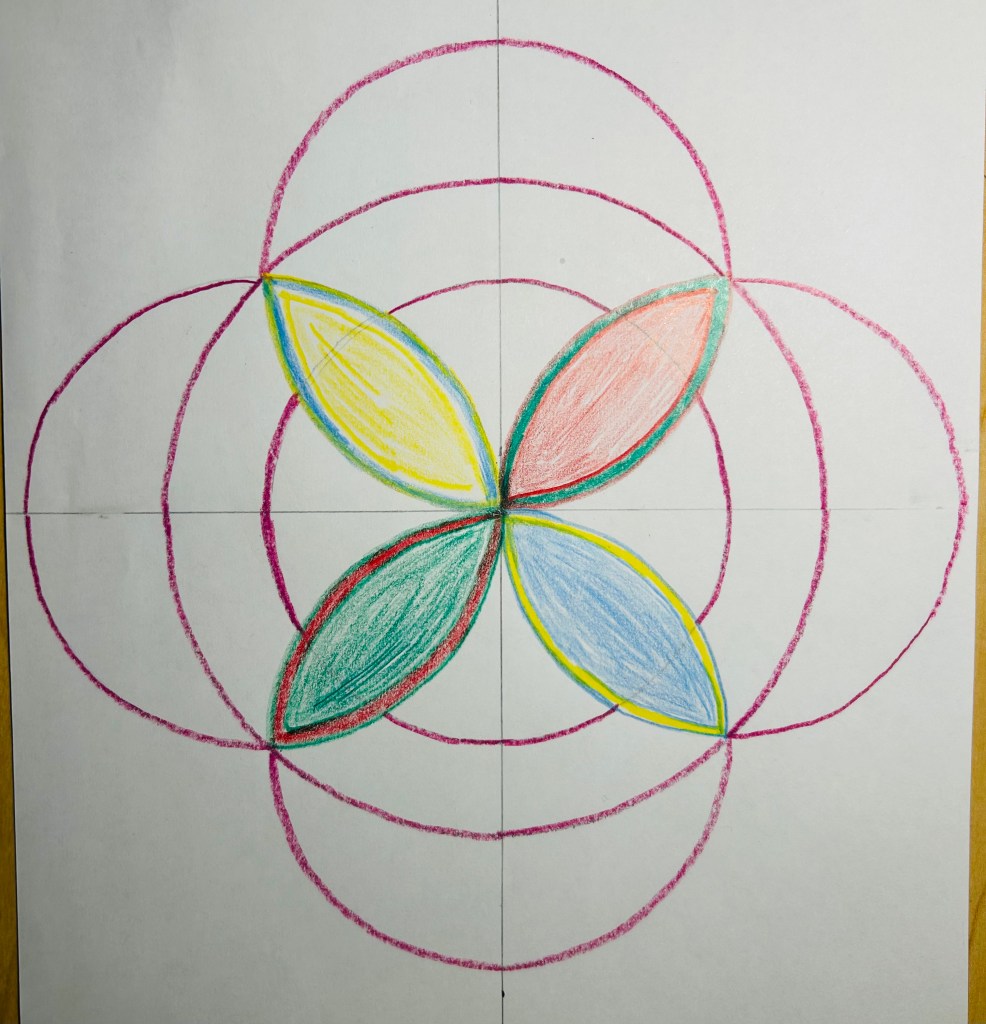
The figure below is my first attempt to create a mandala. Its geometry is relatively simple. It starts with drawing a circle with horizontal and vertical lines running through the center point. The circle intersects the vertical line above and below the center point. And the circle intersects the horizontal line to the left and right of the center point. Each of those four intersecting points then becomes the center of another circle of the same radius as the first.

A sixth circle can then be drawn using the four intersection points of the four outer circles. I used the center of the first circle and measured (with a compass) the distance to the four outer circle intersection points. This sixth circle has a larger radius than the other five circles and is concentric with the original circle.

It took me a few attempts to get a satisfying result. After meditating on it for a bit, I decided to color in a four-petal flower pattern that emerges. I also used a red pencil to highlight the circumferences of all six circles. I was pleased with this first foray into creating a mandala.

Flower of Life

My second foray was a bit more challenging. It involves 6 same-sized circles surrounding an interior circle of equal size. I’m not going to go through the geometric steps involved in creating this here. But like the first figure, it uses intersection points created by previous steps to become the center point for the next circle. All the design is done with compass and straight edge, with no linear measurement required. The finished work is shown in the figure below.

I learned later that the basic template of this figure has been used universally since the time of the ancient Egyptians (6,000BC). It is usually referred to as the “Flower of Life”. There are various interpretations of the symbol across cultures, but a common thread is that it represents “the interconnectedness of all things, the cycle of life, and universal creation”.

This symbol also provides the basis for drawing a perfect hexagon in the center of the central circle.

Concentric Hexagon Mandala

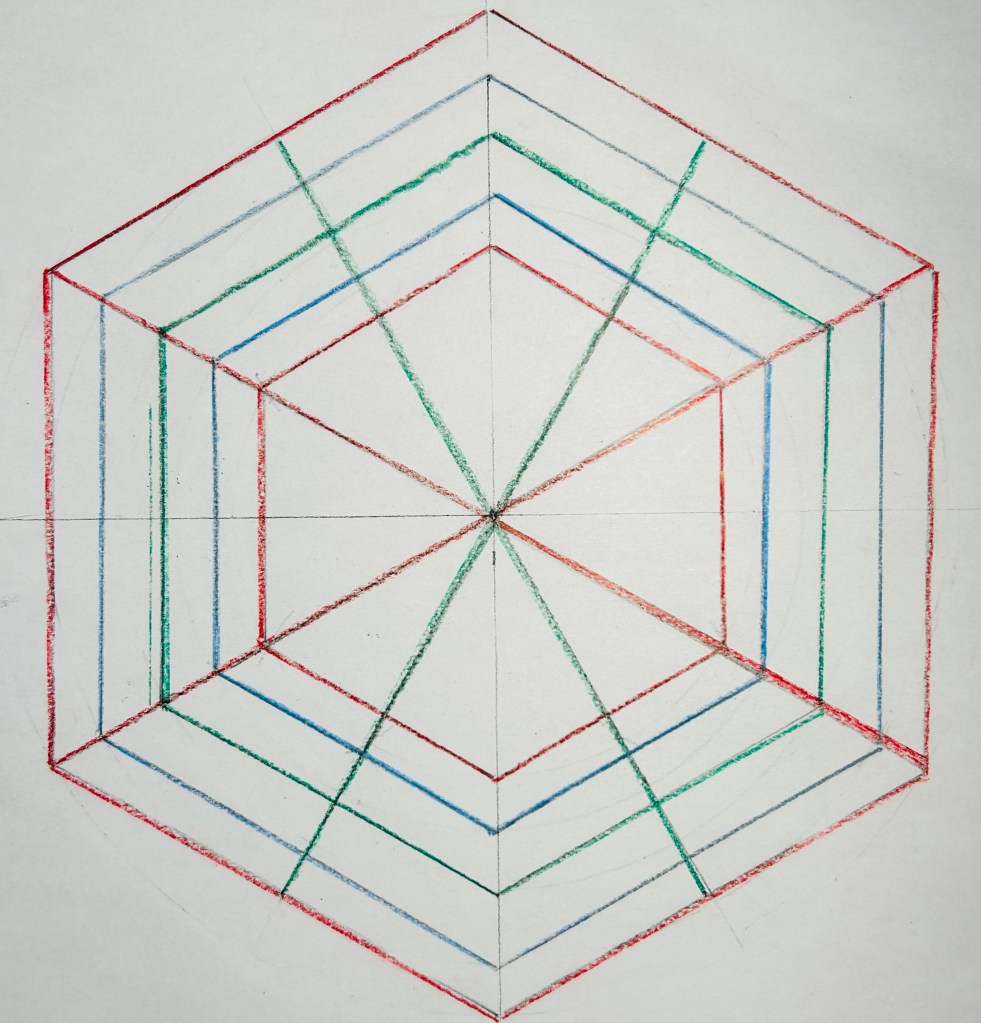
Using what I learned from creating the “Flower of Life”, I was able to easily construct a pattern of 5 concentric hexagons. It involved simply using a compass to draw four concentric circles around the central circle. Then the directional lines used to create the first internal hexagram are extended outward to intersect the concentric circles. The six intersection points on the circumference of each circle become the six points of the hexagon. I added a little color to highlight its mandala character.

The Great Mosque of Cordoba design template

The first real world example of an Islamic geometric pattern that I explored is based on the next complex figure.

The figure’s central motif is an 8-pointed star. The basis of the design is a circle within a square. Horizontal and vertical lines are drawn through the center of the circle, and then diagonal lines are drawn connecting the opposite corners of the square. The intersection points of the four lines crossing the circle become the points of connection for the rest of the pattern. Once the pattern is complete, some of the construction lines can be erased, yielding the following:

Tessellation

Eric Broug teaches that many of the ornate patterns of design used in the world-famous Great Mosque of Cordoba are simple repetitions of the figure given above. This repetitive process is called tessellation. The formal definition of the term is: “an arrangement of shapes closely fitted together, especially of polygons in a repeated pattern without gaps or overlapping.”

Per Mr. Broug’s suggestion, I made 9 photocopies of the figure above and assembled them together to witness the effect, shown below.

As you can see, the repetition of the original figure yields more interesting and complex patterns. Of course, the actual rendition of this in the Cordoba mosque is much more ornate.

I’m obviously still a novice at this, but I wanted to share my initial enthusiasm at discovering the fascinating realm of sacred geometry.

To be continued…

John Bayerl, 1/1/2025