
Introduction
My friend Kerry Reynolds gave a memorable public presentation a few weeks ago. It was about his family history, extending back to the 1700’s when his paternal relatives owned a farm on what would later become the Antietam Battlefield. That personal connection had led Kerry to a deep dive into all aspects of that seminal battle of the American Civil War. I approached Kerry after his talk and he invited me on a day trip to visit Antietam together.
It was a brisk but mostly sunny fall day as Kerry drove us out around mid-morning from Rockville, MD, not far from Washington, DC. He had given me some reading material about Antietam which I had avidly poured over prior to our trip. Included in the material was Kerry’s own written summary of the battle’s highlights. I was not as much of a Civil War buff as Kerry, but I fondly recalled my in depth exploration of the Gettysburg battlefield when I was a 12-year-old, and more recent forays to the nearby Monocacy battlefield.
We had good conversational back and forth throughout most of the day, in the car, at lunch, and touring the battlefield. The focus of our conversation was mostly Civil War history, especially the events leading up to the Battle of Antietam on September 17, 1862. On that long day of bloody battle, Confederate General Robert E. Lee’s first incursion into Maryland was repulsed, allowing President Lincoln to issue the Emancipation Proclamation five days later. Most historians regard it as the turning point in the war.
The reading material Kerry had provided gave me a foundation for beginning to understand the battle of Antietam. It included his own written account that highlighted what happened around his family’s ancestral farm on that fateful day. I had known the basic contours of the story pf Antietam, but not the background nor many of the details. I have made liberal use of Kerry’s own written account in crafting this essay.
In short, by the summer of 1862, the Confederate forces had dominated the fighting on most fronts. They had just won a significant victory at the second battle of Bull Run, leaving the Union’s Army of the Potomac in shambles. Lee decided to take advantage of the situation and set out on a campaign to cross the Potomac into northern Maryland and march east to capture the Pennsylvania state capital at Harrisburg. He believed that this would lead the North to sue for peace, leaving the Confederacy intact.
Pre-Battlefield Stops in Urbana, Frederick and South Mountain
Our first brief stop was in Urbana, about 10 miles south of Frederick, where confederate cavalry general Jeb Stuart had arranged a dance for his men with some local ladies, a few days before the big battle. The old building where the dance was held is still standing.
We proceeded driving north on Rt. 355 to Frederick. As we were passing the Monocacy battlefield, we exchanged our knowledge of that smaller battle in 1864, when Union General Lew Wallace delayed the Confederate forces long enough to prevent them from a successful attack on Washington.
Driving through the city of Frederick on 355 was an eye opener for me. It felt like I was taking in the older, historic parts of the downtown area for the first time. Kerry described how Lee’s army had ensconced there for a few days before Lee decided to send half his army on a dangerous mission up the Potomac to seize the Union’s armory at Harper’s Ferry. His army was much in need of guns, cannons, and ammunition, and scouts reported that the arsenal was under-defended. The mission was dangerous in that Lee’s remaining troops would be vastly outnumbered if the Union Army were to arrive sooner than expected. And arrive they did.
Lee sent a contingent of his army to hold off the Union advance at nearby South Mountain while he led the bulk of his remaining soldiers northwest towards Hagerstown, finally digging in near the small town of Sharpsburg on Antietam Creek. McClellan’s advancing Union Army got wind of Lee’s dire vulnerability and with excessive caution, proceeded towards Sharpsburg.
We drove northwest on RT. 40 from Frederick, the “National Highway”, heading towards Boonesboro and Sharpsburg, following the route of the two armies. We passed through Middletown and other small towns along the way. Just before reaching Boonesboro, we passed South Mountain and the memorial markers for the substantial battle there that preceded the full battle at Antietam a few days later.
Approaching Antietam
We drove through the relatively prosperous town of Boonesboro, reflecting on how the town was enjoying a boost from local author Nora Robert’s’ bookstore and business promotions. As we approached Antietam, we stopped for lunch at the Red Bird restaurant in the little village of Keedysville. Kerry valued its down-home character and generous servings of traditional lunch fare. It was also a good place for him to begin filling me in on more specifics of the National Battlefied Park we were about to explore.
Afterwards, we drove through Sharpsburg, a bigger town that had served as Lee’s headquarters for much of the Battle of Antietam. (Some Southerners still refer to it as the “Battle of Sharpsburg.”) With the horrendous casualties of the day’s fighting, the people of the town were left with much of the labor of burying the dead and helping to transport the wounded. A staggering 23,000 humans of both sides were killed, wounded and missing on September 17, 1862, more than four times the U.S. casualties of D-Day.

Touring the Battlefield by Car and on Foot
We first drove to the park’s Visitor Center, only to find it closed owing to the prolonged shutdown of the federal government. Kerry kidded me by saying that he would have to stand in for the highly knowledgeable Park Rangers who usually gave lively, detailed descriptions of the highlights of the battle. In fact, Kerry’s understanding of the battle’s logistics was as comprehensive and detailed as I was able to take in.
Kerry explained that the day’s fighting consisted of three distinct Union advances, two in the morning and one in the afternoon. The original plan was for all three to occur simultaneously. Part of Lee’s army was still “en route” from Harper’s Ferry and wouldn’t arrive til late in the afternoon. So the Union army had more available soldiers by far.
We then visited the sites of all three phases of the battle by car and by foot.
Phase I of the Battle — Slaughter in the Cornfield
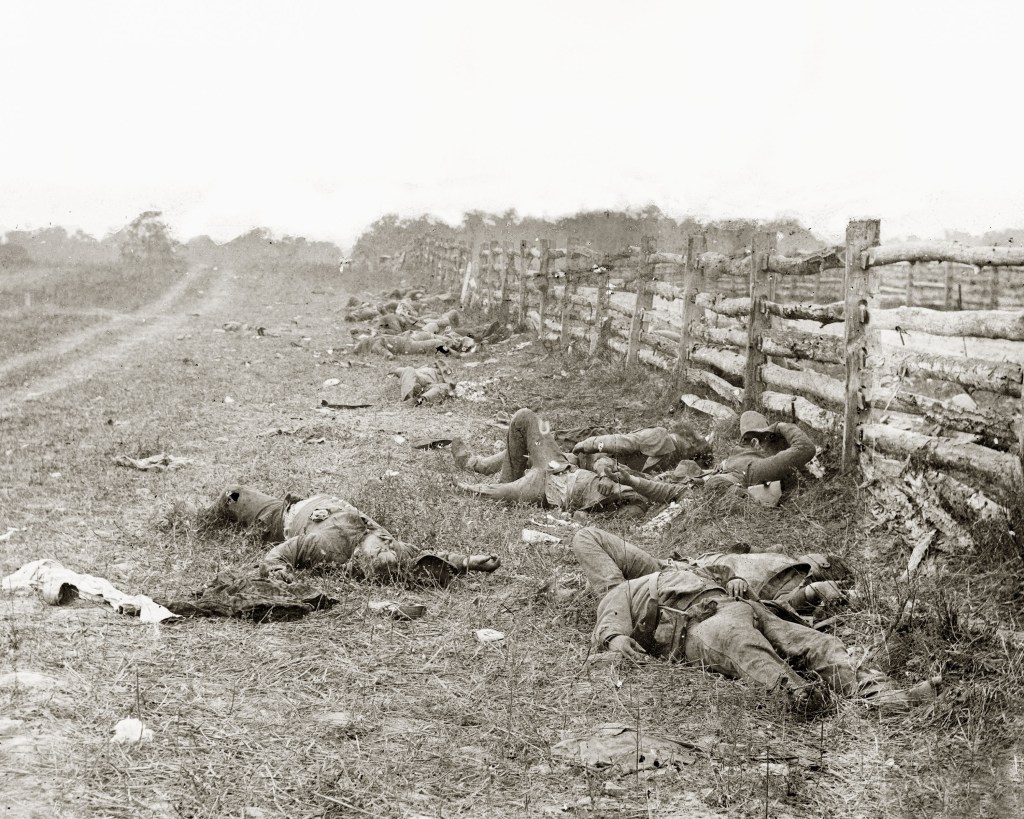
The Union assault began around 6am when Union General Joseph Hooker’s First Corps mounted a powerful assault on Lee’s left flank, led by Stonewall Jackson. The attack took place across a 24-acre cornfield with stalks 6 to 8 feet tall and corn almost ready for harvest. The intense artillery, rifle fire, and hand-to-hand combat in the cornfield was made confusing by the height of the corn stalks and the obtruding sight lines. Command and control of the troops was exceedingly difficult.
Union soldiers eventually emerged from the fighting in the cornfield but were then beaten back by Confederate rifle fire. With no cover available, they retreated back through the corpse laden cornfield. Both sides took heavy casualties, with the Union losing about a third of its attacking soldiers in about 30 minutes of intense fighting.
The Confederates then counter-attacked toward the cornfield but were met by devastating Union artillery fire. They were able to drive remaining Union soldiers from the cornfield but soon found themselves under intense fire on the other side. They retreated south to safety but not before suffering a 60% casualty rate.
We walked the area around the original Cornfield battle site and observed the still standing corn stalks in the fields all around us.
Phase II — the Sunken Road (AKA “Bloody Lane”)
The next phase of battle followed almost immediately, around mid-morning. Union General Sedwick’s division surged from the East Woods and slammed into Jackson’s troops still ensconced in the West Woods. Sedgwick had marched into an ambush, and his attack was quickly repulsed at the cost of 2200 casualties.
Union General French’s division was supposed to link up with Sedgwick, but reached the field a half hour late and attacked the Confederate center instead. French’s forces
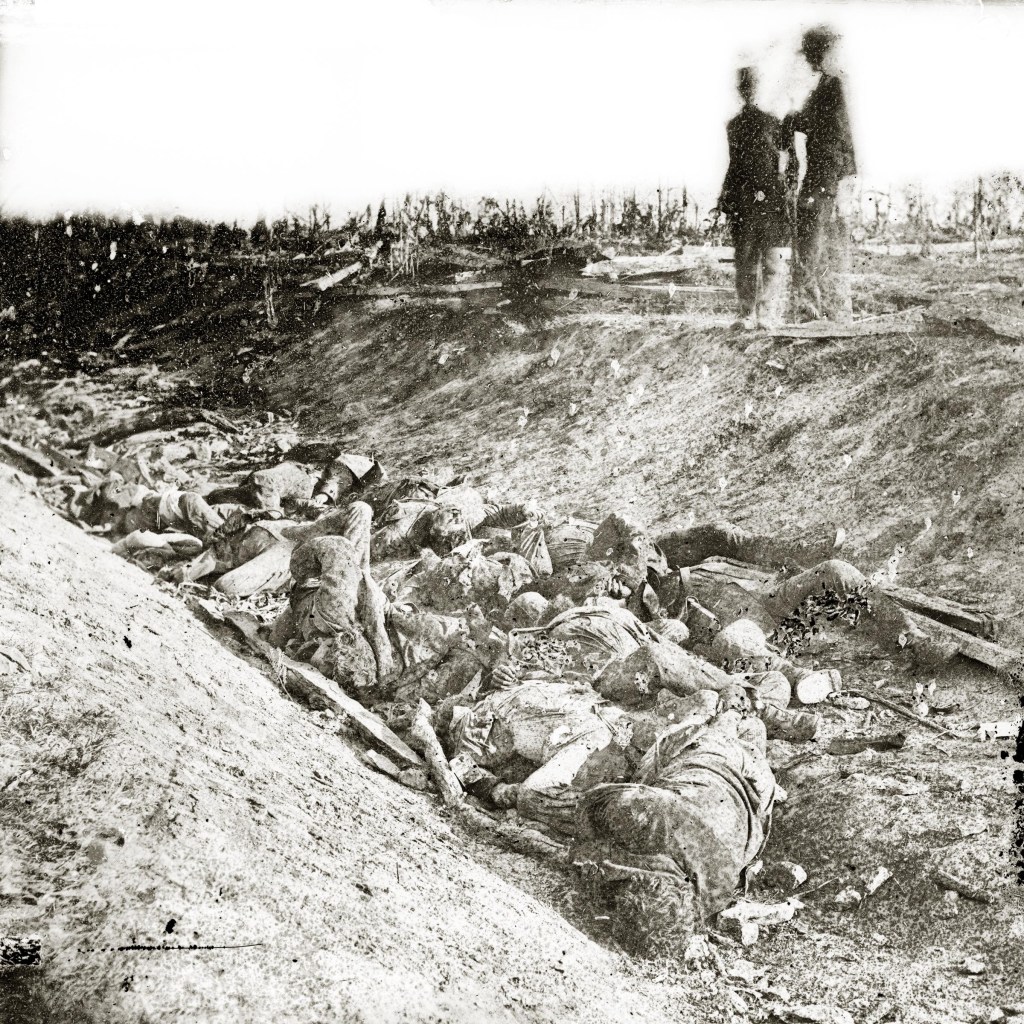
pushed the Confederates past the Roulette farm, climbed a small knoll and then began moving down towards what’s known as the “Sunken Road”. They didn’t get far as Confederate General Longstreet’s forces were dug into the trench of the road and had excellent firing positions. They commenced a withering barrage of rifle fire that purportedly brought down the Blues “like grain falls before a reaper”.
Kerry led us on a walk along the Sunken Road, pointing out how the Confederates used it as a protective trench to fire upon the Union soldiers attacking from the sloping land above it.
After about an hour of unrelieved gunfire from both sides, Union General Richardson’s division arrived and attempted another frontal assault on the Sunken Road, suffering over 60% casualties. One combatant later described the fighting as “one continual thunder that cannot compare to any sound I ever heard”.
Finally, Union General Caldwell’s forces arrived at a spot on the Confederates right flank from which they could pour down fire along the length of the Sunken Road, quickly turning it into a bloodbath of Grey soldiers.
The fighting around the Sunken Road had carried on for about three hours and left a total of over 5,500 casualties. The road soon became forever known as “Bloody Lane”.
Phase III — Burnside’s Much Delayed Advance
The remainder of September 17 contained equal measures of heroism and ineptitude.
Around 1pm, Union forces stormed through the Lane, and the remnants of the Rebel center fell back half a mile. Confederate Gen. Longstreet’s artillery commander famously said, “the end of the Confederacy was in sight”. He knew that a full scale Union attack at that moment would have swept the field.
But the Union army’s lead general, McClellan, feared phantom Rebel reserves and said “It would not be prudent to make the attack.”
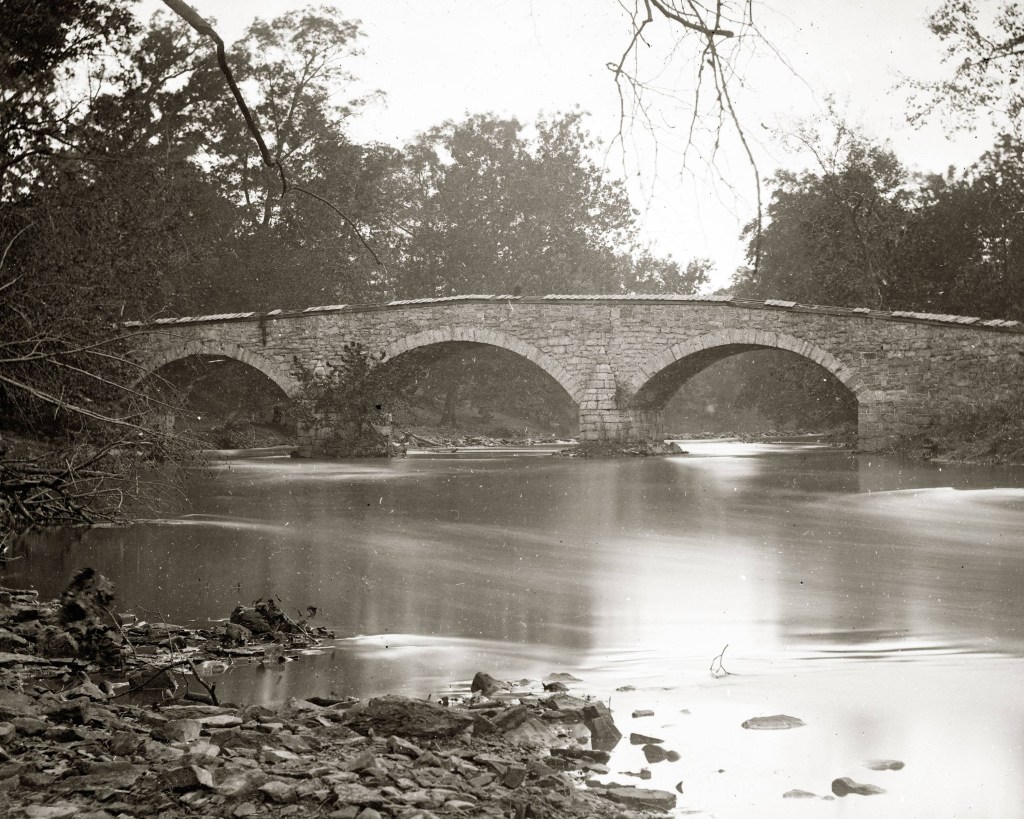
Meanwhile, on the Union left, Gen. Burnside and his IX Corps waited hours for authority to attack. Lee used the time wisely, shifting forces to shore up his weakened positions elsewhere on the battlefield, so there were only 4,000 Confederates remaining when Burnside finally sent 13,000 Yankees to cross Antietam Creek and attack. But Burnside proceeded cautiously and directed his troops to cross the bridge over the shallow creek rather than attempt to ford it on foot. A band of Georgia marksmen focused their rifle fire on the bridge, delaying Burnside’s troops from crossing for over two hours. It was 3pm before Burnside’s troops finally reached the fields south of Sharpsburg.
With Lee’s forces about to crumble from Burnside’s anticipated attack, a large contingent of Confederate forces arrived back from Harper’s Ferry in the nick of time. Once again, fresh Union forces could have ended the conflict, but that was not to be. Burnside’s forces withdrew as dusk descended. It shouldn’t have been the case, but the battle of Antietam was over.
Gen. McClellan could well have attacked Lee’s forces the next morning, or challenged Lee’s retreat back across the Potomac, but his inherent hesitancy meant another lost opportunity for an all-out Union victory.
The Roulette Farm

A major part of Kerry’s fascination with Antietam was the fact that his Reynolds ancestors had owned a farm in the late 1700s that would be right on the battlefield. By 1862 the farm was owned by the Roulette family. The original farmhouse, barn, spring house, and surrounding property are now all owned by the National Parks Service.
We walked around the property and Kerry pointed out its various features. He was concerned that the spring through the spring house appeared to be dried up from the late summer drought.
We proceeded to walk towards the nearby site of the Cornfield battle, as well as the Sunken Road (“Bloody Lane”). Kerry had served in the U.S. Army and showed how the trench of a road provided great cover for the Confederates to fire on attacking Union infantry, before it became a mass gravesite for them after relentless Union artillery fire.
Driving Home
Before driving home we stopped just outside of Sharpsburg to visit the stone bridge over Antietam Creek where Gen. Burnside’s soldiers were delayed in crossing for two hours by Confederate snipers. The narrow creek was low from the recent drought, but we also noticed how steep the banks were. Perhaps Burnside’s reluctance to have his men ford the creek on foot had some merit after all.
My experience of Antietam stayed with me in the ensuing days. I took some time to read a number of chapters in the book Kerry had lent me, “A Day in September – The Battle of Antietam and the World It Left Behind” by Stephen Budiansky. It consists of nine chapters, each detailing the pre and post-battle lives of well known individuals who lived through it, including Robert E. Lee, George McLellan, later Supreme Court Chief Justice Oliver Wendell Homes, Jr., the war photographer Alexander Gardner, the founder of the American Red Cross, Clara Barton, and our great President Abraham Lincoln.
Writing this essay has galvanized me towards a deeper understanding and appreciation of the significance of Antietam for our country as a whole, and for individuals like Kerry whose ancestors inspired him to study their history. The experience has also fortified my long held belief that armed conflict, involving impersonal slaughter of fellow human beings, should be the absolute last resort for trying to resolve chronic political and economic differences.
John Bayerl, 10/30/2025


 John's Blog