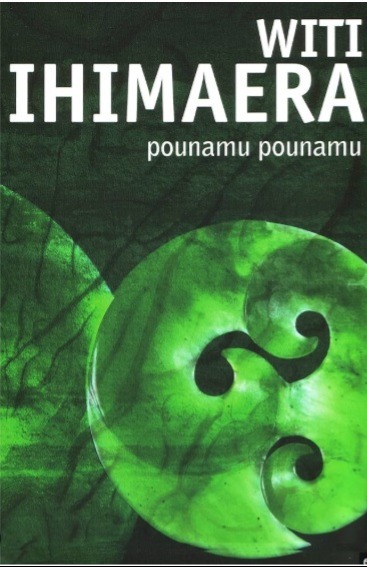
My wife Andrea and I just returned from a marvelous, month-long trip to New Zealand. We were generously hosted there by Andrea’s longtime (and my new) friends, Emily and Paul Morrow, who took us to many of their favorite places. Early on, I borrowed from Paul a book of short stories by the renowned Maori author, Witi Ihimaera. The book is titled “Pounamu Pounamu” and it served as my introduction to the rich culture of the first peoples of “Aotearoa” (the officially recognized alternate name for NZ). In order to better remember these marvelous little gems, I wrote out some summaries. I’m sharing four of those summaries here.
“A Game of Cards”
A Māori college student returns home by train. His father greets him with the news that his beloved “Nani” is very ill. Throughout his boyhood, he and Nani Miro had been very close. It was she who had encouraged him to further his education.
Nani was a leader in the community. She had accumulated shares in tribal land and was considered rich. But she was also very generous with her money and her willingness to care for her many relatives in need. Nani lived next to her tribe’s meeting house and was the keeper of many of her people’s traditional treasures of jade, feathers, and various team athletic trophies.
Nani Miro had a passion for playing card games with other women in the community. She played any and all card games and her skill was legendary. Her principal opponent was Mrs Heta, described as “her best friend and worst enemy”. In the heat of their card rivalry, they often accused one another of cheating.
The student visits his Nani and their emotional bond is easily renewed, despite Nani’s complaint that he visits so seldomly. Nani has just checked out of hospital against her doctor’s advice. That night, she takes a turn for the worse and her closest family members are called to come to her. The student is forlorn at the sight of his Nani’s enfeebled appearance.
All her many relatives and friends have gathered to be with her as she makes her passage. Included in this retinue is Mrs. Heta. Nani regains consciousness and tells Mrs. Heta that she wants to play poker. Miraculously, Nani sits up in bed and pulls out a deck, eager to outplay her nemesis-friend one last time. The two play fiercely, accusing each other of cheating, raising their voices and trading harsh barbs. But then, Nani starts laughing hysterically and promptly dies. Mrs. Heta gently embraces her closest friend and fiercest opponent.
At the elaborate “tangi” (funeral rites) that followed, Mrs. Heta plays solitaire on Nani’s casket. Mrs. Heta dies shortly thereafter and is buried next to Nani so that the two can continue their lifelong card rivalry.
“Beginning of the Tournament”
This story begins like the first with our out-of-town Māori college student, “Tama”, receiving a phone call from his Dad urging him to come home for Easter and help him out with their town’s annual field-hockey tournament. The tournament had been started many years ago by Nani Miro as an annual reunion for dispersed townspeople as well as neighboring tribes. Dad had inherited Nani’s administrative role and needed help.
Tama is reluctant to go but senses the urgency in his Dad’s request and finally agrees to come. At Dad’s suggestion he even invites a pakeha (non-Maori) athlete friend, Jerry, to join him. Jerry is reluctant at first, but assents after he is lured by descriptions of Tama’s gorgeous Māori sister.
Tama and Jerry make the long drive from Wellington to Waituhi and are warmly welcomed by Tama’s Dad. The tournament begins the next day and a welcoming meal needs to be prepared for the 25 men’s and women’s teams that will be competing. In addition, the playing field needs to be marked off in white, and the teams oriented. Tama sets off to work on these tasks but Jerry keeps pestering him to meet his beautiful sister. He finally realizes he has been duped when he meets the 7-year-old sister, Meara. Jerry is very angry of course but is somewhat appeased when Tama then introduces him to an attractive young cousin.
Tama rises early the next morning to pay his respects to his recently deceased Nina Miro whose grave is in the communal cemetery nearby. Tama and Nina Miro had been very close, and seeing her grave again, he becomes strongly motivated to help his father continue a tribal tradition that she had initiated. He laughs aloud when he sees that someone has placed an Ace of Hearts card on her tombstone.
The rest of the story is lighthearted and often farcically funny. The first event is a parade around the field with everyone dressed in their team uniforms. But most of the male players don’t have uniforms! Except for Jerry that is. He sports a flashy gold jersey with matching shorts and wins first prize, although some of the Māori men joke about dirtying the pakeha up a a little.
The women are much better organized, and dressed. They play field hockey with great abandon, bending the rules radically as they go. Jerry makes a new lady friend by offering her the use of his stick and she happily accepts it. It soon becomes clear that winning is a minor element of the games. Everyone is mostly out for the fun of it. At the end of the day, souvenir trophies are given to everyone, and there’s great fun at the traditional feast that marks the end of the tournament.
Tama’s Dad approaches him at the end of the day, tired but happy. “Well, son, we’ve made it through to another year.”
“I thought of my Nani Miro and how she had begun the tournament as a way of keeping up our tribal links, one village with the others. You know: the family that plays together stays together. And what’s going to happen when it’s Dad’s turn to go and the sky falls down?”
“Fire on Greenstone”
This story is about young “Tama’s” relationship with his grandfather, Nani Tama, after his wife, Nani Miro, had died. Much of the story centers on the old homestead where Nani Tama continues to live. It is next to the tribal “meeting house”, and itself contains many of the tribe’s artifacts and memorabilia.
Nani Tama spends much of his time on his front porch, remembering his rich life, and often drinking beer with visiting neighbors. He would also make a daily walk up the hill to his wife’s grave site and spend time communing with her.
Young Tama visits Nani on one of his infrequent visits from his college life in Wellington. They sit on the verandah, drink beer and reminisce. Nani Tama says:
“Your Nani was a great lady. All her life she kept Waituhi together. All her life she protected the land we live on and fought to get back the land that was taken away. Who will carry on the work now that she is gone?”
Nani Tama invites his grandson to join him in the sitting room inside. As young Tama walks through the house, he is flooded with memories of the many childhood hours he spent here, curiously exploring the Māori artifacts and mementos. He realizes that his grandparents’ homestead is the embodiment of their “whanau” — the extended family and friends of their local Māori community.
The sitting room was where Nani Miro conducted her weekly card clubs. The room also contained an old but still functional piano that young Tama had learned to play. He sits down at the piano and plays an old, melancholic Māori song that deeply affects his grandfather.
Just then some old friends of Nani Tama arrived outside and he leaves to join them on the verandah. Young Tama is left alone to take in the rich family history in the various artifacts displayed in the sitting room. He had spent many hours here as a child, curiously exploring the sacred objects, photos, and sports trophies.
Both of his grandparents had been athletic stars and their trophies, and those of other family members, are in full display. He sees an old photo of his grandmother smiling fully. He takes it in and smiles back at her. Then he comes upon a large ledger with handwritten names inscribed. The ledger is a written record of his family’s “whakapapa” — their genealogy going back many generations. The last entry is for his deceased grandmother.
Young Tama’s grandfather returns inside the house to invite his grandson for a meal. But young Tama has to get back to college and politely demurs. Nani Tama then drops to a more serious demeanor as he motions to a small carved box on a nearby table.
“You remember this?” he asks.
Young Tama nods yes and opens the box. It contains a “pounamu” — a sacred green jadestone. He had seen it as a boy and asked his grandmother if he could have it. She had brushed him off, saying he wasn’t ready.
As Tama describes it: “It was a big piece of greenstone, not the valuable dark green kind, but a smoky green like an opal. I used to like to hold it to the sun and look into it and feel the soft luminous glow flooding around me. And I used to whisper to myself, ‘Pounamu…pounamu…pounamu” and almost hear the emerald water rushing over the clay from where the greenstone had come.”
Nani Tama witnesses his grandson’s attachment to the “Pounamu” and remembers his wife’s instruction to give it to their grandson when he was ready. Nani Tama places the greenstone in his grandson’s hand and says:
“Are you ready, Tama? When you are, come home and, this time stay.”
Some months later, young Tama receives a late-night phone call from his father saying that the old homestead had burned to the ground. Nani Tama had survived but had gone crazy, staring incredulously at the flames and crying “Miro! Miro!”
Young Tama weeps at this news. He writes in his journal:
“That homestead was the ‘manawa’, the heart of the family, and my Nani Tama’s heart, too…
“But then I remembered the greenstone and Nani Tama’s words about carrying on Nani Miro’s work. There are some things fire can never destroy. And I saw not fingers of flame but a soft luminous glow reaching out and around me.”
“In Search of the Emerald City”
It’s moving day for 11-year-old Matiu and his family of four — with Dad, Mum and his adolescent sister Roha.
Overcoming his excitement, his first thought is to say goodbye to the family cow, Emere. It takes time to track her down in the muddy paddock and sidestep all the cow pies. Matiu tries to explain to the cow about their family’s move to the big city, but Esmere is disappointedly indifferent. Matiu is angry at Esmere for this but then finds some forgiveness and gives her a kiss.
Matiu hears his Dad calling him to help load the car. As he carries out a big box of his books and notebooks, his Dad frowns and says he’ll need to leave some behind. Matiu objects, saying that his English teacher advised him to take them all. Dad takes his copy of “The Wizard of Oz” out but Matiu begs to keep it and his father relents.
By mid-morning, their front yard fills with family and friends wanting to say goodbye. Then Matiu’s best friend arrives and invites him out to the woods for a last smoke. Matiu declines, but his friend presents him with a farewell gift— the head of a large eel that he caught that morning.
When Matiu returns to his house, a full-scale party has developed, with sandwiches and beer and even live music. Dad has many friends in their village and they try one last time to dissuade him from making the move. They keep offering his Dad more beer. Dad drinks. but remains adamant that he needs to find full-time work and that the big city is the best place to find it.
Mum sends Matiu to bring his Dad back for the last of the packing, but then has to go get him herself, scolding him loudly to the delight of the other wives there.
With the packing complete, the friends and relatives’ approach for one last tearful goodbye. The women are especially emotional, crying in each other’s arms. Matiu’s sister Roha is totally bereft at having to leave her boyfriend behind. Even Dad is beginning to sob. The family will be leaving everyone and everything most dear to them in life.
Witnessing all this, Matiu becomes melancholy as well. He had awakened that morning full of excitement at the prospect of a new life in the city, but all he can now feel is the dire loss of the people and places he has loved most in all the world.
As their car finally pulls away, all he can think of is Dorothy’s refrain on waking up from her dream of the Emerald City:
“There’s no place like home”.
John Bayerl, 3/13/2026



 John's Blog