A Summer Road Trip Journal, Part 1


Day 1 of our summer road trip up north, 7/9/25, Rockville, MD to New Paltz, NY

We left our home in The Village At Rockville around 10:30a after our last-minute packing and loading the car. I’d made us melted Brie and ham sandwiches for the road. We stopped to gas up our 2014 Accord close to home on Darnestown Rd. before taking I-270 north to Frederick, continuing on to Rt. 15 through the rest of MD and on to the outskirts of Harrisburg, PA. I drove the first stretch feeling mostly relaxed and happy to be on our way. Andrea then got us to Hazelton, PA via I-81 and I-81, stopping for lunch at a McDonald’s there. A Mona Lisa reproduction there gave us a good laugh!2

I took the third leg up through Wilkes Barre and Scranton to I-84 and on to Port Jervis, NY. And Andrea got us from there to New Paltz, NY, taking backroads — Rt. 209 through Ellenville and then 55 and 299, along and then across the Shawangunk Mountains with some beautiful vistas.


It was about 300 miles in total — plenty far enough for one day for these two septuagenarians. After resting some at our well-appointed room in the New Paltz Hampton Inn, we drove down Main Street to a nice little Vietnamese restaurant bustling with mostly young people. There we ate vermicelli, veggies, tofu and chicken. We each had a cold beer, which went down nicely with the delicious food. Afterwards, we went for a pleasant stroll on Main Street, appreciating the small, college-town flavor of the place.

The only downer was realizing that I’d forgotten to bring my swimming bag. I’d been looking forward to fresh water swims in both Lake Champlain and Lake Vanare. I didn’t allow myself to get too crestfallen, though. The positive church experience I had the previous Sunday had stayed with me since then, bringing a kind of grounded calm and sense of perspective. I texted my trusted brothers-in-law, Gene Goundrey and Bob Stein, to see if either had an extra swimsuit to bring to our family vacation site at Lake Vanare, NY. (They both did!)

Day 2, July 10, New Paltz, NY to Shelburnen, VT

We arrived in Shelburne around 2:30p after a comfortable 200 mile drive north from New Paltz. We had a good breakfast at our Hampton Inn there, which sustained us into the afternoon. Andrea drove us up I-87 to just south of Saratoga, NY where we stopped for coffee and gas. She was able to reach our old friend Mary Janet in Ireland via a WhatsApp phone connection while we were driving. It was good for both of us to connect with her and hear of her ongoing adventures living on the Emerald Isle.

I drove from Saratoga north on I-87 to exit 20 through Queensbury and on to Rt. 149 to Ft. Anne, NY. We drove behind a big truck for most of that way and were glad we were in no hurry. From there we headed north on Rt. 4 to Whitehall, NY and then east to Fairhaven VT where we stopped at the Vermont Welcome Center for restrooms and lunch. It was in the mid 80’s by noon but we found a shaded spot out front to eat our Vietnamese leftovers from last night.

Andrea drove us the last leg north on Rt. 22A through western VT. The pastoral rural scenery was a delight and we stopped briefly to take it in.
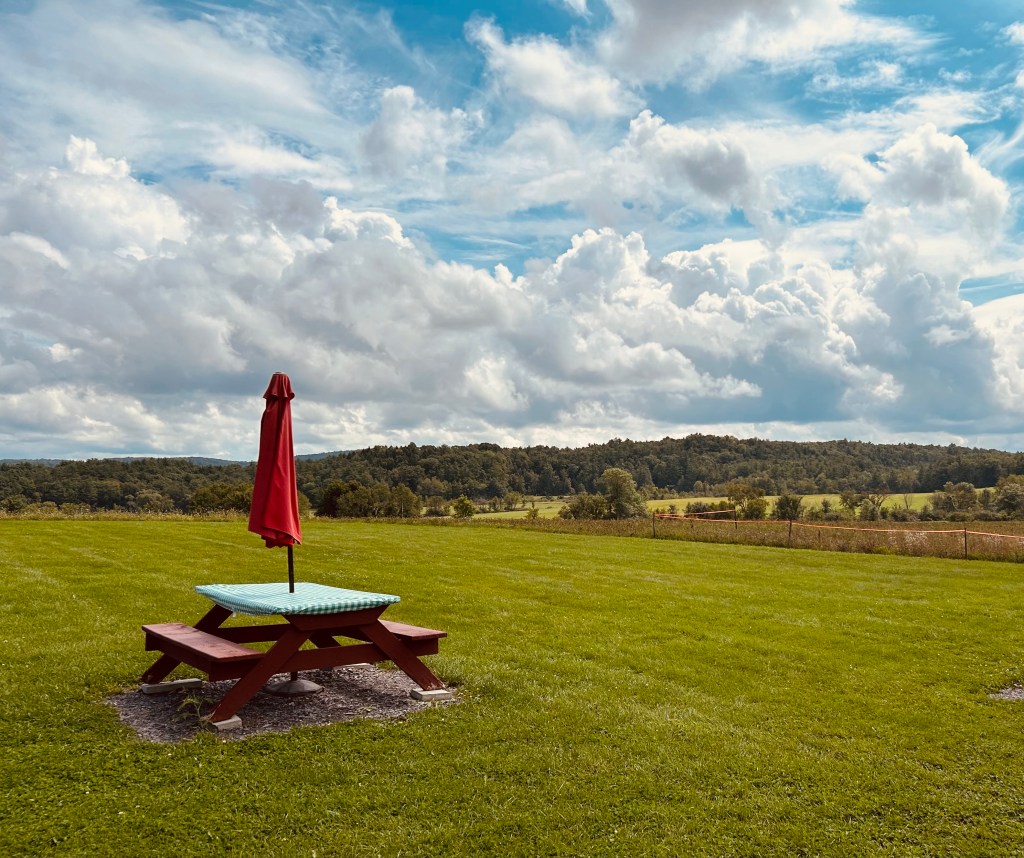

Paul Morrow, our host, was mowing the lawn when we arrived on Pine Haven Shore Lane, right on Shelburne Bay, around 2:30p He helped carry our luggage into his modest family home, where we greeted his wife Emily, Andrea’s longtime friend and former roommate at Oberline College in the 1970’s. We got settled into our comfortable bedroom before joining Paul and Emily for conversation outside on their lawn, overlooking the bay. It was good reconnecting with them. We shared our feelings about the current political reality and lamented Kamala Harris’ defeat after the four of us had watched the upbeat Democratic Convention together here last August.

Andrea and I had a nice nap before supper and reengaging in conversation with Emily and Paul. We’re both looking forward to spending time with them over the next few days before leaving for Lake George on Sunday morning.

Days 3, July11 — Adventures in Shelburne and Burlington

Our first full day in Shelburne started with Andrea and I exploring nearby Shelburne Bay Park, a peninsula in Lake Champlain with large tracts of accessible shoreline. We enjoyed the cooler morning temperatures under the shady forest that abuts the shore there, following a well-marked hiking trail.

Andrea and I made a music video using a recorded hymn while panning an iPhone camera to capture the dramatic sunlight coming through the high limbs of the surrounding trees. The slow, melodic choral singing was a perfect accompaniment to the reverential images of the shady forest. Making the music video together was fun, and we sent it out to our church community. It inspired us to make a second one of moored sailboats offshore to music from a Boccherini cello concerto.

Another more challenging adventure involved going out rowing with Paul in his elegant skiff that afternoon. Paul’s love for rowing almost daily in Shelburne Bay resonated with my own love for daily bike rides. Paul had lent me a swimsuit and patiently demonstrated how to launch the boat from the rocky shore in front of their lakeside home. I hadn’t realizd that his boat had oars for two rowers. It was a learning curve for me to learn how to sit and row in tandem with Paul’s oarstrokes in front of me.

The boat’s relative narrowness required holding the oars one hand above the other. This added complication made it challenging for me to stay in synch with Paul at first. But I quickly got the hang of it. It was satisfying to be part of a two person crew, propelling our craft through calm waters out to the center of the mile-wide bay.

Paul said that his boat was a “St. Lawrence Rowing Skiff”, developed for use in the Thousand Islands. He usually goes out solo but seemed happy enough to have some company. We rowed for less than an hour, but I got exhausted before then and Paul rowed solo to get us back to shore. We had some good conversation as he shared some of his experiences as a forensic pathologist in Vermont, and more recently in Australia and New Zealand.

A third adventure was dining with our hosts at a fabulous Chinese fusion restaurant that evening in nearby Burlington. It was an upscale place that Paul and Emily knew well. I don’t have the gastronomic vocabulary to describe the new tastes and textures I experienced, but they were universally delightful, and included scallion pancakes, mushroom eel, Buddha’s Beef (seitan), and a refreshing iced tea with hybiscus syrup. Andrea and I were happy to pick up the tab for this memorable feast.

Day 4, July 12: a Generous Invitation, and a Visit with Another Old Friend

The highlight of our last full day with Paul and Emily in Shelburne was a conversation our hosts initiated. This was our third summertime visit at their lovely Shelburne Bay summer home. The Morrows were decades-long expatriates, having made a substantial professional and personal life for themselves first in Australia but currently in New Zealand. Their Shelburne home was where Paul was born and raised by his Quaker parents, both medical doctors. Paul had become s chief medical officer in both Australia and New Zealand before retiring last year. Emily had a thriving law practice in New Zealand, though both of them were now initiating new part-time careers in counseling (Emily) and chaplaincy (Paul). They returned to Vermont for a few weeks every summer. Andrea and I both admired Emily and Paul for their strong life force and very active “retirement”.

Andrea and Emily had remained close friends since college. They spoke by phone regularly during all the Morrows’ decades in Australia and New Zealand.

Emily and Paul sat us down that morning after breakfast to make us a very generous offer. They were inviting Andrea and me to visit them in Auckland, NZ within the coming year. They had issued a similar invitation the summer before, but this time it was much more specific and elaborate. Emily and Paul had an alternative residence that they owned in Auckland where we could stay, and they would act as active hosts throughout our time there. Emily even offered to help financially if we needed it. Andrea and I were deeply touched, and excited, and we have now made specific plans to visit Emily and Paul in New Zealand next February!

Friends at Shelburne Bay: Emily Morrow, Andrea DiLorenzo, Paul Morrow

That Saturday was mostly a quiet day. The only excursion that Andrea and I made was a short drive to visit an old friend, Betty McDevitt, who had moved to a retirement community in Shelburne so as to be close to her son and his family there.

We had visited Betty at the Wake Robin community last summer as well. Betty is now in her 90’s and has self-admittedly lost some of her intellectual acuity, yet gladly affirms that she has never been happier. She greeted us warmly and took us to lunch with her in the community dining room. During lunch, she shared about her recent birthday party, and reveled in the love of her son’s family, especially her grandchildren. She took us back to her apartment, still festooned with flowers and other birthday decorations. Andrea in particular felt gratified to stay connected with her old friend from her hometown, New Castle, PA, and a sister alumna of Oberlin as well.

TO BE CONTINUED…

John Bayerl, 7/26/2025
Gaithersburg Book Festival 2025, Part 2

Authors Finding Hope within the Climate Crisis

The next event I attended was an interview with authors of two recent books that affirmed possibility and hope within the daunting climate crisis.

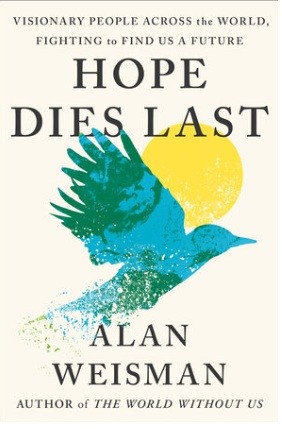
Alan Weisman is a veteran academic and long-term journalist and author on environmental topics. His latest book is Hope Dies Last. Malcolm Harris is a young writer/activist who brings a radical political perspective to his new book What’s Left. The two were introduced by Rockville Mayor, Monique Ashton, who recounted how her 12-year-old daughter had received news of her mom’s election victory by asking her: “So what are you going to do about climate?”

The interviewer for the program was the legendary journalist and activist Elizabeth McGowan who had found her passion for fighting climate change after overcoming two occurrences of serious cancers, and had ridden a bicycle across the country in sponsorship of cancer research.

Weisman was interviewed first. The subtitle of Hope Dies Last is Visionary People Across the World Fighting to Find Us a Future. The book is the fruit of Weisman’s recent worldwide travels in search of people who were on the frontlines of the climate crisis. He recounted a story about an Iraqi man who had spearheaded a successful, decades-long movement to restore an enormous wetlands area in southern Iraq that Saddam Hussein had ordered drained in order to root out his enemies, Iraqi Shias. The man had a scientific background, ecological understanding, and lifelong knowledge of the region’s water flows. He also had a wealth of personal connections to the displaced people who were eager to resume their traditional way of life. Weisman’s story is further dramatized by the fact that the wetlands in question are formed by the Tigris and Euphrates Rivers whose “fertile crescent” was among the sites of earliest civilizations in the Middle East. In reflection on the book’s title, Weisman said that “hope is an active verb” and that all of us could find a hopeful path through the climate crisis if we committed ourselves to collective action.

Malcolm Harris was a well-known leader of the “Occupy Wall Street” movement. His subsequent career as a journalist and author was formed from his experience as an on-the-ground organizer. He became an avowed Marxist and applied a Marxist analysis to the economic challenges of the Millennial and GenX generations. His book title, “What’s Left”, is a well-known political mantra for environmentalists seeking to preserve and protect the natural world as it remains for us now.

Harris identifies three necessary aspects to a successful renewal of climate health: 1) use of carbon credits to economically incentivize companies and governments to reduce fossil fuel emissions; 2) high level governmental mandates such as those enumerated in the Paris Climate Accords; and 3) a renewed commitment to the common good of humanity as a whole that he believes is best espoused in the ideals of communism. He pointed out that all the environmental success stories studied by Alan Weisman involved groups of people coming together to protect environments that their livelihood depended on. Harris urged us to question our American bugaboos about individualism and free enterprise and begin to consider how much better our environment, and our society might be if it prioritized people and the environment over profits.

Elizabeth McGowan as moderator provided an inspiring testimony to the value of finding purpose and hope even amid dreadful prognoses. She herself had received virtual death sentences from melanoma twice in her young life, and both times had miraculously lived through them. Her subsequent environmental journalism and activism was inspired by her confidence that life itself would find a way to survive and thrive. Hope Dies Last!

Two Talented Authors of World War 2 Historical Novels

As baby boomers whose Dad had fought in World War 2, our family book club was always on the lookout for engaging historical fiction set during the war. So I rejoined my sisters for a fascinating presentation by two highly successful historical novelists:  Madeline Martin and Laura Morelli.

Martin’s most recent novel, The Booklover’s Library, is set in Nottingham, England during the second world war. It is a love story about a widowed mother and her young daughter, who is evacuated to the country to avoid the German air blitz. The mother carries on as best she can as a librarian, finding ways to encourage her library’s often quirky readers with books that will inspire and motivate. Martin described her novel as a story of how a mother’s love for her daughter and her dead husband led her into deeper service to her community, as well as her family.

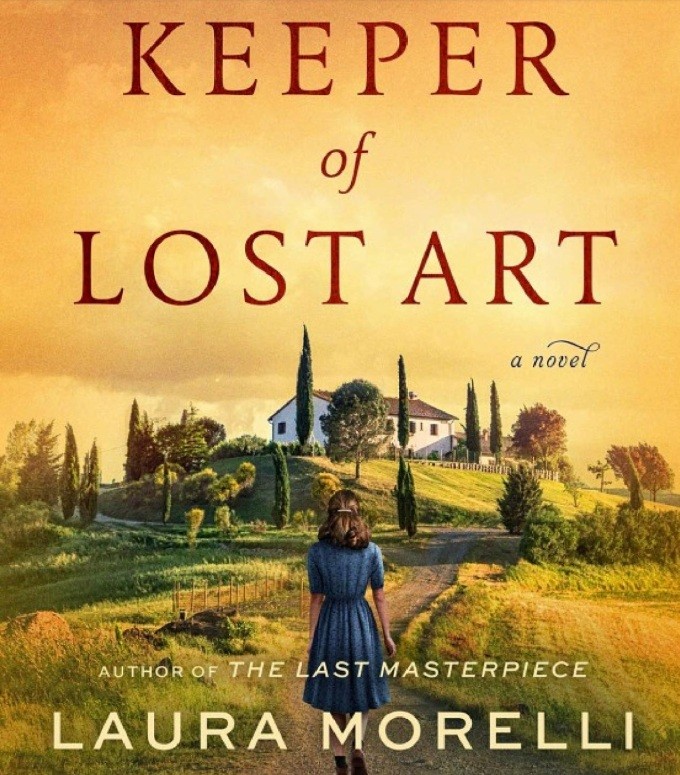
Laura Morelli is a professional art historian as well as a fiction writer. Most of her historical novels are set in Italy and involve aspects of classical Italian art. Her latest novel, The Keeper of Lost Art, is based on the true story of how the Uffizi gallery in Florence shipped all its most valued works of art to various rural locations to prevent them from being pillaged by the Germans during the second world war. Her novel centers around a young woman from Turin who has been sent to a villa in Tuscany where many of the Uffizi treasures are being kept. Ms. Morelli spoke with great eloquence and passion about her book.

What I found remarkable about the interview with these two talented, creative writers was the sense that the two were in no way in competition and that they took in and affirmed what each other was saying. I was also impressed by both writers’ stories of the long, hard research they had performed prior to sitting down to write. Both of their new books were definitely candidates for next year’s reading list!

A Local Author’s Remarkable Comeback

The last author we heard was Jeanine Cummins whose 2018 bestseller, American Dirt, we had read in our book group. It is a gripping novel about a Mexican woman and her young son as they make a perilous journey from Acapulco to the U.S. after their family has been violently targeted by a cartel there. The novel became a topic of controversy after a large group of Hispanic American writers had publicly criticized the book and its author for having expropriated Mexican culture for commercial interests. Cummins has Puerto Rican family roots, speaks Spanish, and spent a lot of time at the U.S. – Mexico border interviewing migrants. Still, the criticism stung and resulted in her withdrawal from writing for over a year. She said she had not been sure that she would ever be able to write again.

We had seen Ms. Cummins at the 2022 GBF when she had interviewed the successful Mexican American writer, Reyna Grande. Grande had signed on to the 2018 letter criticizing Cummins, but it was clear from their interaction at that GBF that the rift had been healed. Cummins was generous in her praise of Grande’s excellent historical novel set during the Mexican- American War of the 1840’s, and Grande clearly reciprocated the positive regard.

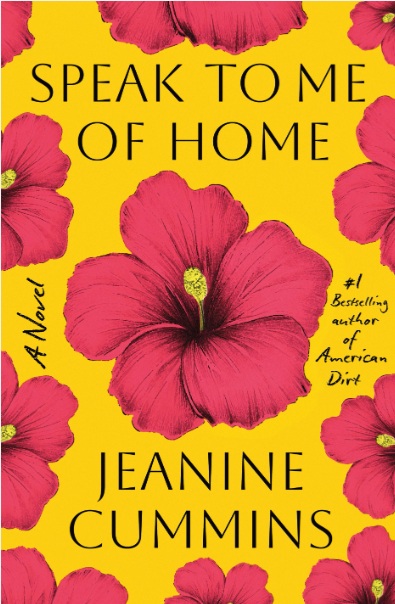
Jeanine Cummins has become something of a celebrity in Gaithersburg. She grew up here and attended Gaithersburg High School, which is right next to Bohrer Park. She was lavishly introduced by the Mayor of Gaithersburg, Jud Ashton, who has been instrumental in starting and sustaining the GBF over the past 16 years. Cummins had recently published a new novel, Speak to Me of Home, whose subject matter touches on her own Puerto Rican heritage. She was interviewed by a local Jamaican American author, Donna Hemans.

Cummins first spoke about the 2018 controversy and how it had deeply affected her. Even though she rightly claimed her integrity in writing American Dirt, the criticism opened within her questions about her own ethnic identity. This led to deeper conversations with her mother and other family members about the Puerto Rican matriarch of their family who had moved to the U.S. many decades earlier. Her latest novel was an opportunity for her to plumb the depths of her own Puerto Rican roots.

Donna Hemans entered an in-depth dialog with Cummins about current issues of ethnic diversity within our American melting pot of cultures. Cummins described her ease in navigating the large multi-ethnic cultures of Gaithersburg – a small city that is regarded as the most ethnically diverse place in the U.S., with over one hundred different languages spoken here. She said it was challenging for her when she left for college at nearby Towson State, because unlike her hometown high school, students there segregated themselves much more pervasively by race and ethnicity.

Cummins talked extensively about her Puerto Rican grandmother and her challenges in navigating American middle-class society. Those stories became an important part of her new novel. Ms. Hemans asked Cummins to read specific passages from Speak to Me of Home. The writing was perceptive and poignant, as usual for Cummins. My sisters and I came away knowing that this novel would be among our top choices for our reading list.

John Bayerl, 5/26/25

Gaithersburg (MD) Book Festival 2025, Part 1

Last Saturday was the long-awaited Gaithersburg Book Festival (GBF) in this Maryland suburban city north of Washington, DC. My sisters Marian and Anna arrived from their long drive from Buffalo around 2:30p on Friday. We had all attended four of the previous festivals, the last one being in 2022.

The three of us plus two of other sibs had been participating in a family book group for ten years. Over the years, our experiences with authors at the GBF had inspired our choices of many of the books we had selected to read.

I went down to greet my sisters and help them to get settled in their Guest Suite just down the hall from my wife Andrea’s and my apartment in our comfortable retirement community in Rockville, MD. Their room was still being cleaned so they came to our place for a nice visit with Andrea and me. They had shared the driving and were tired but in good spirits. Andrea had made us a 6:30 dinner reservation at the restaurant downstairs, so we all had time to rest a bit beforehand. Both Andrea and I always feel a lot of common ground and good cheer in being with my sisters.

After a delicious meal, we treated ourselves to watching a classic 1980’s film, Alan Alda’s “The Four Seasons”, which we all thoroughly enjoyed. We went to bed early enough to get up in time for the 10am festival start at Bohrer Park in Gaithersburg. Andrea drove us the four miles there, right to the entrance (and picked us up there five hours later.) It was a beautiful early summer day, mostly clear and warm, but not oppressively hot.

A Therapeutic Writing Workshop

My sisters and I wanted to attend the 10am writing workshop, “Healing Through Writing”. We arrived just as it was getting started, finding decent seats at one of the tables set up inside a large white tent. At each seat was a nicely bound notebook, pen, and a synopsis of the principles of therapeutic writing.

The presenter was a short, elderly woman, Diane Pomerantz, a “psychologist and author” as the program noted. She spoke in a calm, self-assured way about the documented therapeutic effects of personal writing as a way to achieve perspective and self-awareness after suffering emotional trauma.

She first talked about all our lives as a sequence of stories. While the events of our lives were sometimes outside of our control, she made a compelling argument that we all had the ability to frame and contextualize those events as healing stories. Consciously intending to gain perspective from even severe trauma was a good starting point. Then writing about a trauma and our emotional response to it gave us a vehicle to stand back from it and see it in a greater context.

Ms. Pomerantz had utilized writing to help her heal from a traumatic marriage, and had made that healing experience central to her published memoir. She had a strong personal basis for urging us to consider doing the same.

To get us started, she suggested that we make use of our handsome notebooks to write a 6-word memoir. That seemed like a daunting task at first, but after reflecting for a bit, I came up with a sentence that actually seemed to describe an important theme of my 75-year-old life:

“Cross eyed vulnerability made me different and special.”

I was the second oldest of ten children and was diagnosed early on with strabismus, a condition in which the two eyes don’t look at the same place at the same time (hence, “cross eyed”). By the age of 5 I’d already had two surgeries and wore glasses with a patch covering my “good eye” so that the “lazy eye” might gain strength. None of this actually worked. By the time I started school, I was still “cross eyed” and wore glasses, though the glasses did nothing to fix the underlying condition.

Even in the early years of my family life, I felt competitive for my mother’s attention with my older brother and then my younger baby sister. My vision problem helped to garner me that attention.

One of Ms. Pomerantz’s instructions had been to find some way in which a trauma had brought us some advantage. It didn’t take me long to experience that insight from my own childhood. Both my parents took time to take me to my eye doctor’s appointments across town, and otherwise tend to my vision issues.

But I can also see now that the attention I received for my vision issue contributed to seeing myself as faulty in some way, which fed a kind of victimhood, and a sense that I deserved extra consideration. I left the workshop with a deeper understanding of an important, but largely unexplored aspect of my early life that had had lasting repercussions.

Just Us Books

The GBF is structured as hourly presentations held in small tents scattered about the 40-acre lawn of Bohrer Park. There’s no registration process (nor fees) and seating is on a first-come basis. I was heading to an 11am session with well-known local author Judith Viorst when another tent captured my attention.

Projected on a large screen inside the tent were brightly colored pictures from a children’s book. An attractive African American couple were just beginning their presentation and I was immediately drawn in.

Cheryl and Wade Hudson are a 60-ish couple who are both writers and publishers for Just Us Books, Inc., a company they founded decades ago after mainstream companies had declined to publish their African American-oriented children’s books.

As I was passing by, Cheryl Hudson was reading and singing from her latest children’s book, “When I Hear Spirituals”. It’s about a little girl describing her feelings when she hears spirituals being sung in church. Ms. Hudson took us through each of the visually projected pages of her book, stopping to sing short segments from the spirituals being described by the little girl. These included “Wade in the Waters”, “Swing Low, Sweet Chariot”, “Ring Them Bells” and many more. Her singing and the colorful illustrations really brought the book alive!

Then her husband Wade took us through the illustrations and text of a book he had penned based on the story of his mother voting for the first time in Louisiana in 1969, “The Day Madear Voted”. He beautifully conveyed the jubilation felt by his mother, her family, and other members of their church on finally being allowed to perform their constitutional right to vote.

Andrea and I had visited the civil rights “legacy sites” in Montgomery, AL, last month and the ugly reality of our country’s longstanding abridgment of basic human rights for African Americans was still fresh in my mind. I heartily concurred with Mr. Wade’s assertion that this history needed to be communicated even more at a time when the MAGA forces are attempting to whitewash essential parts of our American history.

There were three other author presentations that I attended and which I will describe in a subsequent post.

John Bayerl, 5/20/2025

Books I Read in 2024

I read of an intriguing idea recently: that a list of the books we read is a kind of autobiography reflecting our deepest interests. For what it’s worth, I decided to compile my list from last year and post it here. I was surprised to find that I had equal numbers of fiction and non-fiction. The seven titles with a preceding asterisk are ones I read as part of a Bayerl Family book group that is entering its ninth year.

I’ve already posted blog reviews of three of last year’s books, as follows:

“Killers of the Flower Moon” as Book and Film, book written by David Gann, film directed by Martin Scorsese, 1/22/2024

“Anything Is Possible” by Elizabeth Strout, 5/27/2024

What’s My Excuse?, a review of Viktor Frankl’s “Yes to Life in Spite of Everything”, 6/24/2024

NON-FICTION

1 *Killers of the Flower Moon, David Gann

2. The Gospel According to James Baldwin, Greg Garrett

3. Uncle Tom’s Journey from Maryland to Canada – The Life of Josiah Henson, Edna M. Troiano

4. Yes to Life, (translation of Viktor Frankl’s essays called “In Spite of Everything”). Daniel Coleman (ed,)

5. Proof of Heaven, Eben Alexander

6. *Democracy Awakening, Heather Cox Richardson

7. A Year to Live, Stephen Levine

8. * Beautiful Country, Quian Julie Wang

9. A Passionate Mind in Relentless Pursuit – the Vision of Mary McLeod Bethune, Noline Rooks

10. In Search of Stones,M. Scott Peck

11. The Road He Travelled – The Revealing Biography of M. Scott Peck, Arthur Jones

FICTION

1. *American Savior, Roland Merullo

2. *The River We Remember, William Kent Krueger

3. Anything Is Possible, Elizabeth Strout

4. *Goodnight, Irene, Luis Alberto Urea

5. Olive Kitteridge, Elizabeth Strout

6. The Little Liar, Mitch Albom

7. The Next Person You Meet in Heaven, Mitch Albom

8. *Trust, Hernan Diaz

9. Olive, Again, Elizabeth Strout

10. *The Storm Beyond the Tide, Jonathan Cullen

11. Foregone, Russell Banks

John Bayerl, 1/26/2025

Verdi’s Macbeth and “Our Oppressed Homeland”

I just returned from a magnificent performance of the Washington National Opera’s “Macbeth” at the Kennedy Center. The music reviewer for the Washington Post wrote an excellent account of the many masterful elements of the production after it opened last week:

 Dark powers guide dagger-sharp ‘Macbeth’ at Washington National Opera – The Washington Post

Rather than discuss the performance itself, I’d like to share some strong feelings that arose in me while watching it.

I first encountered Shakespeare’s classic play, “The Tragedie of Macbeth”, as a sophomore at my Catholic boys’ high school in Buffalo, NY. My English teacher, Rev. Claude Bicheler, had us read much of it aloud in class, stopping frequently to explain some of the arcane Elizabethan English. Rev. Claude was an avid theatergoer and also the director and producer for all our school plays and musicals. He had a way of making the story of Macbeth come to life and encouraged us to persevere even when we were feeling lost. Like many, I was most taken with the scenes of the witches who foresaw and steered the infamous, homicidal direction of Macbeth’s thirst for power.

I had seen some stage versions of the play later in life. I appreciated the keen psychological rendering of the character Macbeth and Lady Macbeth given by Shakespeare, but never felt deeply affected by the story. It all seemed a bit melodramatic to me.

I became an opera fan during my college years (1967-1971) at Fordham University in the Bronx. A friend in my dormitory would listen to the live radio broadcasts of the Metropolitan Opera on Saturday afternoons. I overheard the music and asked him about his interest in opera. He invited me to join him the following Saturday to listen to something called “The Barber of Seville”. He had a copy of the libretto (text) of the opera, and he helped me follow along as we listened to the live singing. My friend was a native New Yorker who had been attending live opera performances at the Met and the New York City Opera for many years. His enthusiasm was contagious. And being able to closely follow the story line of the opera while listening to the Met broadcast drew me in. My friend regularly attended both of the opera theaters at Lincoln Center in midtown Manhattan and I started to accompany him. I was soon hooked.

The nineteenth century Italian Giuseppe Verdi is a giant among opera composers. Over the years, I had listened to recordings and attended performances of many of his most famous operas, including: La Traviata, Il Trovatore, Rigoletto, Aida, Don Carlo, Otello, Nabucco, La Forza del Destino, and Simon Boccanegra.

When I met and married my spouse, Andrea DiLorenzo, in the mid 1980’s, one of the strong common passions we shared was for music of all genres, but opera in particular. We’ve attended dozens of operas together over the years in venues including the Kennedy Center Opera House in DC, the Wolf Trap Summer Opera, the Met in New York, the Pittsburgh Opera, the Charlottesville Opera, Covent Garden in London, and the Mexico City Opera. It became a tradition for us to get opera tickets for Andrea’s birthday every year, and it just so happened that “Macbeth” was being performed in November, her birthday month. We got the tickets some months ago and were eagerly anticipating the performance, which we’d be attending with another couple.

Neither of us had ever encountered Verdi’s “Macbeth”, which is an earlier work of the composer and not often performed. I had learned from my Fordham dorm-mate the importance of becoming familiar with an opera before attending. So a few weeks ago, I began listening to a recording of the opera via a streaming service, following along with a libretto that I easily downloaded.

The story of “Macbeth” is dark and menacing. It’s about a Scottish warrior and his wife, Lady Macbeth, who become addicted to political power by any means necessary. The witches provide a dark supernatural element, a kind of black magic, which convinces Macbeth that he can rise to kingship by killing off the king himself and all potential rivals. He does so in a cold, calculated way and soon gets the coveted kingship. Lady Macbeth eggs him on, scorning her husband at any sign of hesitation. Eventually, their heinous crimes, which include the murder of innocent women and children of their rivals, begin to take a toll on their psychological wellbeing. They both start drifting into a guilt-ridden madness. Lady Macbeth commits suicide, and Lord Macbeth throws himself into one final battle against the king of England’s army and is fully vanquished by Macduff, a former aide whose entire family was murdered by Macbeth’s minions. Macbeth’s last aria laments that he is utterly alone in death, unloved, even hated by his people.

The part of the opera that most moved me this afternoon was a choral piece about the suffering and oppression suffered by the Scottish people during Macbeth’s short, bloody reign. It is called “Patria Oppressa” (Oppressed Homeland) and laments the dire suffering of so many victims of Macbeth’s onslaughts. A translation is as follows:

Oppressed homeland of ours!
You can no longer have the sweet name of Mother
Now that you’ve become a tomb for our sons and daughters.
From the orphans, from those who mourn for husbands and children
A cry of outrage goes up to heaven at each new dawn.
To that cry heaven replies, moved by pity for the oppressed land,
And proclaims our grief forever.
The bell tolls constantly for death,
But no one is so bold to even shed a vain tear
For the suffering and the dying.

The “Patria Oppressa” chorus affected me so deeply because I was still feeling traumatized in the aftermath of the American presidential election last week. I was anticipating a great deal of chaos and suffering that this chorus gave voice to.

Throughout the unrelenting treachery and deceit of the Macbeth story as sung so masterfully by the outstanding singers, I’d been feeling queasy inside, as if the opera was depicting a kind of political dystopia that I feared our country had already entered. The chorus also evoked in me an identification with the peoples around the world suffering under the weight of violent oppression in the Ukraine, Palestine, Lebanon and elsewhere.

In the case of the American election, I realize that the oppression I was anticipating was brought about by the American electorate. In some ways, that realization made the situation even more painful.

When Verdi revised “Macbeth” for a new production in Paris in 1867, he added a number of important elements that remain in the version that has been used since then. In Shakespeare’s tragedy, the play ends with Macbeth’s last words after having been mortally slain: “I sink – my soul is lost forever.” But in 1867, Verdi added a final chorus that followed the death scene. It is the rousing “Inno da Victoria” (Hymn of Victory) which celebrates the death of a tyrant and gives glory to the liberators:

Victory! Victory!
Where is Macbeth?
Where is the usurper?
The God of Victory has struck him down with a breath.
He (Macduff) is a valiant hero who killed the traitor.
He has saved our homeland and our king.
Honor and glory to him!
Our gratitude rises to the great God of vindication!
Let us sing hymns of glory!
The new dawn will bring us peace and glory!”

I was relieved to vicariously experience the victory so triumphantly celebrated as the opera ends. Verdi himself was emphatically committed to the cause of Italian independence during his lifetime. Many of his other operas have hidden allusions to that quest as well. When Italy finally did achieve independence, Verdi was elected and served for four years in the first Italian legislative body.

Andrea and I have been active politically since the 2016 presidential election. We have formed two political groups since then, both of them meeting monthly, both committed to sustaining a strong democracy. We were heartbroken that Kamala Harris failed to convince enough voters to elect her, despite a high energy campaign, and her winning persona.

Many of us are justifiably wary of the kinds of oppression that the current president-elect is capable of. Watching the masterful production of Macbeth yesterday elicited some of my darkest fears of what’s in store for our country over the next four years. But Verdi’s triumphant closing statement, a Hymn to Victory, served to buttress an underlying belief that all is not lost, and that the forces of Good will ultimately prevail. As the story of Macbeth shows, the forces of evil often sow the seeds for their own ultimate destruction.

John Bayerl, 11/17/2024