Remembering Tom Trosey, 1941-2023

I was saddened to hear (via a Facebook posting) of the passing of an old friend and teacher from my Buffalo days. Tom Trosey taught English at the boys’ Catholic high school I attended there from 1963-1967. He was fresh out of college when he arrived as an enthusiastic young teacher whose specialty was creative writing. I never had Tom as a classroom teacher, encountering him in his role as moderator of a fledgling literary magazine and of the yearbook, for which I was the editor in my senior year. Tom became good friends with my English teacher for all four years, Father Claude Bicheler. In my senior year, I began attending plays and concerts with both, and through their influence, decided to become an English major in college.

Tom helped me to come up with a theme for the 1967 yearbook. It was “Men of our Times”, and featured short prose and photo essays about William Faulkner, Dag Hammarskjold, Pope John XXIII, and John F. Kennedy. Both Tom and Father Claude gave me a lot of time and encouragement back then and helped me through my many doubts and fears.

I encountered Tom in a different context in my senior year at Fordham University in New York City. There he was in graduate school at NYU, and I remember many rich visits with him then, discussing our favorite writers, and attending a number of plays together.

After college I experienced a severe depression. I had returned to Buffalo to take care of my draft status and was very grateful to get a 4F deferment owing to my compromised vision. I started a full-time job at the Buffalo Evening News, still living at home on the working-class East Side of town.

Life was going well enough, and I even had a new girlfriend, a young woman who I’d met attending a Buffalo Philharmonic concert one sunny October Sunday afternoon. The relationship started with a lot of promise, but soon devolved into heartache after we got pregnant, and she had an abortion. We ended up breaking up. I was torn by grief and guilt.

Tom was back in Buffalo at the time, and I was able to confide in him. He was very sympathetic and helped me to find a good group therapist. It was my first exposure to therapy, and I credit it with saving me at a time when I felt sucked down into a terrible black hole of hopelessness.

Tom and I remained friends through the two years of my recovery work in therapy. We lost touch when I left Buffalo in the late 1970’s, but occasionally reached out by phone and pen.

I remember Tom as a kind, caring person with a wicked sense of humor and fine tastes in books, music and theater. He went out of his way to help me during a number of challenging times in my life, for which I am eternally grateful. It’s been wonderful reading the soulful postings about Tom from other former students on Facebook and the Legacy site. I can picture him smiling down as those who knew and loved him share their written appreciations of him now.

John Bayerl

“Grounded,” an Anti-War Opera for Our Times

Andrea and I attended a compelling performance of a new opera on Sunday at the Kennedy Center Opera House. We were both deeply affected by this contemporary musical drama about the psychological debilitation suffered by a young, female Air Force pilot. “Jess” is demoted from flying F-16 fighter jets to guiding unmanned drones. She is tasked with killing selected human “targets” over desert terrain somewhere in the Middle East. The subject matter felt all too relevant as guided bombs and missiles continued to fall daily over civilian populations in both Gaza and Israel.

“Grounded” originated as a one-person play written by George Brant after he had made a deep study into the phenomenon of drone warfare and the personnel who directed the drones. The play found an audience and culminated with an off-Broadway production starring Ann Hathaway in 2015. The opera came about owing to the Metropolitan Opera’s current zeal for commissioning new works to attract new audiences. The Met commissioned playwright Brant to work with the established composer Jeanine Tesori to refashion “Grounded” as a full-blown opera and gave the Washington Opera an opportunity to give it a trial run.

Ms. Tesori had created two successful operas already after a celebrated career as a composer of Broadway musicals. Working closely with Brant, they soon realized that the original one-character script needed to be fleshed out with the other characters described in the “Pilot’s” monologs. They realized that the opera genre requires a full expression of human passion by multiple voice ranges for it to succeed. The result is a full opera cast of twelve individual characters and a large chorus.

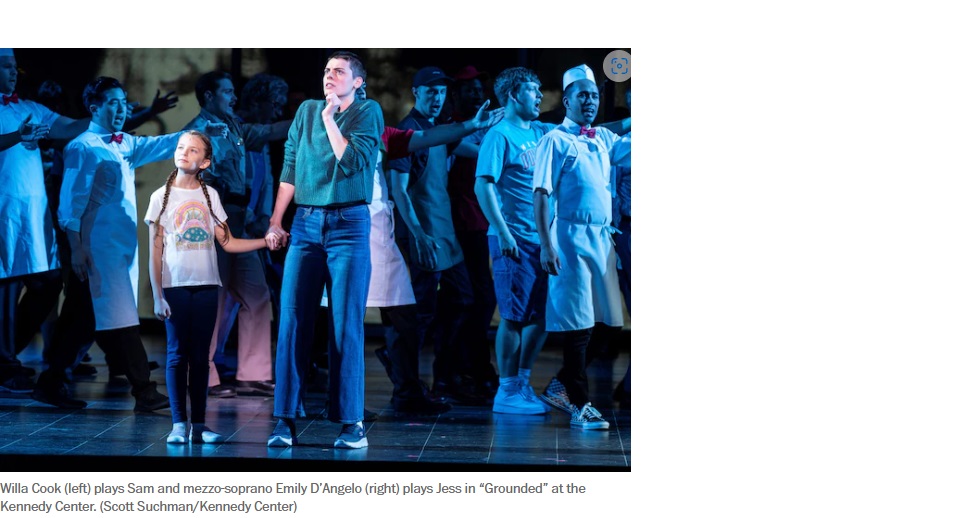
In the opera, the Pilot is named “Jess” and is acted and sung by the consummate young mezzo soprano, Emily D’Angelo. We meet Jess as an Air Force F-16 fighter pilot flying combat missions over Iraq. Jess has trained long and hard to earn her wings flying the most sophisticated fighter jet in the modern arsenal. She has a deep love for flying into the immense “Blue” of enemy skies, thrilling to her missions by avoiding enemy fire and destroying her targets (power stations, factories, enemy bases).  She has truly found her place among the elite pilots of the U.S. Air Force Blue and revels in it.

While Jess is on leave stateside, she meets a man with whom she shares a strong sexual and emotional connection. Her leave is at an Air Force base in Cheyenne, WY, where she joins her male cohorts for rowdy nights of drinking and gambling. A handsome local rancher and card-shark, Eric, soon takes his large share of the card game winnings and encounters the half-drunk Jess, who is immediately attracted to his cowboy manliness. Eric invites Jess to spend the night with him at his nearby ranch-house. Eric and Jess experience genuine passion for one another, and when Jess soon discovers her pregnancy, Eric is eager to marry her.  Jess of course “loses her wings” but is happy to settle in with Eric to have and raise their child, and to partake of the natural beauty of rural Wyoming.

 Jess gives birth to a girl, Sam, and learns to become a good wife and mother. But after eight years of domestic life, she begins yearning to fly planes again.  She approaches the Air Force only to learn that she has lost her place as a fighter pilot but is recruited to serve as a drone “pilot” at an Air Force base outside of Las Vegas. She is put off at first, but then reluctantly agrees to take the assignment.  Eric agrees to join her there with Sam, quickly picking up work as a blackjack dealer for a gambling casino.

 Jess is initially appalled at her new duties, confined for daily 12-hour shifts in a small trailer where the drone operation is directed. Her yearning to fly again is harshly curtailed by her new duties, but she feels trapped and obliged to fulfill her commanding officer’s stark order: “This is where we need you now.”

The second half of the opera is set almost entirely within the confines of a trailer in the Las Vegas desert where Jess, her boyish technology assistant, and two uniformed officers work 12-hour shifts, every day of the week. Their job is to surveil specified areas of a Middle Eastern desert in search of “suspicious activity.” When such activity is located, they may be ordered to obliterate the “target” via a cruise missile fired from the drone plane that they are operating.

The whole opera makes use of state-of-the-art, totally immersive technology. It employs a panoply of colored LED lights and projections to establish a sense of place, adding to the emotional weight of the story unfolding through music. The Co-Production Directors, Jason Thompson and Keitlyn Pietras, say that they “see a common thread in the use of advanced video technology to tell a story about state-of-the-art advancements in military technology.”

The second act shows the slow emotional and psychological degradation suffered by Jess as she pursues her daily 12-hour shifts as a drone pilot. The Air Force employs premium rewards for pilots who successfully find and destroy designated human targets. The work awakens Jess’ killer instinct, which had gone underground during her eight years of domesticity and motherhood. She is very skilled technically and has a keen sense of where her targets might be hiding. She takes genuine joy at each of her kills, like an adolescent playing violent video games, though here the human lives taken are all too real.

We begin to see Jess’ psychological breakdown in her time at home with her daughter and husband. She has become addicted to caffeinated beverages and her sleep patterns become very disrupted. Both her husband and daughter notice Jess’ strange behavior and try to make the best of it. Eric realizes that it is time for him to step up to confront Jess and yet hold on to his commitment to her. But Jess becomes unreachable, and their family life a living nightmare. Jess becomes paranoid about being spied on, and in one lively scene set in a shopping mall, she becomes convinced that someone is trying to sabotage her shopping trip with Sam to buy her a new dress.

The climax of the story occurs after a day’s long tracking of a suspicious car in a Middle
Eastern desert. Regulations require a visual identification of their human “target,” but it’s as if the driver knows that he must not get out of his car during daylight. After hour upon hour of excruciating boredom, Jess notices the car slowing down as it approaches a house. She sees a young girl come running out of the house to greet the car. A man then emerges from the car and runs to embrace the girl and take her to safety. The order is given to destroy the target, but Jess has become deeply moved by the man’s apparent love for his daughter, for whom he would risk his own life. She hallucinates the girl as her own daughter, Sam. In her upset, she refuses to comply with the command and, instead of releasing a cruise missile, purposely crashes the drone.

The last scene is of Jess in solitary confinement after having been court-martialed by the Air Force. She is unrepentant for her actions and has gained back some of her human feelings for her daughter and husband. In this way, “Grounded” differs from another opera on a similar theme called “Wozzeck” by Alban Berg, first performed in 1925. In that one, a former soldier is driven to alcoholism and psychosis by his ill treatment in the military, murdering his girlfriend and ending his own life in desperation. “Grounded” ends on a dark note for sure, but also on a note of heroic human defiance against technological murder.

Although “Grounded” does not outrightly criticize technological warfare, it certainly points to the degrading nature of using that technology to purposely murder. Our country has experienced many of the ill effects of our recent wars in Iraq and Afghanistan via the large numbers of returning veterans committing suicide or suffering from addictions and acute PTSD. A strong anti-war argument is that even the “victors” will suffer emotional damage from human killing, especially when it is done at a distance, but with full human knowledge that another human being’s life is being taken.

John Bayerl, 11/8/2023

Remembering Bennett Miller               1938 — 2023


Bennett Miller was one of the first people I connected with after moving to The Village At Rockville (TVAR), a retirement community in Rockville, MD, in March of 2022. We met owing to our mutual enthusiasm for playing chess. Bennet had written a notice on TVAR’s computer portal asking if anyone was interested in forming a chess club. I responded by email as soon as I saw it and Bennett phoned me shortly thereafter. We agreed to meet the following Tuesday morning in TVAR’s well used Game Room.

That was the first of our regular Tuesday morning chess games. Bennett and I had both been playing chess for some years and had reached a level of “advanced intermediate”. The important thing was that we were evenly matched, and our games were almost always intensely close. We were soon joined by another resident, Ann Birk, who had played in her younger days and was now eager to resume. Ann is a retired psychiatrist and wrote a wonderful portal posting for our nascent club, inviting residents to “get their neurons firing” by taking up chess. Ann even offered to teach the basic rules of the game to beginners. We soon had four or five new people joining us in the Game Room for our ongoing Tuesday morning chess club. Another fine player, Everette Larson, joined us shortly after he moved to TVAR. Marcia Mattocks and Betty Hess also became TVAR Chess Club regulars.

Win, lose, or draw, I always enjoyed playing with Bennett. He was a warm human being, interested in getting to know each of us beyond the realm of chess. He invited my spouse Andrea and me to join him and his wife Pat for dinner a number of times. As newcomers to TVAR, Andrea and I welcomed the opportunity to meet another couple. Andrea especially appreciated Bennett’s sense of humor and roaring laugh.

Bennett was very proud of his family and very connected to his two children and four grandchildren. He spoke glowingly of his grandson whom he had taught to play chess at an early age and who later beat his grandfather regularly. He was also a devoted husband, very attentive to Pat when she encountered some of her own health issues.

Bennett was a retired astrophysicist who had been involved in developing three different companies. He attended Columbia University as an undergraduate and went on to earn a Masters and PhD there before going on to teach at Ohio State University, as well as serving as a Deputy Assistant Secretary in the U.S. Department of Energy for ten years.

I was bereft when told by an ICU nurse that Bennett had passed away last Friday morning, October 20. He will be dearly remembered by all who knew him.

John Bayerl, 10/24/2023

A New England Travelog

Tuesday, 10/10/2023

We arrived a bit early on our late morning flight from Baltimore to Manchester, NH yesterday. Our old friend from Takoma Park, Larry Drake, picked us up there. It was only about an hour flight from BWI.  My spouse Andrea and I had to sit in the middle seats of separate rows on the sold-out flight. We were both near the front of the Southwest 737 flight though, so we were among the first to disembark.

It was easy navigating the “boutique” Manchester airport, spanking new in its design and execution. Larry soon arrived in his comfortable Ford C-Max Hybrid for the 40-mile drive east on Rt. 101 to Portsmouth. It was a mostly cloudy day, with temperatures in the mid-50’s. Traffic was light, and we were able to chat comfortably, Larry serving as an excellent tour guide. He and his wife Joan are longtime Democratic Party activists. He had just retired from a long stint as his county’s party chair. He noted that Rt. 101 had been completed during the tenure of then Governor Jean Shaneen, a strong Democratic leader who had gone on to be elected as a U.S. Senator for three terms.

Larry’s wife of 33 years, Joan Jacobs, is a longtime friend of Andrea’s. They became close friends and political allies while both were living in Takoma Park, MD in the 1980’s and 90’s. Larry had been a classmate of Andrea’s at Oberlin College in the class of 1973. After Joan and Larry had divorced from their first spouses, Andrea had served as a go-between to introduce them. They got married in 1990, just two years after Andrea and I had tied the knot. We had recently re-encountered Joan and Larry at the Class of 1973 50th year reunion in Oberlin, OH back in May. There they’d invited us to come for a visit to their home in Portsmouth, where they had moved after retiring from federal government jobs in 2006.

As we entered Portsmouth proper, we noticed slews of political yard signs. Like our native Rockville, MD, the city was having its municipal elections for City Council. We later learned that Larry co-hosted a weekly radio show on a small, local Pacifica network station. He was in the process of interviewing the candidates on his show. Andrea and I were similarly involved in our Rockville elections, so the feeling of being political allies continued to be nurtured.

We pulled into their lovely townhouse community in the outskirts of Portsmouth around 2pm. After getting settled in our upstairs rooms, we went down to join our hosts for a simple, delicious lunch. It was easy reconnecting with our old friends. After our good food and conversation, Andrea and I retired to our upstairs quarters for a late afternoon nap.

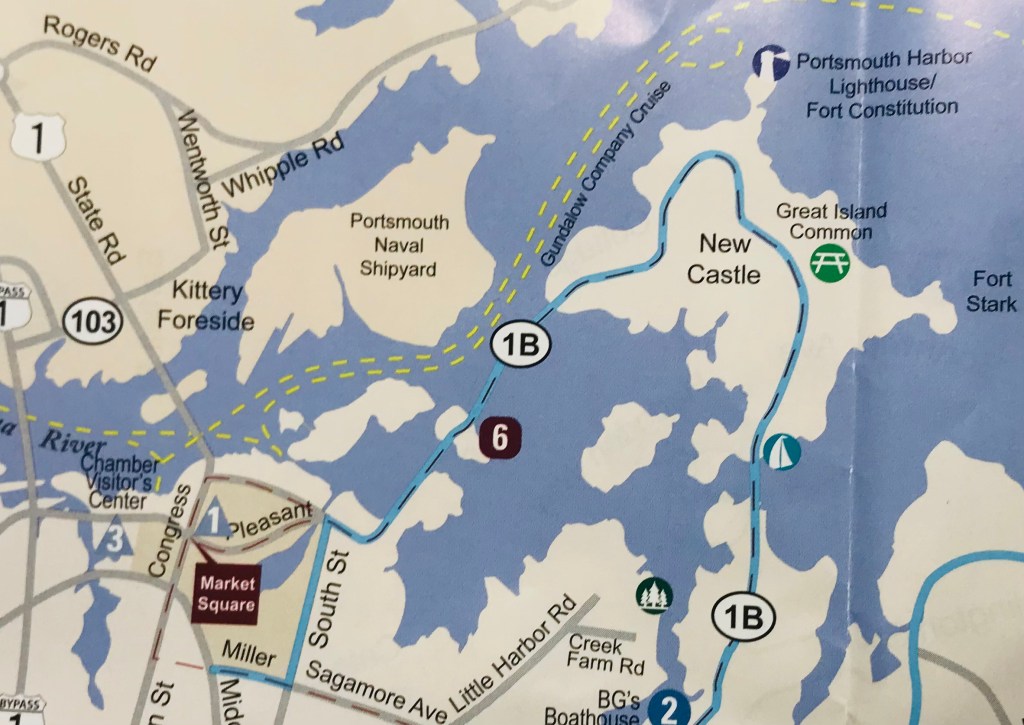
Andrea and I went for a nice walk in the early evening. The “Tidewatch” development is quite pedestrian-friendly even without sidewalks. Its townhouses are joined together in groups of three, with each group separated by open “green spaces” which retain a rural New England feel. The complex is arranged along the full flowing Sagamore “Creek” (actually a substantial river), with a number of boat docks and kayak entry points.

That evening, Joan and Larry gave us a tour of the involuted harbor area of the city, driving us over bridges and causeways, pointing out historic sites and lighthouses. A city of 20,000 residents, Portsmouth was celebrating its 400th anniversary of English settlement. The celebration also included the Wabanaki confederacy of native tribes who had lived there for millennia before the Pilgrims arrived at Plymouth, MA in 1620.

Even though a large Air Force base near town had closed, the U.S. Navy’s large shipyards were still fully active, serving as a primary maintenance facility for the U.S. n nuclear submarine fleet.

We drove through the narrow streets of the downtown area, bustling with theater and restaurant traffic.

We would return downtown during daylight two days later for a pedestrian tour. Our evening excursion culminated with a delicious Mexican meal at the Vida Cantina, a longtime favorite restaurant of our hosts.

Wednesday, 10/11

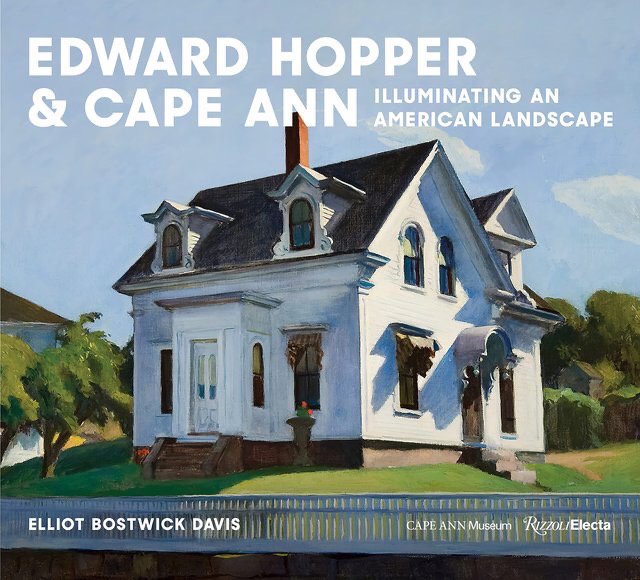
Today was our planned excursion to Gloucester, MA to see the “Edward Hopper In Cape Ann” exhibit at the Cape Ann Museum. Our timed-entry tickets were for 1pm so we had most of the morning to relax and take another long stroll around the Tidewatch community.

The fall is still in an early stage here, with colored foliage not much more advanced than back in Maryland. I took some photos of unfamiliar flora including the plentiful purple New England asters and a Siberian Crabapple Tree out front fruiting fully with red, pea-sized berries. Joan and Andrea had gone out before me, and I caught up with them near the edge of Sagamore Creek where we found a bench to sit and enjoy the scene.

It was about an hour’s drive south on I-95 and then east and north through Cape Ann to the historic fishing town of Gloucester. Larry drove the four of us and Joan navigated up front. It was a bright, sunny day and the midday sun showed off the town in all its simple seaside splendor.

The painters Edward Hopper and his wife Josephine (Jo) Nivison Hopper spent a good part of the 1920’s living and working among the small artistic community that had discovered the rich visual offerings of Gloucester and its greater Cape Ann environs. It was an interesting drive through the old town to the relatively small Cape Ann Museum in the downtown area. Parking was a bit of a challenge, but we lucked out in finding the last available spot in the paid lot across the street.

Andrea had seen a television show about the exhibit and was taken with it. Our host Joan is a talented artist herself and shared Andrea’s enthusiasm for visiting the exhibit. Larry and I were happy to join them. I truly enjoyed the size and scope of the exhibit — about 60 paintings and drawings, all from the earliest days of Hopper’s prolific career, all painted during his extended seasonal visits to Gloucester. Hopper’s particular interest as a painter was the play of light, shadow and wind on the buildings, ships, and landscapes of the Atlantic coast. There are few human beings, yet the paintings of houses and ships all imply their dominating presence in the natural world.

Hopper met his wife in Gloucester when they were both making their way as creative artists. Jo Hopper has only a few of her works in the exhibit, but they give evidence of unique artistic vision with talented execution.

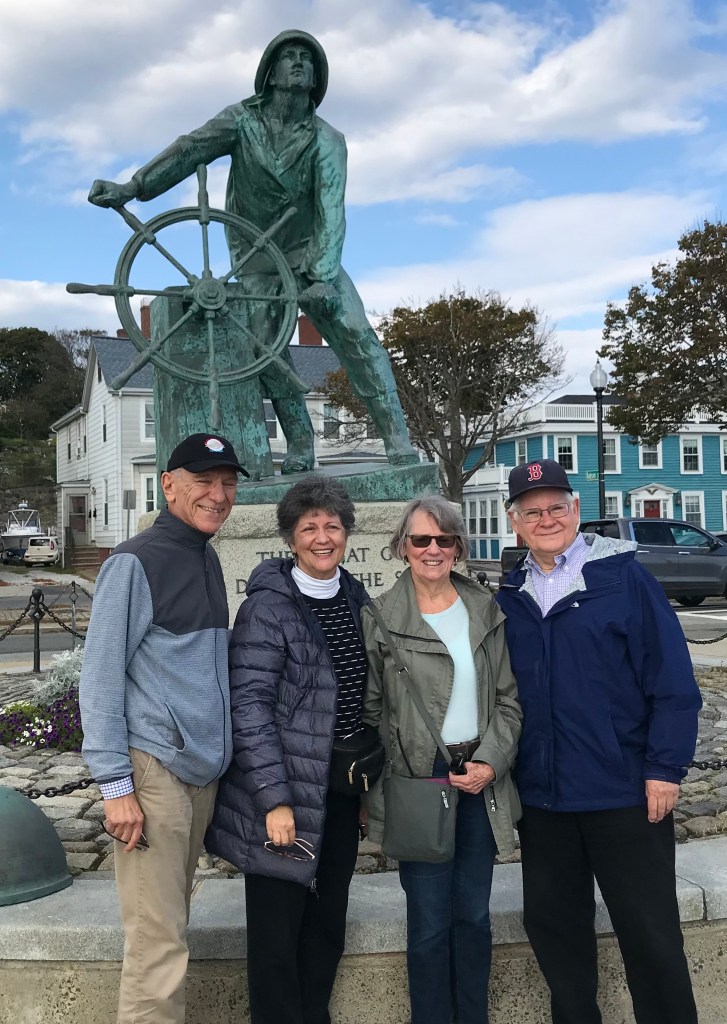
We spent some time touring the downtown section of Gloucester afterwards, seeing some of the still standing structures that Edward Hopper had painted. We then drove a short distance to the waterfront and saw the iconic sculpture of a Gloucester fisherman steering his craft out to sea.


Our Gloucester visit was capped by a late lunch at a fine Portuguese-Azorean restaurant not far from downtown. It was a memorable seafood meal for me, with a delicious halibut filet cooked and served with small, buttery potatoes in a tomato sauce within a small cast iron pan. The skies were still clear for our drive back to Portsmouth, with a slight detour through the picturesque town of Ipswich, MA.

Thursday, 10/12

Another delightful day. The mild fall weather continued with clear skies and temperatures in the low 60s. Once again Andrea and I had a lovely morning stroll along Sagamore Creek, taking in the acrobatic flight of the numerous gulls, enjoying the turning colors in the foliage, taking time to just sit and be quiet on a favored bench.  The serenity of the mornings helped us to better process the horrendous slaughter and deprivation that were simultaneously occurring in Israel and Gaza. Joan and Larry had joined us for some sobering conversations about those events since we arrived. As politically involved people, we were scouring the Boston Globe and New York Times daily in addition to evening news on CNN and MSNBC. The four of us were united in our sense of grief and outrage at Hamas’ original acts of terrorism, as well as a sense of empathy and protectiveness for innocent Palestinian civilians living in Gaza. We had taken in the fact that over 40% of the Gaza population were children, and were equally aghast at the high numbers of children reported killed or wounded by Israeli retaliatory bombings.

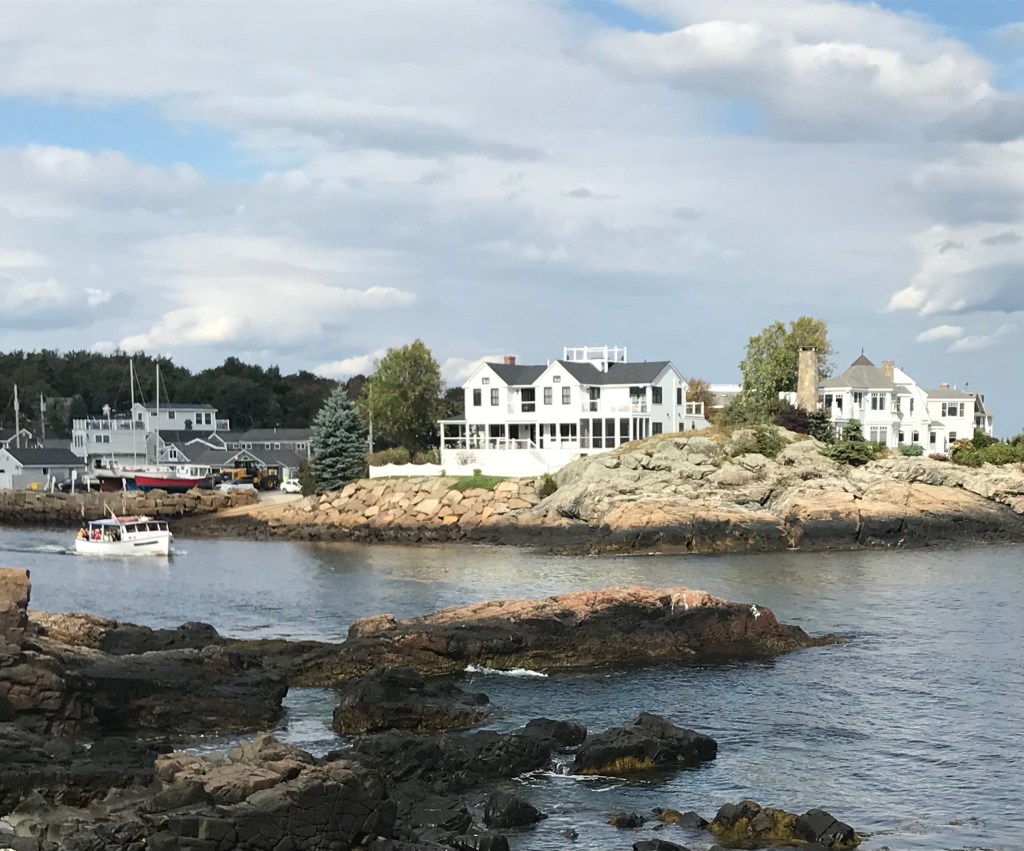
Our car excursion that afternoon was to the quaint little seaside town of Ogunquit, Maine – about 30 miles north of Portsmouth. The town had a reputation for its seaside beauty as well as an active arts and cultural scene. Our principal destination was its Museum of American Art, sitting on a rise above a rocky beach on the edge of town.

The relatively small museum itself is largely the creation of the painter and architect Henry Strater. Strater was at the center of a vibrant arts community in Ogunquit for many decades. He was also an art collector, and the museum is filled with works by a number of well-known 20th century American painters.

We drove into the heart of town for lunch after our museum explorations. Joan and Larry had a favorite seafood restaurant there, right on the water – Barnacle Billy’s. The food was once again memorably delicious and we also enjoyed watching the flight of cormorants, gulls, and even a blue heron, just outside the window.

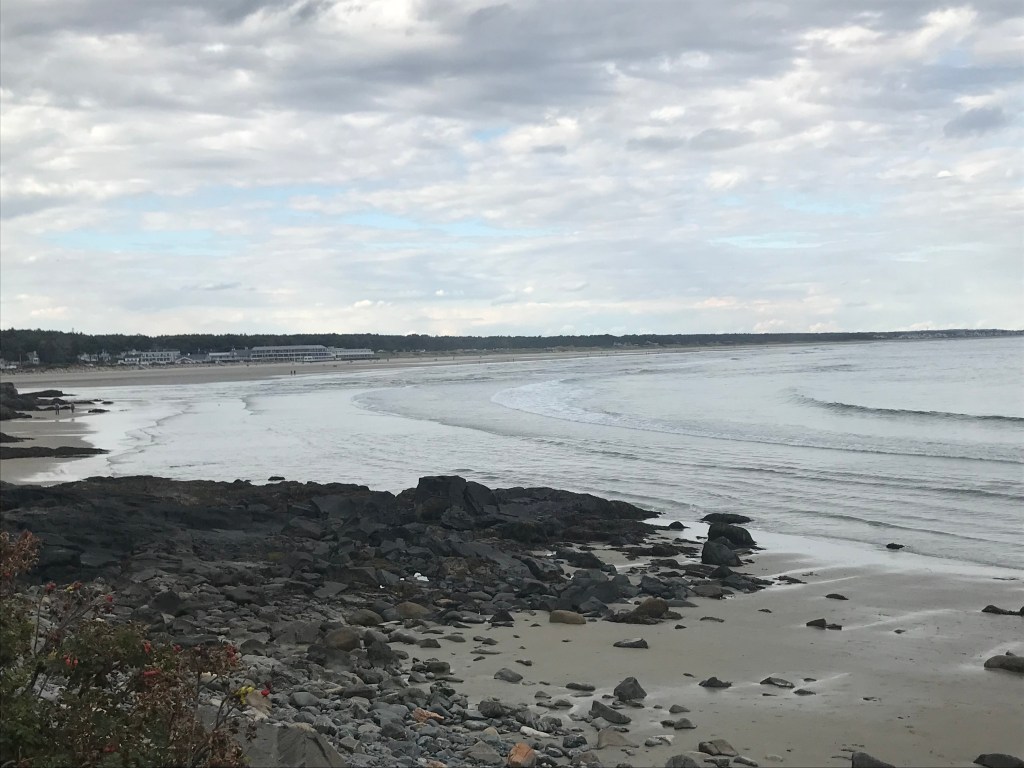
Afterwards, we went for a long stroll along the ocean on a paved path called the Marginal. The sea views were stunning, as the coast takes a dramatic curve at that point and we could see all the way to Kennebunkport, 12 miles up the coast. As the four of us were sitting together on a bench overlooking the ocean, two middle-aged men approached us with three dogs in tow. They excitedly told us that we were sitting on the very spot where they had exchanged wedding vows ten years earlier. We were happy to oblige their request for one of us to take their picture there.

Friday, 10/13

Our original plan had been to drive up into the mountains that day before Joan and Larry would drop us off in Manchester for our 5p flight.  But we were all bit weary and decided to make a last-day jaunt into historic downtown Portsmouth instead.

Our first stop was the downtown’s Visitor Center, which housed an exhibition of

“Portsmouth in 101 Objects” – various objects of art and/or utility as representations of the city’s 400 years of European settlement.  Portsmouth is filled with markers and mementos of revolutionary war battles and heroes. The exhibit included some objects from that era, but a great number of others from pre- and post-revolutionary war times as well. The Center also housed a small collection of colorful African American art, including one painting on wood called “There Is Still Hope”.

Walking from these exhibits, we came upon a sculpture court that was actually a memorial to African American deceased whose caskets were discovered recently at a downtown corner being excavated.

We had a delicious lunch at a classy little French restaurant, La Maison Navarre, on Congress St. as our farewell to Portsmouth. Later that afternoon, Larry drove us back over to Manchester Airport with full sunshine on the changing foliage. The three of us had a spirited interesting conversation about our shared experience as exchange students in our younger days.

This trip was definitely worthwhile, as much for the renewal of our friendships with Joan and Larry as for the new sights and shared experiences of our three full days together in New England.

John Bayerl, 10/15/2023

Three Homes

I drove down to Takoma Park last week for my monthly acupuncture session. Arriving just before 11am in “Old Town”, I parked in the metered lot and walked over to the office entrance on Carroll Ave. When I entered the code to get buzzed in, I waited longer than usual before my practitioner spoke in a surprised voice. I’d misunderstood our appointment time and would have to wait an hour. I agreed to wait and decided to take a walk around the neighborhood where I had lived for more than a decade. It was a clear, cool morning and I quickly accepted my mistake as an opportunity to visit some old haunts.

I made a plan to visit two of the houses where I had lived from 1983 to 1996. That was a mainly happy time in my life, when I had recovered from the collapse of my first marriage, established myself professionally, began a more stable and lasting relationship, and become a true-blue civic activist.

My first destination was 6733 “Little” Eastern Avenue, just a brief jaunt from Old Town. Eastern is the border street between DC and Maryland. “Little Eastern” is a one-block stretch on the Maryland side which runs along a long concrete abutment that separates it from the main strip.  As I approached my destination, I recalled the properties and the neighbors I had gotten to know back when I moved in with Andrea, my second spouse, in 1988, right after we had married. Andrea had bought a simple bungalow in 1979. By 1988, I was renting a house about a half-mile away and we decided that I would move in with her for the first years of our married life.

Andrea had taken justifiable pride in her house back then.  Given the price of real estate in the DC area, I had not even considered buying a house of my own while I was in my 30’s. Andrea had pulled it off because of her solid career in the labor movement and her commitment to saving.  She had a lovely English garden in the front of the house, and a rental apartment in the basement. While I was living with her there, we’d had a white picket fence built along the front sidewalk.

As I approached the house on foot from Old Town, I saw that the fence was gone and the small front yard overgrown. It had the same yellow siding, now quite faded, and the old wooden garage in the backyard looked dilapidated. Despite all that, the memories of our life together there were quite rich. It was a bright sunny morning. I was happy to have the opportunity to revisit the place on foot and inwardly reclaim an era in my life that was full of possibilities. Andrea and I both relished the neighborly simplicity of our life there, were active citizens in local affairs, and shared the Takoma Park political ethos of “think globally, act locally.”

My next destination was 6606 Cockerille Avenue, a small house I had rented from 1983-1988 after having moved to DC proper in 1981. It was a ten-minute walk from Andrea’s house, and I was really enjoying the stroll through the cozy old neighborhood where I had spent my prime adult years from age 33 to 47. I used to walk my dog along this route daily for many years before meeting Andrea, passing her house frequently. 

I walked Little Eastern to the end and turned left on Second Avenue, which took me to Cockerille, This part of town had been part of Prince Georges County, MD while I was living there.  It had been regarded as a poorer part of town before it was incorporated into Montgomery County, MD in the 1990’s. Takoma Park used to be regarded as one of the few affordable DC suburbs for people like me like me back in the 1980’s. But it was clear that “gentrification” had come to this area, apparent from the spiffed-up reconstruction of the many bungalows I was passing.

I didn’t even recognize the old rental house when I first approached it. Only its 6606 street-number sign in front identified it for me. I was taken with the handsome renewal of the old rental house I had inhabited for 5 years. It was here that my first marriage had ended and where I had painstakingly rebuilt a life for myself before meeting Andrea three years later. The house had served me well for those years and I felt grateful for it as I stopped to take it in.

The hot sun was evoking sweat as I made my way back to Old Town via Westmoreland Ave. I noticed at least half a dozen yard signs with slogans printed in different colors. I had seen signs like this before, but never in such abundance. They articulated for me the essential ethos of the Takoma Park counter-cultural community, past and present.

Arriving back where I started, I had a very relaxing and restorative treatment from my trusted acupuncturist of more than a decade. It was well worth the wait. The treatment was a pre-autumn “tune-up”, involving about 15 tiny needles in the back of my body, a long pause, and another set of needles in the front. I don’t fully understand the efficacy of acupuncture, but I always receive its benefits. My acupuncturist had me rest in silence after both the back and front treatments. During that silent time, I dropped into a very quiet place inside. It was a state of sustained inner peace and wellbeing felt throughout my entire body. As I walked to my car afterwards, I felt that the treatment had brought me to a place of fuller habitation of my entire body.

My last stop on my house visiting exploration that day required driving about a mile out of town just over the Takoma Park City line and into neighboring Silver Spring. Andrea and I had actively searched together to find a suitable new home for ourselves after 8 good years together at Little Eastern. We were excited to find this 3-bedroom, custom-designed, single-story, flat-roofed house in a park-like location near Sligo Creek, 8001 Boulder Lane. It had felt good for me to become a real co-owner of that home, albeit using the large equity from Andrea’s first home to secure the mortgage.

We moved there in 1996 after selling the Little Eastern house to a young couple. We were both enthralled with the nine-foot ceilings and the twelve-foot floor to ceiling “picture window” that met the eye on entering the front door.  We agreed that it would be a great home to grow old in…as well as to possibly accommodate some adopted children.

And two years later, in 1998, the two adopted children arrived with us on Boulder Lane after us having spent almost six weeks together during the adoption process in Sao Paolo, Brazil.  The house then took on a whole new dimension as home to a newly created family of four. The Boulder Lane home was big enough to hold us all comfortably. It was close to some of the best public schools in the area, which our new 8-year-old son and 11-year-old daughter made almost immediate use of. We had three good years of family life in that that home, overcoming a host of challenges, before deciding to move to the outer suburbs of Maryland to be closer to members of our spiritual community.

Taking that little house pilgrimage this week put me into a mellow mood, a peaceful and happy state of mind. Visiting the three houses had awakened many dormant memories, not all of them entirely inspiring. Yet the basic sense of wellbeing I am carrying in my present life allowed me to “take what I liked and leave the rest” from those old memories. Each of the three houses had become a veritable home. The feeling that won out is gratitude.

John Bayerl, 9/18/2023

Six Pillars of “Bidenomics”

FILE PHOTO: U.S. President Joe Biden and Vice President Kamala Harris stand on stage together after delivering remarks at the DNC 2023 Winter Meeting in Philadelphia, Pennsylvania, U.S., February 3, 2023. REUTERS/Elizabeth Frantz

(NOTE: This is an extract and summary of a recent article in The Washington Post Business section by Jeff Stein — August 20, 2023; p. G5. I’m posting this here because I find it disturbing that President Biden’s stellar performance on economic matters is largely unacknowledged.)

President Biden has defined his economic program (“Bidenomics”) as encompassing all that is good in the U.S. economy:  falling unemployment, robust wage growth, new small business creation. He says that “Bidenomics” is just another way of saying, “Restoring the American Dream.” The president professes to “growing the economy from the bottom up and from the middle out”.

Since taking office, the president has pushed through dozens of changes and personnel appointments that have upended everything from how workers unionize to how large corporations merge. His administration has helped to revive domestic manufacturing through a clean energy boom. His plan to expand the federal safety net has had some mixed success.

In a nutshell, Bidenomics means having the federal government intervening in the economy much more than has been done in decades. Economists say that Biden has already surpassed both Presidents Obama and Clinton in this regard. His administration has embarked on an ambitious program to boost labor unions and block corporate monopolies while spurring economic and industrial growth to new levels.

Here are six pillars of Bidenomics (and how they are faring):

1. Running the economy hot

2. Evening the playing field so labor unions can grow stronger

3. Reviving domestic manufacturing in key areas

4. Reining in corporate power

5. Expanding the safety net

6. Prioritizing national interests and domestic labor over consumerism and globalization in world trade policy. (NB: I added this sixth pillar based on the lead story in The Washington Post by David Lynch, August 27, 2023, p. A1).

Pillar 1. Running the economy hot

Biden’s first major economic triumph was signing the America Rescue Plan Act of 2021. It represented a $1.9 trillion economic stimulus to push the country forward after the years-long ravages of the Covid pandemic. Biden said he had learned from the early days of the Obama administration that: “the biggest risk is not going too big …it’s if we go to small”.

That one act spurred the fastest growing U.S. economy in many decades. GDP surged to 6% for the first time since the 1980’s. Unemployment rates dropped dramatically, and the number of small business creations soared. We are still reaping the fruits of that initial infusion of communal capital. When inflation began to rise steeply in the following year, skeptics like Larry Summers said that Biden had over-reached with his stimulus. But after Summers’ predicted rise in inflation over an entire year, that rate slowly but steadily started coming down.

After the American Rescue Plan, a massive infrastructure and climate technology initiative added to the economy’s “heating”, but inflationary fires predicted by skeptics have still not yet re-ignited.

Pillar 2. Evening the playing field so labor unions can grow stronger

President Biden has publicly vowed to be “the most pro-union president in history.”  Vice President Kamala Harris says that Biden immediately succeeded in fulfilling that vow with the American Rescue plan, which unleashed a surge in employment. These numbers gave Labor greater power at the bargaining table and brought about long-awaited increases in wages and benefits. Other ways that the Biden administration has strengthened organized labor are:

  • Appointing staunch union allies to the Labor Department and National Labor Relations Board (NLRB)
  • Tying infrastructure grants and other federal funds to companies having unionized labor
  • Meeting publicly with labor leaders trying to unionize their workplaces, including Starbucks and Amazon
  • Encouraging the NLRB to enforce pro-labor rulings, such as forbidding retaliatory firings, tougher penalties on firms that violate labor laws, and banning the practice of requiring all workers to attend anti-union meetings.

Pillar 3. Reviving domestic manufacturing in key areas

Biden has signed sweeping investment laws that are reviving key U.S. industries: semiconductor manufacturing, essential infrastructure, and green energy.

All these growth areas have the potential to address the climate crisis. And the legislation has already helped to ameliorate blockages in supply chains that had restrained further growth.

In fact, all the passed legislation has an additional goal of restoring essential product supply chains in the United States. This is accomplished with a mixture of new tax incentives, trade restrictions, and domestic subsidies.

The Treasury Department is reporting that investment spending in U.S. manufacturing technology has exploded since Bidenomic legislation took effect.

Pillar 4. Reining in corporate power

President Biden has a core plan of muting some of the power of large corporations. This has manifested in trying to break down monopolies, in challenging large-scale corporate mergers, and in cracking down on corporations’ “junk fees”.

Biden has met opposition in Congress but has succeeded in meeting these goals via his selection of Lina Khan to lead the Federal Trade Commission. Khan has driven the FTC to be far more aggressive in blocking large corporate mergers. In fact, the number of merger notifications dropped about 40% since Ms. Khan took the helm. Business leaders seeking mergers report a “chilling effect” of the FTC’s newly found backbone.

The administration’s actions to control “junk fees” have enjoyed strong consumer support. Many of us suffer from the obtuseness of airline billing, mega-fees on credit cards, and the opaqueness of cable company fees and services.

Pillar 5. Expanding the safety net

The president’s initial “Build Back Better” initiative called for the largest expansion of social programs since the 1960s. It included generous child-care benefits, increased housing subsidies for the poor, and new dental benefits for seniors. Unfortunately, Sen. Joe Manchin refused to go along with his Democratic colleagues and prevented these large-scale initiatives from moving forward.

The American Rescue Plan continued to provide Covid-era subsidies to the poor and unemployed, but those have now largely expired. Food stamp payments have plummeted, and the ranks of Medicaid recipients have dropped dramatically.

Biden has taken a number of actions to foster healthcare, including a new cap on insulin costs, a plan to lower drug costs for all Medicare recipients, and bigger subsidies for people using the Affordable Care Act’s exchanges.

The President’s initial effort to cancel student debt was blocked in the Supreme Court, but he has been more successful with some smaller-scale Department of Education loan forgiveness programs.

A key item on the progressive agenda is to restore the Child Tax Credit enacted during Covid. That law allowed many millions of American families to emerge from dire poverty. Biden is a strong supporter of it.

Pillar 6. Prioritizing national interests and domestic labor over consumerism and globalization in world trade policy. (NB: I added this sixth pillar based on the lead story in The Washington Post by David Lynch, August 27, 2023, p. A1).

Many economists were surprised when President Biden let stand many of the significant tariffs that President Trump had imposed. Biden has broken with President Clinton and President Obama in his desire to downplay globalization and focus more on U.S. manufacturing and labor interests. He has blended a “tough-on-China” stance with lavish federal subsidies for favored domestic industries. Unlike Trump though, Biden continues to be a force for multi-lateral agreements in world trade, including international agreements on aluminum and steel pricing, and strong support for an Indo-Pacific Economic Framework for Prosperity (IPEF).

Summary.  It’s clear that President Biden has brought about a most respectable economic program that has already reaped many benefits for citizens of all economic backgrounds. If the state of the economy is a primary indicator of strength for an incumbent, the president is in a strong position to claim the mantle of economic mastery.

John Bayerl, August 26, 2023

Therapeutic Recreation

My favorite outdoor swimming pool is the Upper County facility in the Washington Grove area of Montgomery County, Maryland. It’s a public pool operated by the county’s Recreation Department and is open from Memorial Day to Labor Day. An ongoing summer delight is swimming laps in the facility’s well-maintained lap-and-diving pool. Swimming has become my “goto” form of regular exercise, and swimming outdoors is particularly delightful.

Today I got to experience Upper County in a whole new way. Andrea and I decided to take our two young grandchildren there on a hot, sunny afternoon. In addition to the lap pool, the facility has a large family pool, with a ramped entry for easy access by kids.

Our grandkids, Hailey almost 6, and Junior 4, were excited to be joining us for the outing. They had their suits on when we picked them up. Our daughter had packed a bag with their towels, water bottles, and a change of clothes.

Arriving at the pool around 1pm, it was already more crowded than usual. One of the pool’s attractions is that it’s often underused. But today there were a few minibuses parked out front, indicating that some kids’ summer camps were using the facility.

We paid the fees and entered, finding a shaded spot on the far side of the pools where we could set our chairs and leave our belongings. The kids were excited to be there and eager to enter the family pool, but Andrea made them wait while she applied generous amounts of sunblock. The sun was full and hot, and she wanted to ensure that none of us got burned.

The kids were eager to get in and join the dozens of other kids frolicking in the water. We soon realized that most of the kids were in the county’s Therapeutic Recreation program, guarded over by young adult counselors dressed in red and yellow t-shirts. It became apparent that these were “special needs” kids, and it was touching to see how carefully the counselors were looking after their charges. Our grandkids seemed completely at ease and splashed and played with everyone they encountered. These included a number of kids with various physical disabilities, a few with Downs Syndrome, and a number of others apparently on the autism spectrum.

The good time that everyone was having was contagious. The grandkids splashed and swam to their hearts’ content. The young adult counselors, whose colored shirts all bore a “Therapeutic Recreation” insignia, seemed to be enjoying themselves as well, interacting good-naturedly with everyone, including our grandkids, who they introduced to some of the others.

Our granddaughter challenged me to see who could hold their breath underwater the longest. I was amazed that she could hold her breath as long as she could. She also reminded me how to play “Truth or Dare” and we had fun testing each other’s knowledge and daring each to do something new and challenging.

After about an hour, Andrea rounded us all up to have some snacks in the shade of the nearby trees. The 4-year-old was shivering yet cried that he didn’t want to get out of the pool, but Andrea seduced him with the promise of strawberries. After eating our fruit and nuts, everyone was ready to return for another hour in the water.

The pool featured a large cyclical water slide that was getting full use. Andrea had earlier asked our granddaughter if she wanted to try it, but Hailey looked up and declined in fear. But now she was eager to give it a try. Andrea took her over to the ascending stairs where a height indicator showed that she was just tall enough to use the slide. She bravely ascended the stairs about 50 feet to the top, where a lifeguard was controlling the spacing between descents. Another lifeguard at the bottom would give an ok signal when the previous slider had completed the course by dropping into the pool below. We watched a bit nervously as Hailey launched herself downwards. We could hear her screaming loudly as she descended, unseen, until she came rushing down into the pool below, ecstatic with excitement. She immediately wanted to do it again…and again and again, until it was 3pm and the pool was closed for an hour recess.

We all happily went to the respective men and women’s locker rooms to change for the drive home. Andrea and I had intimated one last surprise, which had them guessing in the car what it could be. Finally, we stopped at a local ice cream stand as the kids squealed with delight. I kiddingly urged that we get broccoli ice cream. They groaned and opted for chocolate and vanilla, but I let them have a slurp of my “broccoli ice cream” (green colored mint chocolate) which they thought was pretty good.

John Bayerl, 8/18/2023

A Battle of Good and Evil


Last week, Andrea and I attended a memorable production of Gounod’s “Faust” at the Wolf Trap Summer Opera in Vienna, VA.

I had bonded with this opera after attending performances of it at the New York City Opera in Lincoln Center back in my Fordham years (late 1960’s). That had been a widely acclaimed production. I attended its opening night in standing-room and was emotionally affected by both the story and music, returning to see it three more times. More than fifty years later, when I saw that it was being performed close to home, I jumped at the chance to experience it once again.

The Wolf Trap production was inspiring. It really brought to life Goethe’s version of the legend of Dr. Faust — an aging, despairing intellectual who, in a moment of utter spiritual darkness, invokes the forces of evil. To his surprise, an enterprising devil responds, appearing in the form of the depraved spirit, Mephistopheles, who offers Faust anything he wants in the physical universe in exchange for his complete spiritual submission in the afterlife. Faust is uninterested in the offered temptations of money or power, craving only a return to his youthful body and opportunities to find love and passion with women, something he’s never experienced. After Faust signs an agreement, Mephistopheles grants him his request, and relishes the spiritual capture of this fallen soul.

Mephistopheles immediately arranges a seduction for his new protege. The victim is a lovely, innocent young woman, Marguerite. She coldly rejects Faust’s initial overtures but is eventually won over by his lyrically expressed passion for her. Faust sings his passion with great warmth and beauty. Mephistopheles works behind the scenes to further tempt Marguerite with fabulous jewelry. In a scene of touching human passion, she finally succumbs to Faust, admitting him to her room.

Any remaining sympathy for the dashing, young Faust disappears when he quickly abandons Marguerite after impregnating her. He later returns to her, filled with remorse. His efforts to make amends are too late, however. Marguerite has succumbed to shame and guilt for her romantic surrender. She is also shunned by her friends and the Catholic Church to which she had been deeply devoted. In her desperation, she murders her infant and contemplates her own suicide.

But she then remembers the spiritual devotion she once had and ventures out to a nearby church. There she confesses her sin and begs God for mercy. But Mephistopheles arrives in thundering fashion to proclaim her crime and the everlasting damnation of her soul. As with Faust, he cravenly feeds on his domination over his fallen victims.

The real drama of the opera lies in this spiritual encounter between Marguerite and the devil. Mephistopheles is so brazen and so powerful in his vocal domination as to appear invincible. But as a church choir also sings out strongly, they are joined by a chorus of angelic voices. This slowly turns the tide against Mephistopheles, with Marguerita adding her beautiful soprano voice to the human and angelic choirs.  She dies ecstatically, within the loving embrace of the forces of the Light, as Mephistopheles slouches away in defeat.

A comprehensive musical review of this “Faust” performance by the Washington Post’s superb classical music critic, Michael Andor Brodeur, is available via the link below.

Wolf Trap’s ‘Faust’ brings a hard bargain to the Big Easy – The Washington Post

My lasting impression of the opera is very much an emotional and spiritual one.

The English poet John Milton is well known for his depiction of Satan as a most cunning and ruthless adversary. As such, Satan’s persona towers over Adam and even Christ in Milton’s epic poem, Paradise Lost. Similarly, Gounod’s Mephistopheles regularly steals the show – his music and words are often charming and urbanely funny. He has a deep understanding of the foibles of humanity and knows exactly how to tempt his victims at their weakest point.

His aria in the final act of the opera paints a picture in which the forces of darkness are obliterating the seemingly paltry goodness of Marguerite and her ilk of “do gooders”. It’s downright chilling to witness. Think of the Nazis winning WW2 and Hitler presiding for decades, with his bestial Third Reich imposing its evil domination over the entire world. That’s the feeling I had as Mephistopheles touted his dominance.

And yet, the forces of the Light rise up to meet this devil, and in a dramatic musical battle, finally overcome the Darkness as Marguerite finds her ultimate salvation.

There’s a Brazilian hymn by Alex Polari de Alverga that I’ve long taken inspiration from. A rough translation is:

“That which comes to test evil

Also comes to test goodness.

God allows evil

To see what we’re made of.

Those words came to mind as I was digesting the thrilling performance of “Faust”. It led me to remember the supreme effort it took for the Allies in WW2 to overcome the dark forces of fascism, or closer to home, the valiant efforts of the Ukrainian people to overcome Putin’s brutal onslaught.

Marguerite wins her salvation by rising up to meet her devilish opponent, literally singing her heart out to overcome the steely treachery of Satan.

John Bayerl, 8/5/2023

A Memorable Massage

I had a memorable full body massage for my birthday last week while Andrea and I were vacationing with my family near Lake George, NY. Here’s what I wrote about it afterwards.

A relaxing massage from “Angie” at a Spa on Rt. 9 heading south into Queensbury. She was about 5’6” with a strong frame, a pretty but somewhat rugged face, and a sweet expressive smile. She had recently finished a session with Andrea, who looked totally relaxed when she emerged from the therapy room. As I stripped down to my underpants and got face-down onto the warm table and under the cover, I was ready to receive an “experience” of body and mind. Andrea was offering the experience to me as a birthday gift, and I was more than happy to receive it fro.

When Angie entered the room, she asked about any areas of concern. I noted my right hip and lower back but said I was receiving regular acupuncture for it and didn’t really want any deep work that elicited a lot of pain. She took that in and said she’d proceed with a Swedish full body massage.

She started with some gentle stroking of my shoulders and neck. Her hands were warm, soft, yet strong. I sensed her feminine athletic presence, capable of working her hands in fluid, stroking motions that were most welcoming. Her steady, even manner also elicited a sense of a very good, “hands on” mother, willing to extend her full attention and energy for an entire hour.

There was a deeply sensuous quality to this massage. It never became overtly sexual, but the pleasurable physical sensations were ones that I habitually associated with sex. I was able to let go of these overtly sexual associations and instead embrace more and more fully the purely sensual splendor.

Living in a 74 YO frame with osteoarthritis and degenerative disk disorder, my body is well experienced in dealing with many hours of physical discomfort every day. On many days, just getting up out of bed is a process requiring full attention and patience. On the table in Angie’s massage room, I was able to move from low level pain to high level, sensual pleasure. It took about half of the session for me to reach that point. Once I did, the feeling of Angies’s soft yet strong undulating hands was absolutely delicious. To actually take pleasure in physical sensation was such a gift.

The playlist for the massage was high quality “spa music” which quickly achieved the desired effect of allowing me to relax into a gentle mindset. There was Native American flute music, Enya-like folk tunes, and the like. One piece that elicited an emotional response in me was an instrumental version of Leonard Cohen’s “Alleluia”.

Angie gave terrific foot massages on both sides. Her work on my back and shoulders elicited frequent skeletal pops from my vertebrae as well as my ribcage. Angie chuckled with each pop. Towards the end, she offered a full cranial massage, which felt utterly delightful. It felt wonderful to experience my brain as another bodily organ that could be massaged into a physically pleasurable state.

I left the session feeling utterly relaxed, happy to fully inhabit my body, and relishing the warm sunlight as we stepped outside.

In Honor of Juneteenth

NOTE: In the spirit of today’s national holiday, I took some time to dip my feet into historian Jon Meacham’s masterful new biography of President Lincoln: “And There Was Light — Abraham Lincoln and the American Struggle”. Meecham’s Prologue has dispelled an old belief of mine that emancipation was the inevitable result of the American Civil War. I thought to post it here as a reminder of the true significance of the crusade to abolish enslavement via the Emancipation Proclamation of 1863 and the Thirteenth Amendment to the Constitution in December 1865, finally moving our country towards universal implementation of one of our most cherished ideals: that all human beings are created equal.

Emancipation was not foreordained. The closest parallel to the American experience with ending slavery, that of the British Empire in the 1830’s, was a story of gradual, compensated emancipation.

The compensation was paid not to the enslaved but to the slaveholders, and the timing was not immediate but tiered. It is estimated that the sum, which underwrote the ultimate liberation of about eight hundred thousand enslaved people, was equal to 40 percent of Great Britain’s annual expenditure, and the instruments that financed abolition were not paid off until 2015 — a century and three quarters later.

Lincoln’s decision to seek total abolition for nearly four million people through a constitutional amendment was, in context, radical and revolutionary — and he risked not only his own reelection but the whole of the cause of Union to pursue it. Under pressure to rescind emancipation, Lincoln stood fast.

‘They tell me some want you to take back the Proclamation’, Hannah Johnson, the mother of a Black Union soldier, wrote Lincoln.

‘Don’t do it. When you are dead and in Heaven, in a thousand years that action of yours will make the Angels sing your praises.'”

John Bayerl

June 19, 2023