


Georges Braque, Still Life
Georges Braque, Still Life



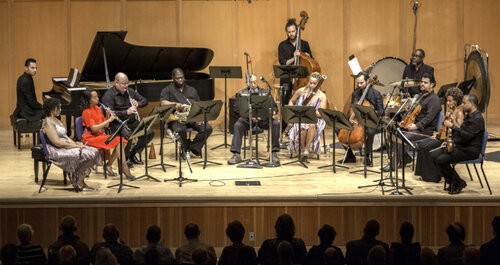
I attended a memorable concert this week in the intimate Terrace Theater of the Kennedy Center in DC. It was given by two primarily classical music chamber groups, the Imani Winds and the Harlem Quarter, joined by three talented jazz musicians and an “orator”, the well-known jazz music critic and prolific poet, A. B. Spellman.
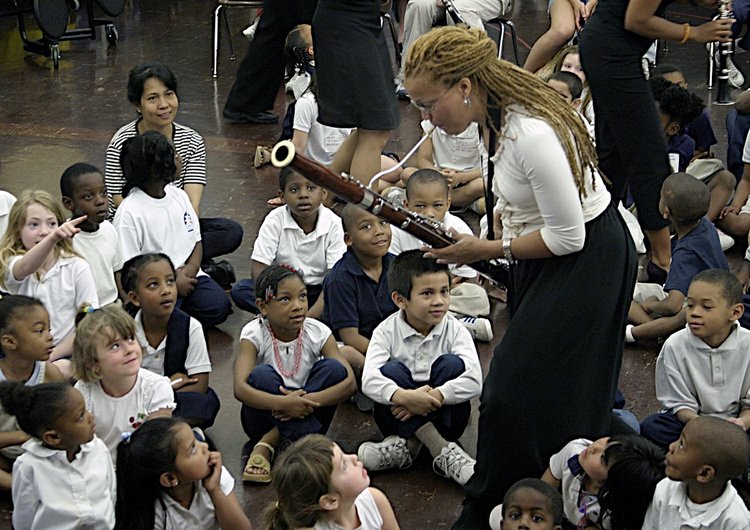
My spouse, Andrea Dilorenzo, had encountered the Imani Winds while she was working as a school therapist at a local public school many years ago. They are a classical woodwind quintet who were bringing their music to kids in disadvantaged communities in the DC area. Andrea introduced herself to the musicians back then and happily discovered that they were graduates of Oberlin College where she had graduated. When she read about their upcoming performance at the Kennedy Center, she was quick to buy us tickets.

Little did we anticipate the sublime experience ahead of us.
The concert consisted of one extended musical work, “Passion for Bach and Coltrane”, by the Oberlin music professor and composer Jeff Scott. The composition was inspired by a collection of poetry, “Things I Must Have Known”, by A. B. Spellman, the father of Mekhi Gladden, who is the oboist of Imani Winds.
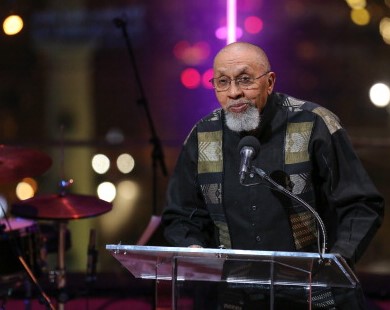
Scott’s work is a brilliant integration of Spellman’s spoken poetry together with classical and jazz music. Both the 5-piece Imani Winds (flute, oboe, clarinet, French horn, bassoon) and the Harlem Quartet (two violins, viola and cello) have outstanding reputations in the classical arena. They were joined by a talented jazz trio on piano, bass, and drums. A. B. Spellman himself, now 89 years old, was the “orator” for selected poems from “Things I Must Have Known”.
Another draw for us was the Harlem Quartet which we had traveled to Winchester, VA to hear in concert about 5 years ago at Shenandoah University. The lead violinist of the quarter is Ilmar Gavilan, a Cuban native who has a brother, Aldo, still living in Cuba, who is a first rate classical pianist. Andrea had seen a TV documentary about the two brothers and their cherished musical reunions both in Cuba and here. Aldo had joined the Harlem Quarter for an unforgettable performance of Schumann’s Piano Quintet at Shenandoah U.

Thursday’s concert was the second musical event that Andrea and I had attended at the Kennedy Center within the week after not having gone to one there in some years. We were pleased to be among the younger, racially mixed audience at the Terrace Theater after our usual experience of older, white audiences. We’d invited a younger friend to join us for the concert as well.
Over the years, I have written a number of concert reviews for my blog. Although I love music of all genres, I always find it challenging to attempt conveying the felt quality of a live musical experience. Part of my inspiration to write this came from the first poem recited by Spellman, “Dear John Coltrane”. In it, the poet describes a musical reverie induced by listening to diverse radio broadcasts in a hotel room late at night. Specifically, he writes of a sublime feeling while listening to the slow movement of a Bach keyboard concerto. Switching stations, he later hears a recording of the jazz legend John Coltrane playing solo saxophone on his own composition, “Slow Blues”. Again, the poet is transported to a transcendent inner state. He reflects on the commonality of feeling evoked by the two radically different musical forms used within the 17th-century baroque tradition and the free jazz form of the 1960’s. I’m including the full text of “Dear John Coltrane” as an appendix.)
The piece starts with Spellman reciting the first stanza of “Dear John Coltrane”. The musicians then come in with the melody and variations of Bach’s F minor concerto. The arrangement is such that each of the woodwind players has a chance to solo. The piano then comes in, followed by the quartet of strings. It was as interesting and beautiful arrangement and rendition of Bach’s well known melody as I’ve heard. Spellman then comes back in, reciting the second stanza of the poem, this one about listening to Coltrane’s “Slow Blues” and experiencing the same kind of fluid transcendence as he’d experienced listening to Bach. The words help to guide the audience into the ensuing musical piece in a languid way.
The next session is entitled “Psalm” and begins with Spellman reciting the poem “After Vallejo” (the Peruvian writer Cesar Vallejo is regarded as a tragic giant of 20th century poetry). It includes the poignant lines:
i’ll be writing when i go, revising another
hopeful survey of my life. i will die of nothing
that i did but of all that i did not do
i promised myself a better self
than I could make & i will not forgive
J. S.Bach composed two large choral works about the passion and death of Jesus Christ – the Saint John Passion and the Saint Mathew Passion. Composer Jeff Scott uses the double meaning of “passion” in his “Passion for Bach and Coltrane”, referring to Bach’s works as well as to the musical passion expressed by A.B. Spellman in his poetry. Two sections of Scott’s work use Spellman’s poems “Out of Nazareth, Pt. 1” and “Out of Nazareth, Pt. 2: Manual for a Crucifixion”. In the latter one, Spellman references a Roman manual on how best to enact the gruesome torture of a crucifixion. Spellman’s portrait of Jesus is as a highly compassionate and selfless man of God. The musical sections here reflect that spiritual purity and integrity, as well as the cynical barbarity perpetrated on him by the Romans.
The entire concert was about 90 minutes long, and the last third consisted of some high powered, driving jazz. The jazz trio provided the rhythmic framework for each of the musicians on stage to showcase their extraordinary improvisational skills. I sat in utter amazement at the sophisticated jazz riffs played by each of the classically trained musicians of the Imani Winds and the Harlem Quartet.
When the musical intensity became a bit challenging for me to stay with, a slower, bluesy interval brought in a welcome lyrical calm. Spellman read from his poem “Groovin’ Low” at that point:
my swing is more mellow
these days: not the hardbop drive
i used to roll but more of a cool
foxtrot. my eyes still close
when the rhythm locks; i’ve learned
to boogie with my feet on the floor
i’m still movin’, still groovin’
still fallin’ in love, but
i bop to the bass line now.
I happen to be 75 and do most of my bopping to the base line, too. My real amazement was that Spellman, at 89, could still speak with such passion, expression and volume.
The last section of the concert, “Acknowledgment”, is an extended recapitulation of major themes from John Coltrane’s magnum opus, “A Love Supreme”. It begins will Spellman reading his inspired lines of meditation on the nature of life, death and love: that the highest purpose of living is to love and be loved. he concert ends with everyone on stage chanting the words “A Love Supreme” over and over again, tapering off to a whisper.
There was a rousing standing ovation as the concert ended, and many rounds of applause for the individual musicians and for the whole ensemble. Jeff Scott was in the audience and was invited to come on stage to partake in the well deserved acclaim for these consummate musicians.
John Bayerl,11/24/2024
APPENDIX:
Dear John Coltrane
by A. B. Spellman

dead night has me writing poetry
in another hotel room. j.s. bach
is on the radio. the keyboard concerto
in f minor: the one you also hear
on oboe or violin, the largo
second movement begins
& the book in my hand drops
the room fades
& I put my reason down
to trail the bach of endless line
along this earthless path, each note full
& bright, a brilliant footprint on the dark
through beauty, past knowledge, into
the state that shines too much
to be wisdom, is too transparent
to be art. i catch a fear of that place
where he will lower me when
this transporting melody closes
then it closes on itself & here I am
dear john, back at the beginning, better

later, different station, cold room dimming
it’s you, john, trane’s slow blues
now it’s your line that opens, & opens
& opens, & i’m flying that way again
same sky, different moon, this midnight
globe that toned those now lost blue rooms
where things like jazz float the mind
this motion the still & airless propulsion
i know as inner flight. this view
the one I cannot see with my eyes
open. i hear the beginning approach, &
i know the line i traveled was a horizon
the circle of the world, another freedom
flight to another starting place
if I believed in heaven I would ask
if you & bach ever swap infinite fours
& jam the sound that light makes
going & coming, & if you exchange maps
to those exclusive clouds you travel thru
& do you give them names?
I just returned from a magnificent performance of the Washington National Opera’s “Macbeth” at the Kennedy Center. The music reviewer for the Washington Post wrote an excellent account of the many masterful elements of the production after it opened last week:
Dark powers guide dagger-sharp ‘Macbeth’ at Washington National Opera – The Washington Post
Rather than discuss the performance itself, I’d like to share some strong feelings that arose in me while watching it.
I first encountered Shakespeare’s classic play, “The Tragedie of Macbeth”, as a sophomore at my Catholic boys’ high school in Buffalo, NY. My English teacher, Rev. Claude Bicheler, had us read much of it aloud in class, stopping frequently to explain some of the arcane Elizabethan English. Rev. Claude was an avid theatergoer and also the director and producer for all our school plays and musicals. He had a way of making the story of Macbeth come to life and encouraged us to persevere even when we were feeling lost. Like many, I was most taken with the scenes of the witches who foresaw and steered the infamous, homicidal direction of Macbeth’s thirst for power.

I had seen some stage versions of the play later in life. I appreciated the keen psychological rendering of the character Macbeth and Lady Macbeth given by Shakespeare, but never felt deeply affected by the story. It all seemed a bit melodramatic to me.
I became an opera fan during my college years (1967-1971) at Fordham University in the Bronx. A friend in my dormitory would listen to the live radio broadcasts of the Metropolitan Opera on Saturday afternoons. I overheard the music and asked him about his interest in opera. He invited me to join him the following Saturday to listen to something called “The Barber of Seville”. He had a copy of the libretto (text) of the opera, and he helped me follow along as we listened to the live singing. My friend was a native New Yorker who had been attending live opera performances at the Met and the New York City Opera for many years. His enthusiasm was contagious. And being able to closely follow the story line of the opera while listening to the Met broadcast drew me in. My friend regularly attended both of the opera theaters at Lincoln Center in midtown Manhattan and I started to accompany him. I was soon hooked.
The nineteenth century Italian Giuseppe Verdi is a giant among opera composers. Over the years, I had listened to recordings and attended performances of many of his most famous operas, including: La Traviata, Il Trovatore, Rigoletto, Aida, Don Carlo, Otello, Nabucco, La Forza del Destino, and Simon Boccanegra.
When I met and married my spouse, Andrea DiLorenzo, in the mid 1980’s, one of the strong common passions we shared was for music of all genres, but opera in particular. We’ve attended dozens of operas together over the years in venues including the Kennedy Center Opera House in DC, the Wolf Trap Summer Opera, the Met in New York, the Pittsburgh Opera, the Charlottesville Opera, Covent Garden in London, and the Mexico City Opera. It became a tradition for us to get opera tickets for Andrea’s birthday every year, and it just so happened that “Macbeth” was being performed in November, her birthday month. We got the tickets some months ago and were eagerly anticipating the performance, which we’d be attending with another couple.
Neither of us had ever encountered Verdi’s “Macbeth”, which is an earlier work of the composer and not often performed. I had learned from my Fordham dorm-mate the importance of becoming familiar with an opera before attending. So a few weeks ago, I began listening to a recording of the opera via a streaming service, following along with a libretto that I easily downloaded.
The story of “Macbeth” is dark and menacing. It’s about a Scottish warrior and his wife, Lady Macbeth, who become addicted to political power by any means necessary. The witches provide a dark supernatural element, a kind of black magic, which convinces Macbeth that he can rise to kingship by killing off the king himself and all potential rivals. He does so in a cold, calculated way and soon gets the coveted kingship. Lady Macbeth eggs him on, scorning her husband at any sign of hesitation. Eventually, their heinous crimes, which include the murder of innocent women and children of their rivals, begin to take a toll on their psychological wellbeing. They both start drifting into a guilt-ridden madness. Lady Macbeth commits suicide, and Lord Macbeth throws himself into one final battle against the king of England’s army and is fully vanquished by Macduff, a former aide whose entire family was murdered by Macbeth’s minions. Macbeth’s last aria laments that he is utterly alone in death, unloved, even hated by his people.

The part of the opera that most moved me this afternoon was a choral piece about the suffering and oppression suffered by the Scottish people during Macbeth’s short, bloody reign. It is called “Patria Oppressa” (Oppressed Homeland) and laments the dire suffering of so many victims of Macbeth’s onslaughts. A translation is as follows:
Oppressed homeland of ours!
You can no longer have the sweet name of Mother
Now that you’ve become a tomb for our sons and daughters.
From the orphans, from those who mourn for husbands and children
A cry of outrage goes up to heaven at each new dawn.
To that cry heaven replies, moved by pity for the oppressed land,
And proclaims our grief forever.
The bell tolls constantly for death,
But no one is so bold to even shed a vain tear
For the suffering and the dying.
The “Patria Oppressa” chorus affected me so deeply because I was still feeling traumatized in the aftermath of the American presidential election last week. I was anticipating a great deal of chaos and suffering that this chorus gave voice to.
Throughout the unrelenting treachery and deceit of the Macbeth story as sung so masterfully by the outstanding singers, I’d been feeling queasy inside, as if the opera was depicting a kind of political dystopia that I feared our country had already entered. The chorus also evoked in me an identification with the peoples around the world suffering under the weight of violent oppression in the Ukraine, Palestine, Lebanon and elsewhere.
In the case of the American election, I realize that the oppression I was anticipating was brought about by the American electorate. In some ways, that realization made the situation even more painful.
When Verdi revised “Macbeth” for a new production in Paris in 1867, he added a number of important elements that remain in the version that has been used since then. In Shakespeare’s tragedy, the play ends with Macbeth’s last words after having been mortally slain: “I sink – my soul is lost forever.” But in 1867, Verdi added a final chorus that followed the death scene. It is the rousing “Inno da Victoria” (Hymn of Victory) which celebrates the death of a tyrant and gives glory to the liberators:
Victory! Victory!
Where is Macbeth?
Where is the usurper?
The God of Victory has struck him down with a breath.
He (Macduff) is a valiant hero who killed the traitor.
He has saved our homeland and our king.
Honor and glory to him!
Our gratitude rises to the great God of vindication!
Let us sing hymns of glory!
The new dawn will bring us peace and glory!”

I was relieved to vicariously experience the victory so triumphantly celebrated as the opera ends. Verdi himself was emphatically committed to the cause of Italian independence during his lifetime. Many of his other operas have hidden allusions to that quest as well. When Italy finally did achieve independence, Verdi was elected and served for four years in the first Italian legislative body.
Andrea and I have been active politically since the 2016 presidential election. We have formed two political groups since then, both of them meeting monthly, both committed to sustaining a strong democracy. We were heartbroken that Kamala Harris failed to convince enough voters to elect her, despite a high energy campaign, and her winning persona.
Many of us are justifiably wary of the kinds of oppression that the current president-elect is capable of. Watching the masterful production of Macbeth yesterday elicited some of my darkest fears of what’s in store for our country over the next four years. But Verdi’s triumphant closing statement, a Hymn to Victory, served to buttress an underlying belief that all is not lost, and that the forces of Good will ultimately prevail. As the story of Macbeth shows, the forces of evil often sow the seeds for their own ultimate destruction.
John Bayerl, 11/17/2024
March 13,1956 — September 24, 2024
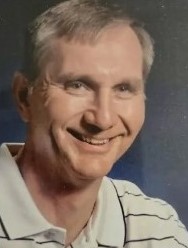
My younger brother Tom died two weeks ago at his home outside of Buffalo in Elma, NY. Tom had been seriously ill with Lewy Body Dementia (LBD) and had been in home hospice care for almost a year. His wife Karen was a devoted and loving caregiver for Tom since the onset of his symptoms over five years ago. Their three adult children, Michael, Greg, and Kristen lived close enough to help out, but the brunt of Tom’s 24-7 care rested on Karen and his devoted healthcare aides.
Origins
Tom was the 6th of 10 children born to our parents, Irene and Joseph Bayerl, both lifelong residents of Buffalo, NY. There were 5 girls and 5 boys in our Baby Boomer brood, whose birth-years extend from 1947 to 1964.
I was the second oldest (born 1949) and remember some of the circumstances of Tom’s birth. Our family of five kids had moved into our own house the year before after spending the preceding years in a small flat above our mother’s parents’ home just two blocks away. I was almost 7 years old when Mom was pregnant with Tom, and I well remember Mom being rushed to the hospital to have her appendix removed while she was well into that pregnancy. I remember whispered fears from the adults that our mother might lose the baby. But mother and child survived, and Tom proved to be a healthy, happy baby. Children weren’t allowed to visit in hospitals back then, but I recall our Dad packing us all into the family car one evening and parking outside our Mom’s hospital room so she could come to the window and wave to us with little Tom in her arms.
Tom followed the same initial educational track as his older sibs: a year of kindergarten at nearby P.S. 43 followed by eight years at Visitation Parochial school, just two blocks from home. We were taught by an order of nuns called “The Little Servant Sisters of the Immaculate Conception.” The nuns brooked little tolerance for misbehavior, and most of us recall at least one episode of being slapped on open palms by a ruler-wielding nun. Like the rest of us, Tom was a smart, mostly well-behaved student, graduating from “Vis” in 1969 and then attending two different boys’ Catholic high schools.

High School Basketball Star
I had left home in 1967 to attend Fordham University, a Jesuit run institution in the Bronx. But I kept up on Tom’s, and his next older brother Larry’s, high school athletic prowess during those years. Tom became a star basketball player on a championship team at St. Francis High School while Larry starred in football at Bishop Ryan High. My older brother Martie had gotten the ball rolling in the athletic direction by starring in football at Bishop Turner High School, where we had both attended. I liked to play sports too, but my own athletic abilities were limited, and I ultimately chose to focus on academics. I was always proud of my brothers’ athletic accomplishments.
I can’t say that I had much influence on Tom as he came into his own as a student-athlete in his high school years. I do remember, however, some pretty competitive games of one-on-one basketball we used to play in our backyard during my summers home from college. By his early teens, I could clearly see that Tom was going places with his smooth, artful basketball shooting and his aggressive defense.
Entering Adulthood
After graduating from Fordham in 1971, my own early adult life had some significant challenges of my own making. I floundered in my work life as well as my attempted relationships. Tom meanwhile was doing well at Buffalo State University, graduating in1976 and going on to marry his high school sweetheart, Karen Hojnacki, two years later. Tom and Karen were eminently compatible. They even shared the same birthday. They soon bought a house and started a family while I was still driving cab and taking sporadic graduate classes in American Studies at SUNY Buffalo.
I had little contact with Tom or the rest of my family for about a decade while I attempted to find a meaningful direction for myself in Savannah, Atlanta, and then Washington DC. The next real connection I remember occurred in 1986 when Tom and Karen hosted a big, outdoor 40th anniversary party for our parents in Buffalo. I had just gotten divorced and was ready to make a fresh start with my family of origin. I still remember Tom’s generous, playful spirit at that party, setting up horseshoes and other games for the kids, and interacting seamlessly with everyone. I truly admired Tom’s many virtues as a family man and realized I had things to learn from him.
My next significant connections with Tom occurred almost twenty years later. During that time, I had married my current spouse, Andrea DiLorenzo, and had entered into a period of personal and professional fulfillment. Andrea and I adopted two children in 1998, and I finally had the opportunity to become the kind of “family man” I admired in Tom.
Tom and I had always enjoyed an easy back and forth at the occasional family affairs I was able to attend back in Buffalo. When my sister Kathy lost her 19-year-old son Byron to muscular dystrophy in 2007, both Tom and I felt distraught and were able to share our grief together. That led to a regular phone relationship with Tom in which we were both able to share some of the challenges we were facing in our lives. I had studied to become a counselor and had learned how to listen attentively and compassionately, without judgment, and without the need to give direct advice. During those years of phone conversations, we were both able to open up about our ongoing struggles with depression.

Illness and Decline
Tom started manifesting disturbing physical and mental symptoms around the time of his retirement over five years ago. A lifelong athlete and still avid golfer, he was then finding himself regularly fatigued, debilitated, and mentally foggy. Karen quickly picked up on this and helped Tom on a long medical search for what was wrong. Clearly, this was beyond the garden-variety depression that we had both experienced. Tom began experiencing acute anxiety on a regular basis.
Tom and Karen had been loving, hands-on grandparents but his inability to sustain his energy and motivation now made this difficult. I remember a family vacation to Rocky Mountain National Park in 2019 in which Tom was not able to keep up. I remember his confessing to me how bad he felt about this, and about his guilt for occasional angry outbursts towards family members. Finally, some in-depth neurological testing came up with the Lewy Body Dementia diagnosis.
Very little was known about LBD until the suicide death of the actor Robin Williams in 2014 at age 63. Williams had been diagnosed with Parkinsons Disease (PD), but his wife Susan Schneider knew that the PD diagnosis didn’t explain the aberrant mental and emotional disturbances she was noticing. None of his doctors or therapists seemed to know exactly what the problem was. The diagnosis only came from an autopsy which revealed Lewy bodies infiltrating Williams’ entire brain stem. Lewy bodies are abnormal clumps of protein that gather in brain cells, and which are now thought to be responsible for 10-15% of dementia cases.
Ms. Schneider pursued the reason for her husband’s suicide partly because she wanted to protect him from the innuendos about Williams’ past drug addiction. Her persistent efforts to find out about LBD led to the creation of the 2018 HBO documentary film about Williams’ death called “Come Inside My Mind”. By telling the story of Robin Williams’ illness in detail, Schneider succeeded in creating a film that is now being recommended to all the families of patients suffering from LBD.
Last Years
I began making trips home to Buffalo to visit Tom shortly after the LBD diagnosis was given, and after watching the film “Come Inside My Mind”. The first of these visits was in March 2023 when Tom was still able to sit down to a marvelous breakfast Karen had prepared for a tableful of visiting family members. At that time Tom still had moments of clarity and recognition. But most of the time he was just staring out into space, his body semi-paralyzed. I visited again that December to find Tom spending the greater part of each day either in bed or laying back in a recliner. Karen had requested hospice care to help her to attend to Tom’s many physical needs. On that visit, I remember a few moments of eye contact with Tom and a feint smile.
In June of this year, Andrea and I drove to Buffalo to spend a day with Tom and Karen. Karen was firm in her wanting to keep Tom at home, even though she was getting worn down by the 24-7 nature of Tom’s required care. We were mightily impressed with the care and commitment being provided by Karen and also by two aides who Karen had employed to help her: Linda came in each morning to bathe and feed Tom, and Jim every morning and evening to get Tom in and out of bed. In addition, hospice was providing a weekly nursing visit and regular visits by a healthcare aide and a massage therapist. Karen was also very grateful for the significant assistance she was getting from all three of her adult children: Michael, Greg and Kristen.
Tom died peacefully in his sleep on September 25 after having stopped eating and drinking twelve days earlier.
Andrea and I have just returned from the funeral in Elma. There was a very beautiful Funeral Mass at their neighborhood Catholic Church followed by a brunch at a local restaurant. There was also a wake the night before, providing great opportunities to connect with family and friends and share stories about Tom’s life. The highlight was Tom and Karen’s eldest son, Michael, a public high school teacher, delivering a heartfelt eulogy for his father at the Funeral Mass. In it, Mike praised his Dad’s big heartedness, which manifested most strongly in his lifelong enthusiasm for sports and his love in sharing that enthusiasm with his wife, kids, grandkids and everyone else who knew him. It was the same quality I had admired in Tom at that anniversary party he and Karen had hosted for our parents so many years ago.
We love you, Brother Tom!
Rest in peace!
John Bayerl, 10/4/2024

Democracy Awakening is the latest book by the well-known American history professor and author, Heather Cox Richardson. Richardson has made a big name for herself of late by virtue of her online newsletter “Letters from an American” – the most popular site on the Substack site. I’ve been a subscriber for over six months and always look forward to Ms. Richardson’s cogent analyses of contemporary events in American politics. She always provides an accurate historical background for current events and is able to contextualize even the most convoluted political events of our time.
As this year’s presidential election season approached, I decided to take a deeper dive into Ms. Richardson’s world view by reading her latest book, a New York Times bestseller for many months. The previous work of history I’d read was Jon Meacham’s The Soul of America, published in the aftermath of the right-wing assault on Charlottesville in 2017. (My review is available on my blog entry of January 8, 2023). That book covered some of the same territory as Democracy Awakening, though Richardson’s focuses more attention on our more recent history.
Meacham’s main thesis was that “the soul of America” is embodied in our Declaration of Independence’s assertion that “all men are created equal, endowed by their Creator with inalienable rights of life, liberty, and the pursuit of happiness.” The realization of that bold assertion had periods of advancement and retrenchment in the course of American history. Meacham argues that the responsibility for continuing to advance this ethos of human equality lies with us as citizens. In dark periods like 2017-2020, it became even more essential for citizens to rise up to protect and defend the democracy that our founding fathers had initiated as a compelling idea.
Richardson begins her book with an epitaph from the great American poet, Walt Whitman:
“We have frequently printed the word Democracy. Yet I cannot too often repeat that it is a word the real gist of which still sleeps, quite unawakened.” Democratic Vistas, 1871
In her Foreword, she says: “America is at a crossroads. A country that once stood as the global symbol of democracy has been teetering on the brink of authoritarianism.” She announces her intention to explain how this has happened, and also to describe “how we can reclaim our democratic principles.”
Her book has three parts: Part 1: Undermining Democracy, Part 2: The Authoritarian Experiment, and Part 3: Reclaiming America.
Undermining Democracy
Part 1 traces the origins of a “conservative” movement in the United States over the last century that laid the groundwork to the ascendancy of Donald Trump’s MAGA phenomenon. It began with a backlash to Franklin Roosevelt’s “New Deal” programs and policies of the 1930’s, programs that helped lift millions of ordinary Americans from the throes of a prolonged economic depression.
Business interests in the U.S. had held strong political influence since the late 1800’s. Their heyday was the 1920’s when unfettered capitalism led to the 1929 stock market crash. FDR was from a wealthy family himself, but he saw that the business interests of his peers had been poison for the nation as a whole. His implementation of dozens of federal programs to help feed, house and employ indigent Americans took much of the sting out of the depression and made him a popular hero. Business interests recoiled at FDR as a traitor to their self-serving interests and began working behind the scenes to upend him politically. Many of them were friendly to the 1930’s fascist experiments occurring in Germany, Italy and Japan. It took the U.S. entry into World War II in December 1941 to finally quiet the loud fascist movements that had arisen here.
Emerging victorious from the war and with one of the only intact industrial infrastructures in the world, the U.S. prospered in the post-war era. Many of the federal programs instituted during the depression, like Social Security and strong union protections, were highly popular. During the war, FDR helped establish very high income taxes on the richest Americans. These high taxes (up to 70% on incomes over $1 million) were also popular and resulted in full government coffers to fund the many infrastructure investments of that era. Even Republican President Eisenhower approved the high tax rates for the wealthy. The majority of Democrats and Republicans alike ascribed to what has become known as the “liberal consensus”.
The liberal consensus continued through most of the 1960’s and culminated in the “Great Society” anti-poverty programs implemented by President Lyndon Johnson. After that pinnacle, however, the forces of backlash and retrenchment re-established themselves. It began with the election of President Nixon in 1968 and continued through much of the 1970’s, except for the single term of President Jimmy Carter (1976-1980). President Ronald Reagan is the one who brought the forces of economic “conservatism” to the fore during his two terms (1981-1988). Reagan’s mantra was that government was the enemy of the rightful expansion of business interests. His administration significantly lowered income and corporate taxes for the richest Americans while cutting back on the programs that created a “safety net” for ordinary citizens. Reagan established a “new normal” for American public policy in which business interests were given priority over the needs of ordinary people. The “Reagan Revolution” went mostly unchecked into the 21st century, including during the two terms of the neo-liberal Democratic President Bill Clinton (1992-2000).
The undermining of the liberal consensus occurred as much for “cultural” as for political reasons. The success of the 1960’s civil rights movement led to a racial backlash epitomized in the rise of George Wallace as a presidential candidate. Similarly, the vociferous, student-led movements against the Vietnam War resulted in many people of the World War Two generation to turn against the values of the 1960’s “counterculture”. Even though many labor union protections were being eviscerated, many working people voted against their interest in favor of the white, “patriotic” voices of men like Nixon and Reagen. And a rising tide of politically directed fundamentalist Christians more and more gravitated to the “family values” that the Republican party exploited.
Richardson does a good job of demonstrating that MAGA did not begin with Donald Trump. In fact, “Make America Great Again” was Ronald Reagan’s campaign slogan forty years earlier. After the surprising Presidential victories of Barack Obama in 2008 and 2012, Republicans formed a “Tea Party” movement to prevent the return of any semblance of the liberal consensus embodied in programs like Obama’s modest reforms in his Affordable Health Care Act. Meanwhile, Republican leaders in Congress refused to support a single Obama initiative and succeeded in blocking Obama’s second named justice to the Supreme Court. The stage was set for a giant step away from democracy as we know it.
The Authoritarian Experiment
The second section of the book documents a painful litany of undemocratic political and economic retrenchments engineered by Donald Trump and his lackeys during his term as President, 2017-2020. It begins with a brilliant chapter that documents Trump’s political rise from business mogul to reality TV star to an overbearing and boorish presidential candidate who reduced his Republican rivals to impotence. It also describes how some major mishaps in Hillary Clinton’s campaign, including James Comey’s infamous breach of established FBI practice in mistakenly resurrecting Clinton’s email lapses, led to Trump’s victory.
Richardson calls Trump’s presidential victory a “shocking event” in the eyes of many Republicans as well as the millions of Democrats living in their “blue bubble”. Former Republican president George W. Bush expressed his surprise and his dismay by saying: “that was some weird shit!”
Trump failed to support the traditional Republican oligarchy, instead jumping into full-scale authoritarianism. Richardson calls on significant scholarship about the fascists’ rise to power in Germany and Italy to help explain how Trump got away with it all. One of fascism’s first principles is that of “the big lie”. It rests on the principle that a blatant falsehood repeated loudly and often enough will soon be accepted. Trump’s first big lie had to do with the size of the crowd at his inauguration. He could not stomach the reality that attendance at a spontaneous “women’s march” in Washington the following week would far exceed the crowd at his inauguration. So he lied, and forced his subordinates to lie. That would set the pattern for the next four years.
Another key ingredient to Trump’s use of propaganda was his insistence on “alternative facts”. This term was used by Trump advisor Kellyanne Conway as a justification for Trump’s refusal to accept reality as reported in established media.
Other classic fascist techniques used by Trump included “gaslighting” and blackmail. In gaslighting, a perpetrator overwhelms his victim by loudly asserting offensive falsehoods loudly and repeatedly until the victim is too worn down to fight back. Trump aide Steve Bannon described it as “flooding the zone with shit” so that the public feels unable to make sense of the world. Trump used blackmail by first enticing his associates to do something slightly illegal, and then threatening them with exposure if they refused to do something much more egregious. Richardson observes that one of Trump’s most important advisers in his early career was Roy Cohn, the same person who advised Sen. Joe McCarthy in his use of propaganda during his decades of bogus “communist” witch-hunts.
Trump’s authoritarian nature also dominated his actions. One of his first official acts was to order a travel ban on visitors from Iran, Iraq, Libya, Somalia, Sudan, Syria and Yemen. This so-called Muslim travel ban provoked an immediate response from his opponents, who flooded major airports with their demonstrations. Trump had to fire a Justice Department official who recognized the illegality of the ban. But eventually the ban was overruled in court.
By all reports, Trump didn’t take the daily work of President seriously, ignoring daily intelligence reports, and spending many hours each day watching Fox News. When the Covid pandemic occurred, his administration was caught completely flatfooted, despite well laid contingency plans for pandemics that the Obama administration had readied. Trump was ambivalent at best about masking and school closures and the U.S. suffered one of the highest rates of contagion in the world. The economy tanked and Trump’s response was to allow businesses and schools to reopen far earlier than his public health advisors specified.
Trump was impeached twice by the House of Representatives during his term of office. In addition, the Mueller investigation revealed that Trump and his aides had substantial contacts with Russian operatives who were actively maligning Hillary Clinton’s campaign. His Attorney General William Barr whitewashed the many egregious Russian connections made by Trump and his campaign officials, even though many of those officials were eventually tried and convicted.
In 2019, a story broke about a government informer’s claim that Trump had tried to bully the Ukrainian president into initiating a bogus case against Trump’s feared presidential rival, Joe Biden. The story was well documented, and a number of high-level State Department officials testified as to the illegality of Trump’s phone call, and its troublesome implications. The House of Representatives voted for impeachment but Trump’s Republican cronies in the Senate failed to convict him, and Trump emerged from the impeachment more intent than ever on punishing his political opponents.
The most egregious crime of Trump’s presidency was his refusal to accept the results of the presidential election of 2020 in which he lost his race against Joe Biden in both the popular and the Electoral College vote. He made completely unfounded accusations that the election had been rigged against him. When over 60 court cases resulted in no evidence of an unfair election, Trump devolved into an illegal scheme to have his VP, Mike Pence, sidestep the normal procedures for certifying the election and instead throw the result into the hands of the House of Representatives. To aid his scheme, he invited thousands of his most avid, right-wing followers to assault the U.S. Capitol while both houses of Congress were convening to certify the election.
This brazen affront to American democracy was on another level – that of unadulterated treason. At his second impeachment after the January 6 debacle, his friends in the Senate, led by a duplicitous Mitch McConnell, again refused to approve the articles of impeachment that the House of Representatives had again pursued.
Once again, Trump had perpetrated a frontal attack on American democracy by using a “Big Lie”. He had so bamboozled his millions of followers that many of them believed this outrageous lie was true. In this way, his authoritarian threat to U.S. democracy remained alive.
Reclaiming America
In the last section, Richardson steps back to take a more macro look at what the American experiment is all about. Going back to our nation’s origins, she too, like Jon Meacham, singles out our Declaration of Independence’s statement that “all men are created equal” as our country’s most salient theme. She sees the U.S. Constitution as a flawed attempt to provide a governmental framework to further the underlying goal of achieving true equality for all.
The United States was a long way from true equality at its inception. Certainly, women and people of color, most of them enslaved, continued to be regarded as unworthy of full citizenship. In addition, most of the states required that voting be limited to male property owners. The compromises made in the Constitution to assuage southern slaveholders resulted in a political system that perpetuated gross inequalities that pervaded through to the Civil War and beyond. And yet, the impetus towards universal equality remained alive in the hearts and minds of many Americans throughout our history. This movement was carried on mostly by those who had yet to achieve the promised dream of democratic equality – women, people of color, and ongoing waves of immigrant people.
Even the authoritarian movement that Trump leads makes use of strong democratic urges for economic equality that is part of the American dream. The fact is that well-off oligarchies in both major political parties have pushed a “globalist” economy that mostly benefits their own wealth and well being, at the expense of the laboring people who built the country.
Richardson does a good job at showing how Trump and his MAGA movement have co-opted the legitimate economic grievances of working people and created a twisted populism that perverts those legitimate grievances in service to the well-being of Trump and the super-rich.
Like Jon Meacham before her, Richardson sees patterns of success and failure in the democratic experiment that is our nation’s history. Both historians remind us that even in our darkest hours, the seeds of regeneration are present. And that even in times of seemingly unlimited success, as in the halcyon decades after World War II, undemocratic elements based on wealth, racism and sexism remained ready to pounce.
Richardson shows in detail how the deep vulnerabilities of our present social and economic realities mirror those of the 1930’s, when strong fascist movements emerged. The United States could easily have veered to fascist authoritarianism at that time. Similarly, the seeds of authoritarianism have been sprouting all around us for decades now in the likes of Nixon, Reagan and Trump. These significant threats to our democracy can only be met and overcome when a substantial number of our people awaken to the danger. This awakening is propelled by remembering the long history of democratic movements that have arisen when we’ve been on this brink before.
To conclude, I’d like to share the inspiring words of still another important American historian, Howard Zinn:
“To be hopeful in bad times is not just foolishly romantic. It is based on the fact that human history is a history not only of cruelty, but also of compassion, sacrifice, courage, kindness. What we choose to emphasize in this complex history will determine our lives.
“If we see only the worst, it destroys our capacity to do something.
“If we remember those times and places – and there are so many – where people have behaved magnificently, this gives us the energy to act, and at least the possibility of sending this spinning top of a world in a different direction.
“And if we do act, in however small a way, we don’t have to wait for some grand utopian future. The future is an infinite succession of presents, and to live now as we think human beings should live, in defiance of all that is bad around us, is itself a marvelous victory.”
(from You Can’t Be Neutral on a Moving Train: A Personal History of Our Times, 2018)
John Bayerl, 8/9/2024

I recently finished reading a small book of essays by the renowned psychiatrist and author, Viktor Frankl. It’s called Yes to Life In Spite of Everything and contains three essays by Frankl that were written just months after his release from three years in Nazi concentration camps.
Frankl is best known for his internationally best-selling memoir about his time in the camps, Man’s Search for Meaning. I initially read that book in high school, and it had a strong effect on me. I was amazed and inspired that someone could live through the inhuman conditions perpetrated by the Nazis and still have a positive view of life. I’ve re-read the book three or four times since my youth, and each reading has succeeded in reinspiring me.
Yes to Life contains Frankl’s early essays that were published in English for the first time in 2020, brilliantly introduced by Daniel Goleman, author of Emotional Intelligence and chief spokesperson for the therapeutic movement that book inspired. In his Introduction, Goleman expresses his deep concern about the current wave of doubt and pessimism being experienced by millions of young people in the face of seemingly unsolvable, catastrophic world problems like climate change, large-scale technological warfare (including the possibility of nuclear war), a resurgence of political authoritarianism, and unconscionable economic inequality brought on by unfettered capitalism. How does a person find meaning in the face of these staggering challenges?
Frankl’s approach to finding meaning is rooted in the very nature of human awareness. As a practicing psychiatrist in pre-war Vienna, Frankl subscribed to Sigmund Freud’s exposition of two principal sources of meaning: work and love. In finding creative work in our lives, paid or unpaid, a person engages in an enterprise that is greater than the individual ego, and which gives satisfaction and fulfillment in its own terms. Learning how to love and be loved is the other main source of meaning that the Viennese school of psychiatry espoused. Loving another person requires a transcending of our own self-interest in our regard for, and wishing the best for, our beloved.
But early on, Frankl added another realization as to what gives life meaning. Even in the absence of creative work and loving relationships, Frankl maintained that a human being always has the possibility of finding meaning in the simple, existential freedom of choosing how to relate to outside circumstances.
Frankl’s early work on what became known as “logotherapy” was fully tested by his own challenges in surviving the camps. There he was forced to evaluate his hypothesis on a daily basis. Although he was radically brought down from his highly regarded professional status, although he was cruelly separated from his pregnant wife and aging parents, Frankl still found ways to choose meaning by remembering his freedom, in every moment, to choose his own reaction to the direst of circumstances. Man’s Search for Meaning documents the daily horrors and dehumanizing forces in the camps, as well as Frankl’s ability to keep hope alive. He did this over and over by remembering his always available potential for choosing how he responded to outward circumstances.
The three essays in Yes To life provide the theoretical underpinnings of logotherapy in straightforward language that a layperson can easily understand. Reading it has reminded me of an always available way to approach challenges to my own mental health. It’s helping me to face the same existential challenges that young people are having with the current environmental mess that their elders have created.
I’m grateful for the freedom that retirement allows me, but I’m also invested in how humanity can move forward to meet the enormous challenges facing us on planet Earth right now. Part of my “skin in the game” comes via my love and concern for our children and grandchildren. I know that when I become pessimistic in my attitude, what I have to offer my family and the world decreases in strength and effectiveness. I’m blessed in my daily life to have self-chosen, creative work projects and a happy marriage. When those blessings aren’t enough to sustain me, Frankl’s logotherapy has become my “goto” fallback. I remind myself that I can choose my attitude in response to whatever challenges life throws me.
I’ve suffered with depression for some periods in my life, and one thought has usually helped me (along with therapy and meditation) to find a way out. I think of Viktor Frankl in those horrible concentration camps for three years and how he kept “saying yes to life in spite of everything”. He was able to do this by affirming a fundamental existential truth of human awareness: the ever-present freedom to choose our attitude. If Viktor Frankl could find meaning there, then what’s my excuse?
John Bayerl, 6/24/2024
Foreword
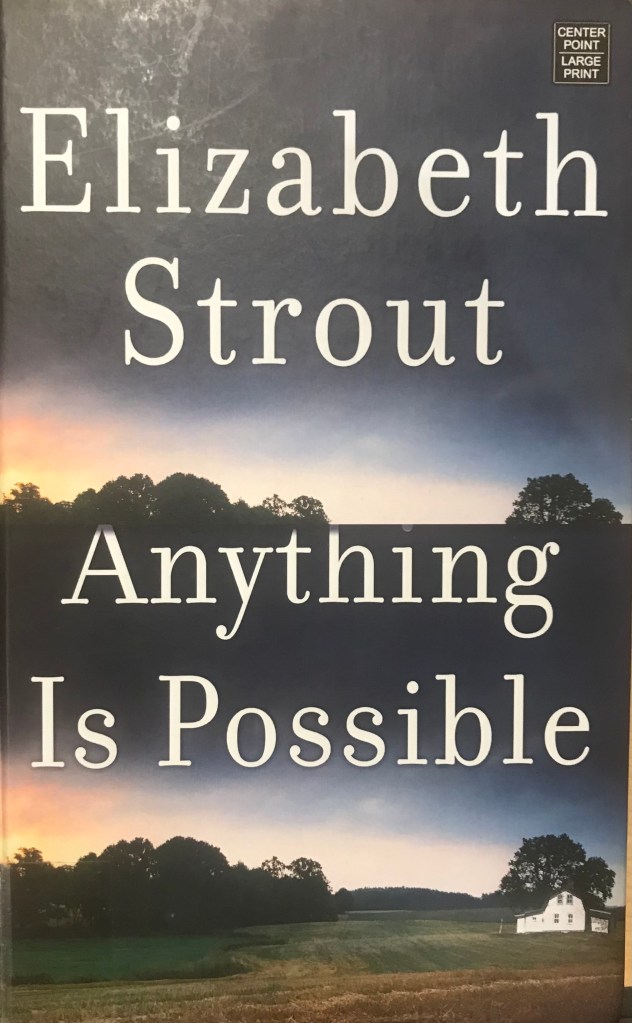
“Anything Is Possible” is a masterful collection of inter-related short stories by the acclaimed American novelist Elizabeth Strout. I first encountered Ms. Strout’s work when I picked up a copy of her latest novel, “Lucy by the Sea”, at our public library two years ago. I was completely taken by that relatively short, trenchant novel about an aging writer and her ex-husband as they navigate the first year of the Covid pandemic together in a secluded, seaside cottage in rural Maine.
Intrigued by the character of Lucy Barton, I read another of Ms. Strout’s series of novels about this character. “My Name Is Lucy Barton” is a novel framed as Lucy’s memoir after she has made it big in the publishing world. It traverses the story of her childhood emotional abuse and impoverishment, and her lifelong struggle to declare herself as a fully human woman who can claim her name and her background on her own terms.
When I recently came upon Strout’s 2017 collection of short stories in the Large Print section of the library, I quickly grabbed it up. It turns out that the nine stories of “Anything Is Possible” are each about various characters in Lucy Barton’s early life and how their lives are unfolding. The stories are set against the background of the publication of “My Name Is Lucy Barton” and each of them reflects in some way on the successful writing career of a “native daughter” who had been scorned and isolated because of her family’s poverty and isolation.
When I was an undergraduate English major long ago, I developed a deep appreciation and love for the short story genre. Classic short stories by Edgar Allan Poe, Guy de Maupassant, Herman Melville, Ernest Hemingway, Katherine Anne Porter, and others, were a mainstay in my literary diet. Reading the poignant, finely crafted short narratives of Ms. Strout has reawakened my love for this genre.
To help me remember each of the stories in “Anything Is Possible” I took some time to write a synopsis of each. I was so taken with the stories that I read them all a second time and revised my synopses. I felt to share these on my blog for anyone who might be interested. I fully realize that these synopses are pale shadows of Ms. Strout’s vibrant, nuanced prose. I heartily recommend reading the full-length originals to garner the full scope and depth of her writing.
1.“The Sign”
The first story is about Tommy Guptill and his remarkable encounter with Lucy Barton’s brother, Peter. Tommy and his wife Shirley are in their early 80’s, enjoying their retirement in a humble rural home near Lucy’s fictional hometown, Amgash, IL.
On a beautiful May morning, Tommy drives into the more prosperous town of Carlisle to buy birthday presents for his wife. He stops at the bookstore there and buys a gardening book for her, and notices Lucy Barton’s memoir, “My Name Is Lucy Barton” there. He fondly remembers Lucy from her years in the Amgash school where Tommy had worked as the janitor.
Tommy’s backstory is that he had been a successful dairy farmer, happily married with three well-adjusted kids, until an electrical fire burned down his barns and home. He was 35 years old at the time, stunned by this sudden reversal of fortune. In the midst of his terror, he feels a warm, reassuring presence that communicates the message that “all will be well”. Tommy is in awe at this unbidden manifestation of God, and is able to reconstitute a happy, productive life. He is content with his ensuing career as a janitor at the impoverished town’s only school, becoming a steady and positive presence to everyone he encounters there, teachers and students alike.
As Tommy is driving back home, he makes an unplanned stop at the dilapidated rural home of the Barton family, inhabited now only by Lucy’s older brother, Peter. Peter is a reclusive man in his 60’s whose main human contact is a weekly phone call from Lucy. Tommy had witnessed the three Barton children suffer isolation and derision at the Amgash school owing to their extreme poverty and their parents’ antisocial behavior. After seeing Lucy’s book, Tommy feels humanly called to look in on his reclusive neighbor.
Peter is initially suspicious of Tommy’s visit. After exchanging pleasantries, Peter asks that Tommy not visit again since it just makes him feel guilty. Tommy is incredulous, so Peter explains.
Peter believes that it was his own Father who had set the fire on Tommy’s property some 50 years ago. His Father had worked for Tommy for a while, but then stopped. Peter assumed that he had been let go and then set the fire as vengeance. Peter assumes that Tommy knows this and that his occasional visits are his own form of revenge in provoking Peter’s guilty feelings.
Tommy is stunned by Peter’s story. Tommy believes that it was his own negligence with his milking machines that had ignited the fire. While he understands the plausibility of Peter’s story, he has long ago come to peace with that tragedy. He assures Peter that he bears no grudge against him.
Peter adamantly defends his Father as a good and decent person who was “twisted” by the traumas he experienced during World War Two. Tommy shares how his own brother came back from that war, a much-diminished person who was eventually abandoned by his wife and children. He tries to comfort and reassure Peter, who eventually is able to accept Tommy’s positive intentions.
As Tommy is about to leave, Peter asks that he drive him down to the road where his long-deceased Mother’s business sign still stands: “SEWING AND ALTERATIONS.” Peter brings an axe with him and proceeds to vehemently destroy the wooden sign. Tommy looks on, aghast. He has the realization that it was the Mother who was the central force of abuse within the Barton family. Before Tommy drives away, he tells Peter that he will continue to look in on him, and Peter agrees to it, thanking Tommy.
Tommy is emotionally shaken by what he has witnessed. The rock-solid belief in a compassionate God that has sustained him since the fire has now begun to crack.
When he arrives home, his loving wife is sitting out front waiting for him. She sees her husband’s distress and asks him what has happened. Tommy shares what Peter has told him. He also shares with Shirley for the first time about the compassionate presence that had visited him during the fire. Now Tommy doubts that his experience was real. Shirley lovingly embraces Tommy and says that his experience was real, that nothing Peter shared invalidates it.
Tommy is able to receive his wife’s comfort and support. “You might be right” he says. And then adds “I love you.” It’s clear that the real love between Tommy and Shirley will get them through this crisis of faith.
2. “Windmills”
This story is about Patty Nicely, a high school guidance counselor, a widow in her 40’s, who has to reorient herself after a disastrous meeting with one of her students. Patty takes anti-depressant medication to help her deal with her grief at losing a loving husband. She has gained a lot of weight as a result. Patty is also the main caregiver for her elderly mother, who has lived apart from her family since having a brief affair when her three girls were teenagers.
A key factor in Patty’s reorientation is her chance encounter with the book “My Name Is Lucy Barton”. Patty knew of Lucy Barton from some minor childhood connections. Reading the book is a striking revelation to Patty of how a person growing up in abject poverty and emotional abuse could go on to become a highly successful author.
Patty’s first encounter with Lucy Barton’s 15-year-old niece in her guidance counselor office is quite upsetting to Patty. The girl is sullen and verbally abusive to her, insulting her as “Fat Patty” and as a woman who is rumored to never have had sex. Patty is deeply offended and embarrassed by this and calls the girl “a piece of filth.”
Patty is appalled by her own behavior. She calls her sister Linda (the main character in “Cracked”) for support, but Linda only affirms that the girl IS a piece of filth, and that Patty should have nothing to do with her.
In the course of a weekend, Patty has encounters with her mother, her younger friend, Angelina, and with a married man she has a strong emotional attraction to, Charlie Macauley. She is also reading the Lucy Barton “memoir” and is being deeply affected by it. Driving home from her visit with Angelina, Patty has a fundamental realization that she can overcome her own sense of shame and insufficiency, just like Lucy Barton did.
Patty has a second meeting with Lucy Barton’s young niece and sincerely apologizes to her for her behavior. The girl is taken aback by this. When Patty goes on to encourage the girl, saying she will help her go to college, the girl becomes very emotional, as she is not used to receiving such positive attention.
This dramatic turnaround in Patty’s belief in herself and her determination to do right by her poverty-stricken student is a testament to the power of literature to transform lives. In the end, Patty is even able to establish a positive, mutual connection with Charles Macauly.
The title “Windmills” derives from Patty’s appreciation of the hundreds of wind turbines in the rural areas surrounding her town. She is intrigued by how all the windmill arms seem to turn at different speeds, but that sometimes, some of them fall into a similar pattern. She takes this as an affirmation that sometimes people can relate with one another in harmony.
3. “Cracked”
Linda Peterson-Cornell is one of the three Nicely sisters, a sister of Patty in the previous story, whose family was disrupted when their mother left to have an affair and their father refused to accept his penitent wife back. The sisters reluctantly sided with their father, but all of them felt rejected by their mother’s affair. Their father has a successful business, and the sisters all go to college.
Linda had a one-year marriage after college but then had a longer marriage to a very wealthy man. Now, she feels like she would like her rich husband to “disappear” but is trapped by the luxurious home and lifestyle that he provides. Her husband Jay has a sexual fetish that includes voyeuristic observation of female houseguests. Linda plays along with Jay’s perversion, even reluctantly joining him in his voyeurism.
The story involves two other women, professional photographers, who are leading workshops in the local photography festival. Karen is the director of the festival and has brought in her friend Yvonne to assist. Yvonne is staying as a guest in the home of Linda and Jay.
Yvonne is put off by her accommodations, an ostensibly well-appointed private apartment downstairs, which has no doors. She is unaware of the hidden video cameras there that Jay uses to observe her. Yvonne stays for three nights, keeping her distance from her hosts.
On the third night, after coyly coming on to her, Jay assaults Yvonne sexually and she flees the house, terrified, with only panties and a tee shirt on. She tells her story to the police, who appear at Jay and Linda’s home to arrest Jay in the middle of the night.
Linda is in an emotional fog as all of this transpires. Jay has the town’s best lawyer and is intent on denying any wrongdoing. Linda is complicit with this yet shaken by it as well.
She runs into Karen in a convenience store the next day. Karen initially confronts Linda about her apparent complicity in the assault of Yvonne. Linda denies it, saying she knows nothing about the accusations against her husband.
Karen has recently experienced the unexpected suicide of her own husband. She realizes the duplicity of her assumption that Linda was complicit, when Karen herself was so in the dark about her own husband’s unhappiness. She apologizes to Linda.
Unjustifiably forgiven, Linda then has a bleak vision of her future life with Jay in which she continues to be complicit in his perversions. She feels utterly hopeless and empty with this fate. She recognizes the same sense of betrayal and loss she experienced when her mother left home to have her affair.
The title “Cracked” comes from a recurrent theme in Karen’s recent photographs, which all include cracked glass and other objects, as if from an earthquake. They are an out-picturing of Karen’s own shattered life after her husband’s suicide, as well as Linda’s perception of her “cracked” life.
4. “The Hit-Thumb Theory”
This is a story about Charlie Macaulay, a middle-aged veteran of the U.S. war in Vietnam. He is emotionally scarred from the combat horror he experienced, carrying a sense of guilt and repressed rage rather than any overt PTSD.
He is in a cheap hotel outside Peoria, IL, awaiting the arrival of a prostitute he has been visiting for some time. He has developed a real, human fondness for her, but feels guilt about the deceit his actions have introduced into his longtime marriage with his college sweetheart.
When “Tracey” arrives, he can tell that something is amiss with her. She had previously acknowledged her own feelings for Charlie and had refused to accept payment. But this time, she is distraught and asks for $10,000 to save her son from a drug deal gone bad. She says that her son’s life is threatened.
Their tryst is interrupted by a desperate phone call from Charlie’s wife. Charlie had been reflecting with warmth on the early days of their courtship while in college. Charlie recalls his wife’s innocence and zest for life. Now he confronts her pathetic neediness and his inability to take her seriously as a person.
Charlie desperately decides to get Tracey’s requested money, knowing it means the end of his relationship with Tracey, and also with his wife. He drives to a branch of his wife’s bank and withdraws the $10,000 for Tracey. Feeling unable to return home after such a heinous violation of his marriage, he checks into “Dottie’s BnB” for the night.
There he awaits the inevitable cascade of guilt for his action. As a boy, he had learned that the real pain of physical injury occurred some minutes after the trauma itself. This is the “hit-thumb” theory that he now realizes applies to emotional trauma as well. Checking into Dottie’s, he connects with Dottie on a human level. When he comes down to watch TV in the guest parlor, Dottie joins him, sensing that her guest is going through hard times. Charlie breaks down in tears as the emotional weight of the day comes crashing down on him.
Dottie is able to compassionately witness his pain without being put off, nor being overly involved. Charlie deeply appreciates that his suffering has been witnessed in such a way. Few words are exchanged. But both Charlie and Dottie feel that a significant human, ennobling connection has been made.
Dottie is quick to communicate that she is not available for a romantic encounter, and Charlie is happy for that. He remembers having his tears witnessed by strangers at the Vietnam Veterans’ memorial in Washington and how he felt that his grief was respected by them. He feels the same about Dottie’s witnessing his current emotional pain.
His sense of utter darkness is mitigated by that connection, and he leaves the next morning with some small hope for the value of his life.
5. “Mississippi Mary”
This story is about an elderly American divorcee living in a seaside northern Italian town with her younger Italian husband, also divorced. They have been happily in love for about 15 years, ever since they met when Mary got lost from her American tour group there.
Mary had lovingly raised five daughters back in Illinois. She grew up in poverty in Mississippi but later married a successful businessman in Illinois. Her first husband had had a romantic relationship with his secretary for many years. Even after that relationship ended, Mary never felt much affection or appreciation from him. When she met a kind, considerate Italian man who expressed warm feelings for her, Mary returned his affection and decided to start a new life with him.
All but her youngest daughter, Angelina, had come to terms with their mother’s new life and had visited her in Italy. Angelina and Mary had a very deep emotional bond, and it took Angelina many years before deciding to visit. When she finally did visit, Mary was overjoyed. But Angelina still felt hurt for being abandoned and expressed this to Mary.
Mary understood her daughter’s pain and shared in it as well, but she also communicates to Angelina that her previous life felt like it had dried up, and she still wanted to live. On the night before Angelina leaves for home, she sees her mother from afar and notices how happy she seems, sitting in the small Italian town square listening to music. When a bent over old man has difficulty crossing the street, she watches her mother lovingly go to his assistance. The old man is very grateful, and they have a big hug.
Witnessing this, Angelina understands why her mother has decided to live in a country where people are so much warmer and more expressive. She leaves the next day with a sense of acceptance that her mother has found love and happiness in her old age.
6. “Sister”
Lucy Barton has planned for her first visit “home” since her father died 16 years earlier. She will be in Chicago on a book tour and will rent a car to drive the two hours to her Illinois hometown.
Her brother Peter, a barely functional recluse, still lives in the dilapidated family home. Her sister Vicki lives in a nearby town with her husband and teenage daughter. Peter is anxious to see Lucy, who has maintained regular phone contact with him over the years. Vicki resents Lucy’s “escape” from their impoverished family when she left for college and never returned. Vicki is not planning to see her sister, even though Lucy regularly sends money and letters to Vicki.
Peter spends two weeks trying to spruce up the dark, decrepit, filthy house he lives in. When Lucy arrives on a Sunday afternoon, he is uneasy about the house’s condition, even though he has worked hard to clean it, and even bought a new carpet. Lucy is happy to see her brother and soon puts him at ease. She praises him for his recent volunteer work as a cook at a homeless shelter (made possible by his neighbor, Tommy Gupthill and his wife).
Then Vicki shows up unexpectedly. She treats Lucy with disdain. Lucy does her best to normalize things, asking Vicki about her job in a nursing home. Vicki shares that her daughter is getting a college scholarship and Lucy is overjoyed, but Vicki is much less so.
Vicki starts telling horrible stories of their toxic childhood. Lucy has spent the better part of her adult life coming to terms with the deprivations of her family life. One of Vicki’s stories about their mother’s ruthless cruelty causes Lucy to convulse into a panic attack. Vicki thinks her sister has gone “cuckoo”, while Peter is beside himself.
Finally, Lucy asks Vicki and Peter to drive her back to Chicago, taking two cars so that they can return home. Peter drives Lucy’s rental car, following Lucy and Vicki in Vicki’s car. Peter struggles to follow them, driving on unfamiliar roads (he has never gone more than a few miles from home).
Finally, Lucy has them pull off the highway as they near Chicago, saying she feels ok to drive the rental car back herself. Vicki and Peter return home in her car. Vicki shares with Peter how flabbergasted she is at Lucy’s strange behavior.
7. “Dottie’s Bed & Breakfast”
Dottie is an aging woman (60’s) who operates a small BnB in a small town in Illinois. She is happily divorced, mostly content with her independence. She is the sister of Abel Blaine (story #9) and shared her childhood poverty with him.
Dorothy has a significant role in story #4, “The Hit-Thumb Theory”, in which she soulfully befriends an overnight guest who is suffering a crisis in his marriage. In this story, she similarly befriends a woman guest of about her own age, wife of a cardiologist, who is traveling with her husband for a conference.
When the woman returns bereft to the BnB in the middle of the afternoon, Dottie makes her tea and gives hours of her time listening to the woman’s story (which includes an important interlude about Annie Appleby of the next story.) Not once during her hours-long monologue does the woman take in Dottie.
When the woman’s husband returns, he is upset that she has been sharing her time with the humble proprietor. The next morning, the woman gives Dottie the cold shoulder, embarrassed that she has shared herself so fully with this lower-class stranger.
Dottie takes an acid dislike for the woman and her husband, being all too familiar with the kind of disdainful class judgments of their kind. She expresses her disdain for them by secretly spitting in their morning jam. She also confronts them both verbally, eliciting further demeaning judgments from her guests.
8. “Snow-Blind”
Annie Appleby is the youngest of three kids growing up on a potato farm in New England. She seeks and finds relief from the shame-driven emotional poverty of her family by spending much of her childhood exploring the woods abutting the farm. There she has magically mystic experiences of the natural world.
Her rich inner life opens her to deep feelings and the capacity to express them. She takes to acting in school plays and at age 16, is “discovered” by a traveling theater company which successfully recruits her to a life in the theater. She has a highly successful career in small regional theaters.
A crisis in her farm family brings her home. Her mostly loving father’s dementia has gone out of control. He has revealed himself as a lifelong homosexual who maintained an ongoing secret relationship with a local schoolteacher. Annie had cherished her father as her protector after a childhood walk with him through the snow-covered farm fields. (Annie appears as an “offstage” character in the previous story, “Dottie’s Bed & Breakfast”).
9. “Gift”
Abel Blaine is the “successful” brother of Dorothy (of “Dottie’s Bed & Breakfast”) and a childhood cousin of Lucy Barton. Like Lucy, he found a way out of hopeless poverty, in his case by working hard and using his creative intelligence in business. As an aging executive of his thriving air-conditioning business, he is generous, soulful, and devoted to his children and grandchildren, but is caught in a marriage gone stale with a higher-class woman who holds disdain for his humble beginnings.
Attending a pre-Christmas performance of “A Christmas Carol” with his family, things start going awry when the lights mysteriously go out in the theater. On finally reaching home after a very long day, Abel has to return to the theater to retrieve his granddaughter’s beloved stuff animal. There he encounters the semi-deranged actor who played “Scrooge” in that evening’s performance.
“Scrooge” initially taunts Abel for his middle-class uptightness, but Abel engages him in a friendly way. Abel finds the stuffed animal and is trying to leave, but Scrooge keeps engaging him, now in a more friendly way himself. Abel starts feeling intense chest pain, reliving his heart attack the year before, one that almost killed him.
Scrooge is terrified at Abel’s collapse and calls 911. As Abel is taken to the hospital in an ambulance, he experiences a pervading sense of well-being. As he approaches his death, he embraces the gift of an all-encompassing peace and love that engulfs him. He thinks to himself that “anything is possible.
John Bayerl, 5/26/2024
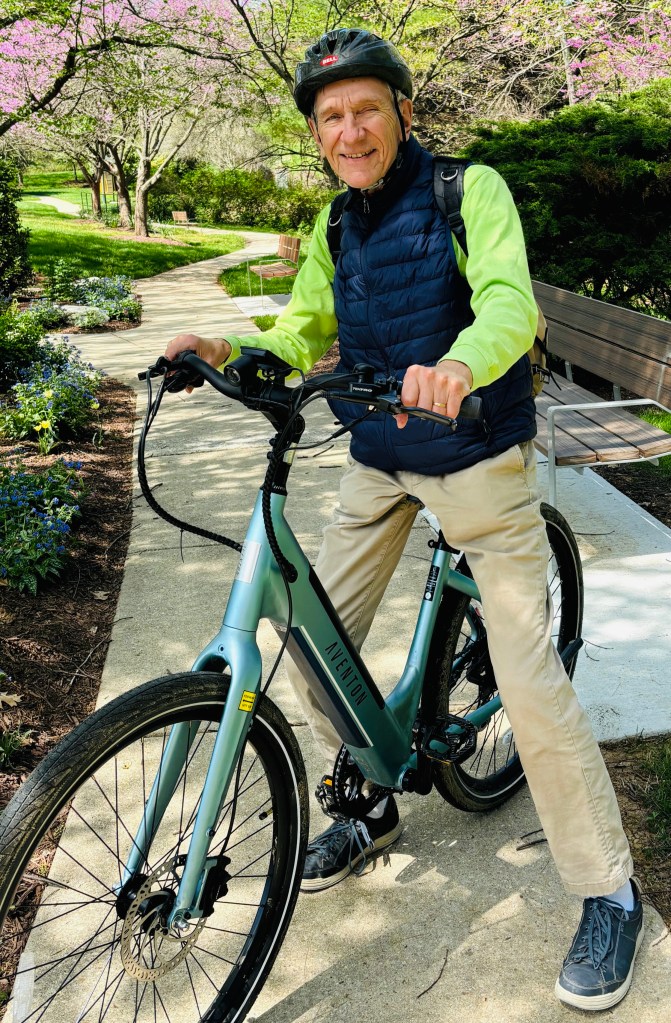
I’ve had a lifelong love of riding bicycles and recently rekindled that ardor after purchasing a new eBike (electric bicycle).
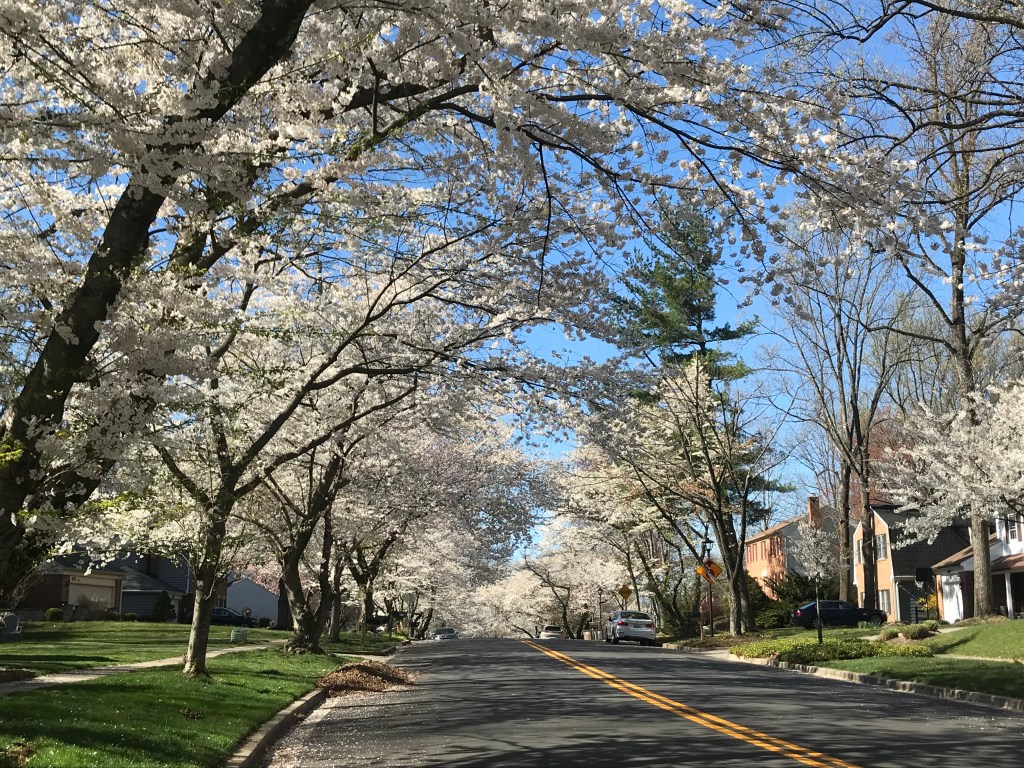
I retired from my day-job in 2015 and one of the first things I did to mark the occasion was to purchase a new, modestly priced, hybrid-style, 24-gear, bicycle. I’ve never been a “serious” cyclist in that I’m not one to pedal long distances and have never joined a bicycle club. But since boyhood, I’ve retained a love for the pure physicality of riding a bike, and the sense of freedom it brings. In my retirement, I’ve come to really enjoy viewing the world around me from my bike – especially being able to slow down and take in the beauty of the natural world as well as the sumptuous landscape architecture in many of the suburbs of Montgomery County, Maryland, where I’ve lived for the last 30 years.
Like many of my fellow retirees, I had some challenges finding my life focus in the first six months of not having a formal job. Early on though, whenever I felt at sixes and sevens about what I was doing with my life, I found that if I just got on my new bike and set out, the sense of inner confusion and disarray soon evaporated. Cycling requires being present in the moment. It proved to be just the antidote I needed.
I started by just riding around my own and adjacent neighborhoods of Derwood – an unincorporated suburb between Rockville and Gaithersburg. I soon discovered that I could see my surroundings differently from the seat of a bike. Driving a car for me is mostly about getting from Point A to Point B. On my bike, I can slow down to take in people and things that catch my eye. And it gives more mobility than walking, allowing me to take in broader swaths of my environment. Like many iPhone users these days, I’ve become something of an amateur photographer. On a bicycle, it’s no problem to pull over and take a picture of things that attract my attention.
Over time, I became a bit more adventurous in my bike rides. There were two marvelous hiker-biker trails in close vicinity to my home. One was the Rock Creek Trail, which traverses some 25 miles from Lake Needwood (in Derwood) down through the Maryland suburbs and through Rock Creek Park in DC. The trail follows Rock Creek all the way down to the Potomac, and while I never made it that far down, I did make it to northern DC, finding numerous stunning vistas and secluded places along the creek, perfect for quiet intervals in the lap of Mother Earth.
One of my favorite half-day bike journeys was pedaling from my home down through the Rock Creek trail about ten miles to the Strathmore Music Center in North Bethesda. I loved the artistic landscaping of the grounds there, including a marvelous outdoor sculpture court, where I often stopped, walked, and found interesting places to sit and eat my sandwich lunch. I also became a fan of the art exhibitions within the beautiful galleries of the Strathmore Mansion. Often as not, I would get home by riding my bike to the nearby Grosvenor Metro Station and take the Metro back up to my home near the Shady Grove Metro stop.
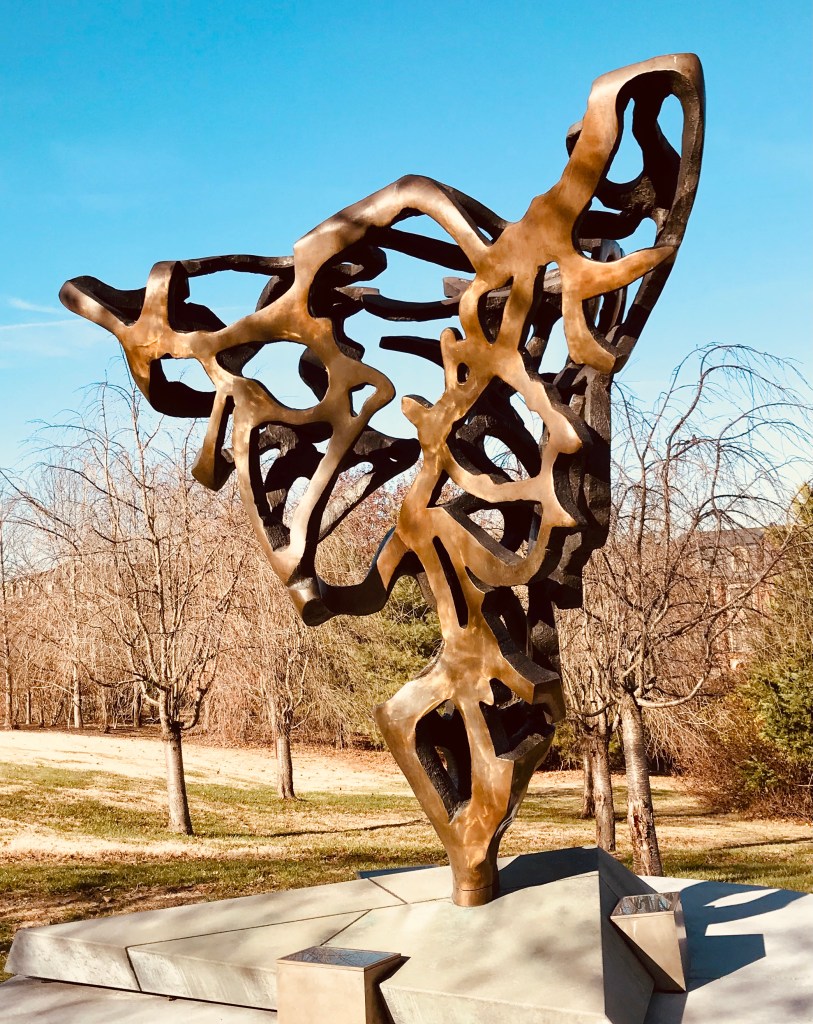
Another favorite ride was on the more recently constructed hiker-biker trail that ran along the Inter-County Connector (ICC) highway from Derwood to Emory Lane. I sometimes rode this route with a neighbor of ours, Steve Crawford, another aging cyclist with about the same stamina as me. Steve and I had been friends for years, but our friendship noticeably deepened as we spent time together on our bikes, traversing trails and neighborhoods quiet enough to ride in tandem and talk. Steve had an untimely death from a heart ailment two years ago and I miss him dearly, especially when I’m out riding alone.
Two years ago, my wife Andrea and I moved to a marvelous new retirement complex in southwest Rockville. Part of the attraction of The Village At Rockville (TVAR) for me was its proximity to the city of Rockville’s many bike trails, and bicycle friendly roads. Our facility even has a bicycle storage room within the parking garage. Soon after moving here in March 2022, I was out exploring the new terrain on my bicycle. It was a great way to familiarize myself with our new geographical environment.
I have some persistent lower back and hip issues from degenerating spinal disks and arthritis. The discomfort was causing me to ride less often, and for shorter distances. Last October, I began to consider getting a new bicycle, one on which I could sit more upright. In the process of bicycle shopping online, I began noticing a wide variety of electrical bicycles that also had more upright seating configurations. So, I decided to try out an eBike and visited the Rockville Trek store.
I encountered a very helpful young woman salesperson at the Trek store. She was an avid biker herself, riding 10 miles to work each day on her manual bicycle. When I told her about my back issues, she encouraged me to try out their eBike model. There was a large Metro parking lot down the street which she encouraged me to use for my initial spin. As soon as I started feeling the battery-assist power of the bike, I was sold. I had an exhilarating spin around that parking lot for a good long while before returning to the store. The Trek cost a bit more than I wanted to pay though and I decided to visit a couple more bike stores.
In the end, I purchased an Aventon 500.3 eBike from the modest “Good Vibes Bikes” store about 3 miles from home. I test rode that model as well and really liked everything about it –- upright seating, throttle-on-demand power, and reasonable price ($1.6K). The store had their own maintenance shop, and I got their one-year service plan.
After six months, I’m totally delighted with my new eBike. My back issues had begun reducing the frequency of my rides to once every week or two. Throughout our mild Mid-Atlantic winter, I was able to ride two to three times per week, and for much longer distances than I’d been able to go on my manual bike. The 10-pound lithium-ion battery can get me up to 50 miles on a charge. Mostly though, I’m riding for about 10-15 miles at a time.
My new bike has 8 derailleur gears which I can peddle without electrical-assist as desired. But I seldom do that. The torque-sensor motor provides seamless power assist on hills and great speed (up to 20mph) on straightaways. It has four levels of power-assist, and has a thumb-activated throttle that can provide power without pedaling at all.
My new eBike has renewed my love affair with bicycles, allowing me to experience my environment with ease and comfort. A friend recently gave me his bike-rack for my car and I’m eagerly awaiting warmer weather when I can begin driving the bike down to the C&O Canal for longer rides along the Potomac. I’m very appreciative and grateful for this new technology that has given a new lease on bicycle-life for aging seniors like me.
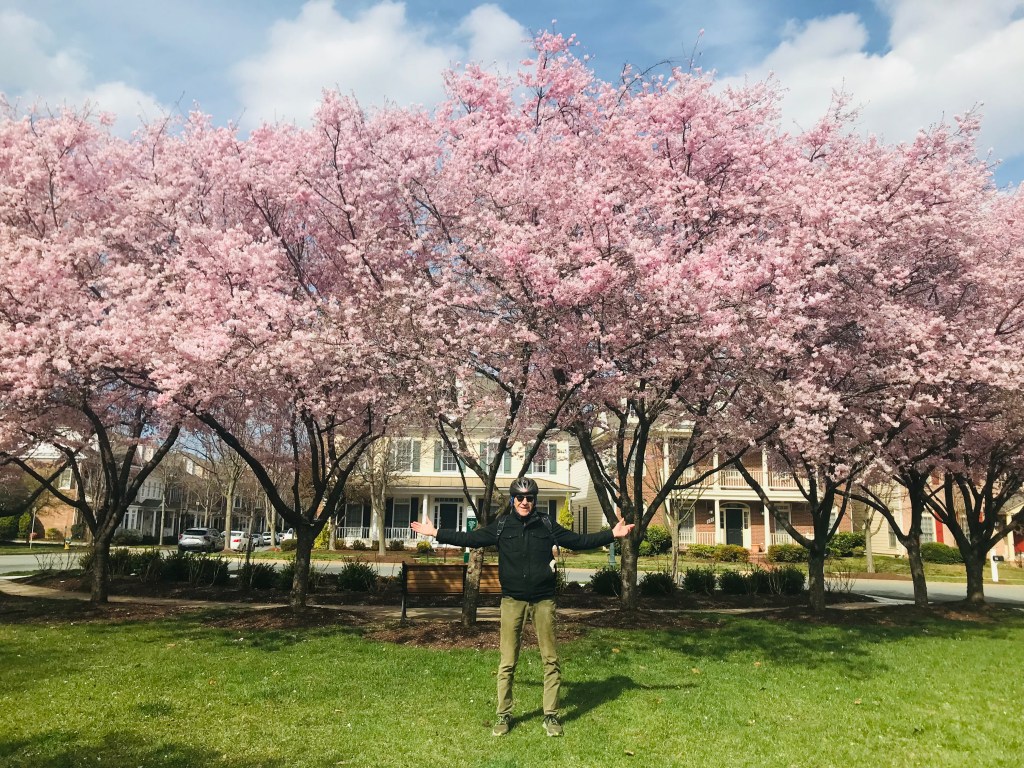
John Bayerl, 4/16/2024

Our favorite beach in Puerto Rico is about a mile west of Isabela’s Villa Pesquera on the coast road. It’s about a ten minute drive from our current digs in the Isabela Beach Court (IBC), adjacent to the Villa.
The beach is named “Playa Poza de Teodoro” and marks the western point of the mile-wide Isabela bay. It features a formidable array of offshore rock and reef formations against which the fierce waters of the surging Atlantic crash headlong, creating periodic bursts of soaring ocean water. When the surf is up, the site can be very dramatic in sight and sound.
“Playa” simply means beach, and a “poza” is a pool of water created by an indentation. The offshore rock-reef formations are called “montones”. These form a barrier behind which the ocean water fills a calm, natural pool that is typically about 200 yards wide and about 50 yards from beach to montones.
When we arrived yesterday morning around 10am, the air temperature was 84F and the water temperature in the pool only a bit less. It was clear and sunny and the usual shore winds were noticeably diminished. It’s about a 200 yard walk from the makeshift sandy turnoff to the beach proper, ascending the large sand dunes on a designated path maintained by a local environmental group . We hauled our two beach chairs across the dunes until we finally got sight of our destination.
We were surprised that the poza was smaller and shallower than we’d ever seen it in our 17 years of visiting here. It was low tide, and there was only an occasional small surge of water over the montones to replenish the pool. It was actually a pretty tranquil scene. Rather than sit out under the full tropical sun, we pitched our chairs under the shady branches of some nearby palm trees.
Andrea and I sat in silence for a while, taking in the natural beauty of sun, sand, sea, clouds and sky. We keep returning to this place because it inspires in us a deep sense of wonder and peace. As we age, the preciousness of life becomes more poignant, and this place brings those rich feelings to the fore.
We’ve come already stripped down for the beach and soon start off for a closer exploration. The sand was already getting hot to our feet, and it felt good to wade in the clear, cooler water of the pool. I’d brought my small binoculars and spent some time to continue taking in the panorama.
We then walked a short distance off to the west where we could see a group of surfers in the relatively small waves. This is one of the more popular surfing beaches on the Isabela coast and it’s always fun to watch the surfers, men and women, dexterousLy balancing on their boards. With my binoculars I also spotted a large, flat rocky promontory offshore where a large flock of gulls were resting.
Returning to the poza, we retrieved our masks and snorkels for our first foray into the water. It was amazingly warm and we were both soon happily exploring the silent, underwater world where tropical fish abounded around the large rocks scattered around the pool. I always feel a sense of deep peace and appreciation when snorkeling in those shallow tropical waters. I can really relax into the calm, bounteous sea world in which I’m immersed.
In addition to brightly colored tropical fish, the pool also supports schools of silvery sardines. These attract hunting pelicans which occasionally circle around and plunge headfirst into the water to nab one. A pure white ibis patrolled the first level of reef in search of little crabs. Soon a pair of oyster catchers arrived on a similar mission.
The snorkeling was very relaxing in the clear calm of the warm shallow waters. I was able to release all my usual background anxiety and really let go in this richly bio-diverse environment. This feeling of loving immersion in the natural world is one that I’m learning to value and cultivate. A friend uses the term “biophilia” (love of living things) to describe this feeling, and I find it very apt.
We were first introduced to the magic of the Isabela coastline by our old friends Freeman and Joyce Allan. They had purchased a condo at the IBC in 2007 and invited us to visit. Andrea had been wanting a winter vacation after being told by her oncologist that her cancer history put her in a vulnerable statistical category. We had our first visit that year. The Allan’s showed us all their favorite beaches and restaurants in the area, and we were completely enamored, returning nearly every February since then.
The Allens referred to the Playa Poza de Teodoro simply as “the Ted”. That’s the name we’ve affectionately used for it ever since. The Spanish “Teodoro” is “Theodore” in English. I also like to think of it as an abbreviated version of “te adoro” (“I love you”). Yesterday was Valentine’s Day, a perfect day to spend within the arms of a loving earth and sea.
John Bayerl, 2/16/2024

 John's Blog