“Let go, let God”

[I prepared this piece as the lead sharing for our weekly, parents Alanon group last night. My wife Andrea and I have been active members of the Alanon fellowship for seven years.]

“Let go, let God”

Step 6 of the Twelve Steps says: “Were entirely ready to have God remove all these defects of character.”

I am still working Step 6.  I did conscious work for many months on Steps 4 and 5 with an Alanon sponsor.  In Step 4, I took the plunge to do a thorough self-examination.  As I began that process, my sponsor asked me to first write out a list of my best qualities.  This eased entry into the more difficult work of acknowledging and admitting my faults to “God, myself, and to another human being.”  My sponsor also helped me to see that there was an interesting relationship between my virtues and my faults; that many of my faults were distorted versions of my virtues.   Step 5 invites us to go a level deeper to determine “the exact nature of our wrongs.”  This took me to a level of questioning some of my fundamental beliefs about the nature of Reality.  The “nature of Reality” is my current working understanding of God.

I am learning that working Step 6 requires prayer.  My inner work sometimes suffers from an over-reliance on my self-will.  Self-will works fine in the domain of most self-help programs. But Alanon is more than another self-help program.  The prayer “Let go, let God” allows me to release my self-will and trust in the benevolent unfolding of a Higher Power.

My positive will serves me very well in many aspects of my life.  In fact, my positive self-will got me to Alanon and to a place of serious inner work.   It gets me out of bed in the morning and enables me to make commitments to projects and goals that are important to me.  But I discovered that I cannot simply will serenity, peace, or happiness.  The entire efficacy of the Twelve Steps is based on a personal experience of our Higher Power, and that requires me to loosen the reins of “what I want”.  Another version of the prayer for me is:  “not my will but Yours be done”.

To become “entirely ready” to turn my inner doubts and fears over to a Higher Power, I had to first use my conscious good will to honestly and fearlessly face myself as I am.  For me, this requires a stripping down from pretense and from an identity built on outward accomplishments.

One of the beliefs that I unearthed in Steps 4 and 5 had to do with my motivation for one of the most important undertakings of my life:  the adoption of two older Brazilian street kids:  “at risk” kids par excellence.  These two grown children are now my Alanon “qualifiers”.

Along with a genuine desire to expand our loving home, and a genuine desire to come to the aid of “throw away” children, I discovered a self-righteous pride for being such an exemplary person.  When our kids acted out with drugs and alcohol, this self-righteous pride took a serious hit.  I was doubting myself and slipping into depression.  Part of the reason was that I could no longer proudly claim my great valor and compassion for the adoption.  Drilling down into the “exact nature” of my depression revealed how I had built a sense of self based on the performance of good deeds.  When my good deed went awry, my sense of self took a big hit.

This led me into an inquiry into the truth-value of my ruling belief that my self-worth required an ongoing performance of good deeds.  Is this what reality is requiring for me to feel like a whole, healthy person?  I could easily see the fallacy in this belief, yet I felt it was so deep in me that letting it go would mean the loss of everything worthwhile in my being.

I could certainly see that others of my family and friends were not so driven by the need to perform good deeds.  And I admired and loved many of them.  I certainly didn’t require others to be performing good deeds in order for me to accept, trust, and value their essential worth.  “Let go, let God” became an important prayer for me in releasing the tyranny of my self-imposed requirement that I must always do good deeds to prove my value and worth.

So Step 6 is steering me to fundamentally challenge this false belief that my self-worth requires ongoing self-sacrifice.  I can accept the mission that I signed up for with the adoption, without relegating my life to ongoing strife and hopeless disappointment.  Once I articulated this, I sensed other possibilities.  And yet, with the continued acting out of a qualifier, I would regularly return to my false belief.

I’m learning that in prayer, I can acknowledge my own powerlessness.  Using self-will alone, I’ve not been able to make the leap to a new personal paradigm.  “Let go, let God” and the serenity prayer are helping me to let go of responsibility for all the many events in life that I have no control of, especially the choices and behaviors of my adult children.  These prayers offer me inner peace and positive self-esteem even when my wayward adult-children act out once again.

The prayer “Let go, let God” points me to a place where I can feel myself as real, whole and loving, without having to prove it to myself or anyone else.  With faith and trust in my Higher Power and my own Higher Self, I can become “entirely ready” for the God of my understanding to liberate my spirit.

Remembering Fr. Claude Bicheler

Claude Bicheler

Remembering Father Claude Bicheler (1933-1986)

I had the great good fortune to have Father Claude Bicheler as my English teacher for all four years at Bishop Turner high school in Buffalo, NY, 1963-1967.  I say this in retrospect, because for the first six months of freshman English with him, I often felt challenged and somewhat disoriented.  Fr. Claude ran a tight classroom in our all-boys, Catholic high school.  And he had a way of making us squirm when he insistently engaged us in real-time Socratic dialogs, requiring that we think and speak on our feet.

I considered myself a good student, but the Catholic nuns who taught me in grade school didn’t prepare me for the kind of wide-reaching, creative assignments that Father Claude gave us.  Father Claude was a real stickler with our written assignments, marking them up with questions, comments and suggestions.  I was intimidated at the care he took with language and expression and at first dreaded our one-on-one assignment reviews.  I remember agonizing for most of a fall weekend over an essay we were asked to write on any topic with only one requirement:  not to use any form of the verb “to be” (“is, are, were, was,” etc.).  I was at a complete loss at first, discovering just how dependent I was on that one verb for most of my expression.  But eventually I got the hang of writing in the active voice with action verbs and Father Claude rewarded me with encouragement and praise.  At the end of the first semester, he invited me to consider writing for the school newspaper, which he was moderating then.  I remember writing my first story about the Turner track team, and the thrill it was to see it in print with my by-line.

Fr. Claude loved all the arts — literature, drama, music, and the visual arts.  He was best known as the director and producer of all the plays and musicals presented by Turner and our nearby sister (all girls) school, Archbishop Carroll.  Turner opened its doors in the early 1960’s and had a large, well-appointed auditorium which Fr. Claude put to good use.

In freshman year, we studied Thornton Wilder’s classic play “Our Town”.  Fr. Claude’s teaching method was to assign the parts to his students and read it aloud in class.  I remember being mortified at having been assigned the part of Mrs. Gibbs, anticipating the wisecracks from my peers.  Fr. Claude allowed some good-natured kidding but quickly made it clear that he’d brook no sarcasm during the reading.  I was shy and introspective when I entered Turner and the very idea of being on stage really scared me.  Somehow I got through the reading and was surprised to find myself strangely moved by Mrs. Gibbs.  “Our Town” was our school play that spring and I loved watching the fully staged performance.  I was amazed and admiring of the credible performances of the student actors and actresses, especially by one of my new friends, Mike Krempa, who played the town miscreant, Simon Stimpson.  The next year Fr. Claude pulled together an ambitious and exciting student production of the Rodgers and Hammerstein musical “Oklahoma”.  Others of my classmates had major parts in it and I absolutely loved the performances.  I had unexpectedly discovered a life-long passion for live theater that rivaled my interest in sports.

By sophomore year at Turner the trajectory of my academic interests gravitated more and more to literature, writing and the arts.  I’d entered Turner expecting to follow in my older cousin’s stellar academic footsteps with lots of math and the hard sciences (chemistry and physics).  But Fr. Claude was still the most compelling of all my teachers, even when he made me angry and uncomfortable.  I began hanging with the guys who acted in Fr. Claude’s plays and who edited the school newspaper and yearbook.  I continued to hone my skills as a student journalist, while also developing a deep appreciation for literary novels, plays, and even poetry.  This was pretty far afield from anything I had grown up with on the hard-scrabble, working class East Side of Buffalo.  The one exception was my Mother, who was an avid reader, and who encouraged me in my new-found interests.  I enjoyed the required course in biology in sophomore year, but when it came time to decide, I followed my intuition and signed up for the “liberal arts” track for my junior and senior years.

Fr. Claude became a real mentor for me in my last two years at Turner.  I became an editor on the school paper, and then the lead editor for our yearbook.  By senior year, I even auditioned for and got an important part in the spring play, “Caesar and Cleoptra” by George Bernard Shaw.  Once again, I went through some deep personal challenges as Fr. Claude pushed me out of my remaining shyness into a place where I could actually enjoy being in the floodlights.

By that time, I had become a full-fledged member of a group of about a dozen classmates united in our devotion to Fr. Claude and what he had to offer.  We accompanied him to professional theater productions in Buffalo, neighboring Toronto, and the world-class Shakespeare festival in Stratford, Ontario.  We went to classical musical concerts at Kleinhans Music Hall, art shows at the Albright Knox art gallery, and the occasional art film or lecture at the University of Buffalo.

In my junior year, I attended a school assembly about a Catholic student exchange program with South America.  I’d been saving some money from my paper routes and other odd jobs and was inspired to sign up.  In the spring, I was assigned to spend eight weeks that summer with a family in Quito, Ecuador.  We were expected to know some Spanish and I recruited Fr. Claude to be my private tutor.  Among all his other talents and experience, he had lived in Puerto Rico as a young priest and was fluent in Spanish.  He happily agreed to tutor me and I was deeply grateful for it by the time I landed in Quito early that summer to discover that my new family spoke no English at all.  Fr. Claude had suggested that I write to him in Spanish that summer and I did, further enriching the whole experience.

In junior year, we focused on British literature in Fr. Claude’s English class.  I was swept off my feet by the English romantic poets, especially Wordsworth.  I remember Fr. Claude reading aloud from Wordsworth and feeling a kind of inner spiritual expansion and mystical connection with God’s presence within the natural world.  The romantic poets gave expression to amorphous feelings I was having in my own solo walks and bike rides in Buffalo’s parks and undeveloped woodlands outside of the city.  Those experiences made me decide to be an English major when I entered college.

When I began my college search, my immediate focus was on small out-of-town Catholic colleges.  I had done well academically at Turner and felt confident I would garner some scholarship money.  I went to Fr. Claude for advice and his first suggestion floored me:  “Why don’t you apply to Harvard, John?”  Once again, I was intimidated by a challenge from Fr. Claude, but my experience of the past years allowed me to at least consider his suggestion.  I ended up applying to Siena College, Fordham, and Harvard.  I had an interview with a Harvard alumnus in Buffalo and felt ok about it.  Even though I got a rejection letter, I was grateful to Fr. Claude for his confidence in my abilities.

I remained in touch with Fr. Claude all through my years at Fordham University in the Bronx.  Having all of New York city at my disposal, especially the New York drama and music scenes, was very exciting.  One of my friends from our tight group at Turner, Steve Polniaszek, was studying downtown at the the NYU drama school in Greenwich Village.  I was downtown with Steve almost every weekend, attending plays and going to concerts, and taking in the burgeoning counter-culture of the late 1960’s.  We both stayed in touch with Fr. Claude and saw him in Buffalo or during his own occasional ventures into the big city.  I remember seeing the original off-Broadway production of the rock musical “Hair” in 1967 and buying the cast recording as a gift for Fr. Claude that Christmas.

After college graduation, Fr. Claude helped me to get a teaching position at Archbishop Walsh high school in Olean, NY.  During that time, Fr. Claude was renovating a country home in South Wales, NY and I spent some time helping out, even recruiting my Dad and brothers to help put up drywall. I remember many wonderful visits with Fr. Claude in his country home, one time even venturing out the 30 miles from Buffalo on a bicycle.

I eventually moved south to take various teaching positions in Savannah and then Atlanta, GA.  I had less contact with Fr. Claude after he left Turner in 1971 to become a parish priest, but still visited on my journeys home. I remember an all-day trip with him to Niagara-on-the-Lake for dinner and a play at the summer Shaw Festival there.  I knew that Fr. Claude suffered some heart problems, but I was shocked to hear of his early passing in 1986.  I was living in Washington, DC  and was not able to come home for the funeral – a lapse that I still regret.

Fr. Claude remained a devoted Catholic priest to the end.  I admired his devotion, integrity and creativity even after I left the church in the 1970’s.  Knowing him is certainly a highlight of my life, an ongoing inspiration and challenge to strive for excellence in every endeavor.  He was a teacher and mentor who helped me find my way in life and I remain ever grateful.

Copperhead

Copperhead

Opening the barbecue for cleaning,
removing the grill and bars,
I see you coiled in the base.
The light and sound disturb your rest
And you slowly uncoil,
Your small head leading,
Forked tongue flickering.
Your long sleek body is grey with brown
Hourglass patterns.
As I approach you with a broom handle,
Primal fear arises from my belly.
I’ve read reports of your kind here in the ‘burbs
And pause to take a photo and check the Web.
The hourglass skin is your distinctive feature,
Confirming my fear.
The recommended approach:
Stand clear and let you leave.
Unique among venomous snakes,
You strike without warning,
Using sensitive heat sensors beneath your eyes
To detect movement.
Sobered, I stay clear for an hour.
Returning outside, I see no sign of you,
Though your acrid pissy smell
Pervades the patio for days.

John Bayerl
7/2/2017

A Marriage Redeemed


Delight of Being


A Marriage Redeemed

I started out to write a review of Roland Merullo’s masterful and thoroughly enjoyable new novel, aptly named “The Delight of Being Ordinary – a Road Trip with the Pope and the Dalai Lama”.  I read it as my family book club’s latest selection and we had an engaging discussion about it just a few days ago.  I should also note that this was the third of Merullo’s novels that our book club read and discussed in the past year.

Reading over most of the reviews currently online, I decided to focus on one subplot that particularly engaged me.  For anyone looking for a traditional review of the book as a whole, I suggest one in the Kirkus Review:

https://www.kirkusreviews.com/book-reviews/roland-merullo/the-delight-of-being-ordinary/

… and another one, the first “Customer Review” by Kit Marlowe embedded in Amazon.com’s page for the book:

https://www.amazon.com/Delight-Being-Ordinary-Road-Dalai-ebook/dp/B018CHA2BE

Besides Pope Francis and the Dalai Lama, the other two characters in the car on the 5-day Italian road-trip are Paolo and Rosa.  They are still legally married though they haven’t lived together for about many years.  Paolo is a younger cousin of the Pope who works as a personal assistant for the Pontiff in the Vatican.  The two were playmates as boys and the Pope insisted on hiring Paolo to his current position, knowing that his relative had been unemployed since his travel business went under.  Rosa is a fiery Neopolitana who started her own hairstyling business after their separation.  Unlike her husband, Rosa’s business has prospered beyond her wildest dreams with her salons spreading all over Italy.  Rosa is everything her husband is not – good-looking, aggressive, flamboyant, always looking for fun and adventure.  One reviewer has aptly compared her to the actress Sophia Loren.

The backstory is that the Argentine Jesuit Cardinal, Jorge Bergoglio, regularly visited Paolo and Rosa in Rome during his frequent visits to the Vatican on church business.  The future Pope was fond of them both and their beloved only child, Ana Lisa (now a young teacher living in the Adriatic coast city of Rimini.)

Rosa met Paolo while she was still a university student in Rome.  She walked into his travel agency one afternoon and they struck up a conversation that led to a date and a passionate courtship.  She dropped out of university to marry Paolo, falling for his suave, cosmopolitan, sometimes cynical demeanor but mostly for the fact that he appreciated her for more than her fantastic good looks.  Their daughter was a love child who both her parents continued to care for deeply.

The reasons for the couple’s falling out with one another becomes readily apparent as the unlikely four-some make their getaway from the Vatican’s considerable security apparatus.  Paolo was extremely reluctant to accept the Pope’s insistence that he find a way for him and his new friend, the visiting Dalai Lama, to abscond from the pomp of the Vatican for a few days.  Overwhelmed by his task, he calls Rosa to solicit her help.  Rosa immediately jumps at the challenge and the opportunity for fun and adventure.  She masterminds their escape in a friend’s Maserati after having her expert stylist and dresser concoct hilarious yet believable disguises for the Pontiff, the Tibetan holy man, and for Paolo.

The tension in the car between Paolo and Rosa leaks out at first, but soon becomes an ongoing back-and-forth of sarcastic one-upmanship. Rosa insists on driving the Maserati and Paolo chafes at her aggressive, erratic driving.  She brazenly tells the Pope that she and her daughter are no longer practicing Catholics and grills the Pontiff on what exactly being a Catholic means.

Rosa swung her eyes to me, once, quickly, then back to the road.  “What?’ she hissed.  “What, Paolo?  You’re giving me one of your looks.”

 I tried to hold the words in my mouth, but they pushed their way out, little puffs of old trouble singeing my lips as they escaped.  “You’re being borderline irreverent,” I said quietly.  “This is the Pope you’re speaking to about your problem with the Church!”

“Who else should I speak to about it?” she said, beneath the noise of the engine. “You?  Even now that he’s Pope, he likes to be treated like an ordinary human being, can’t you see that?”

“I think I know him a little better than you do.”

“You think you know everything a little better than I do.”

This underlying marital tension persists through most of the five days of the novel, abating somewhat after Rosa allows Paolo to take the wheel of the car.  There are also some sweet moments between them when they stop in Rimini, at the Pope’s suggestion, to visit their daughter.  Ana Lisa is a vibrant, attractive young woman who looks forward to seeing her parents despite the alarming news she’s been hearing of the Pope’s assumed abduction by his personal assistant – her Dad.  The disguised travelers have also heard these reports on the car radio, driving Paolo to near panic for his own implication.  They meet Ana Lisa on the beach at Rimini to avoid possible surveillance at her apartment.

Ana Lisa is excited at meeting the disguised dignitaries.  Though no longer a practicing Catholic, she has a deep interest in all things spiritual, especially Buddhism.  She takes the whole party to a meditation and dharma-talk that her boyfriend Piero is giving nearby.  The Pope, Dalai Lama and Rosa are all at ease sitting in silence with the meditators.  But Paolo fidgets and squirms throughout, offended by his daughter’s observation that he’s never been one to sit still.

At one point, Paolo shares directly with the reader about his wife:

I admired Rosa’s business sense, her work ethic, her unfailing optimism in the face of life’s many difficulties.  She’d been an absolutely spectacular mother – present, attentive, affectionate, supportive.  A loving partner in the bedroom.  A friend.  I thought she was beautiful, still; that she’d always been beautiful.  But almost from the hour we’d met, there had been places in which our personalities ground against each other like gears in a ruined transmission.  Fighting had become as regular as lovemaking, and then more regular.  In time, like some kind of cancer, it took over so many cells of our relationship that when Ana Lisa was out of the house and we were left alone with each other, the tension became unbearable.  To my last breath I will remember the night we sat down and, after talking for three and a half hours, decided we should try living separately.  The enormous sadness of that, the immense relief.  The bitter loneliness.

Together in the car for days on end, the tension returns along with the underlying love and admiration.  Their shared love for their daughter brings them together more strongly in Rimini.  And when Ana Lisa announces that she is pregnant and that she and Piero are lovers and planning to get married, the parents share their surprise and conflicted joy with one another.

From Rimini, the foursome drive north along the Adriatic before turning west into north-central Italy.  At one point they realize that they are following the path that the fallen dictator Mussolini had taken as he tried to escape the Italian partisans who were hunting him down.  Rosa had studied modern Italian history at the university and was particularly knowledgeable about the rise and fall of Il Duce.  She shared Paolo’s fierce anti-fascist political views.  One of Paolo’s uncles had died at the hands of the fascists, and his hometown on Lake Como was the very place that Mussolini had been assassinated.

Rosa has an old friend she met through her business, a wealthy, former movie star who owned a villa near Padua, along the route they were taking.  She calls him and garners an invitation for the four of them to spend the night.  Little do they know that their overnight stay comes with a requirement that they all attend the movie star’s extravagant costume party that he is hosting that evening.  The excess and decadence of the party offends the sensibilities of them all, including Rosa, who apologizes profusely for the ignominy she has put them through.  Paolo is taken aback by her apology, claiming it is the first time he’s heard an apology from her in all their marriage.  Rosa is so chagrined that she acknowledges other personal failures to Paolo as well.  Paolo softens to Rosa at that point and recalls the first time he had brought her north to visit his parents near Lake Como.  The bloom of love returns to his memories as he steers them through the exquisite scenery of that area, and north towards his hometown Mezzegra.

Without giving away too much, the foursome meets another travelling party in Mezzegra that has its own genuine spiritual avatars.  At this point the story is infused with a decidedly mystical aura that even the cynical Paolo is not immune to.  There is a magnificent 10-course Italian country dinner, served outdoors with a stupendous view of the lake.  At the end of the dinner, one of the guests, a beautiful and spiritually enlightened American woman, gently challenges both the Pope and the Dalai Lama regarding some of the impediments she sees in their traditional approaches to religion.  Paolo rushes to the Pope’s defense, in much the same way that he urged Rosa to tone down her anti-religious statements in the car earlier on the trip.  But this time something happens that stops Paulo in his tracks.  He hears himself spouting traditional Catholic doctrine and realizes that he is caught up in old, stagnant way of thinking and being.  When one of the child-avatars reveals that her 3-year old accomplice has removed the Pope’s and Dalai Lama’s prayer beads from their pockets, he witnesses the astounded expressions on both their faces.  Rosa breaks out into full-bodied laughter and Paolo joins her.  At that moment, something lifts in Paolo – an uptightness, a need to be right, a fearful caution at the prospect of anyone daring to challenge his beloved cousin.

That night, Paolo and Rosa have to share a sleeping space in a barn.  After sharing his own breakthrough in self-awareness, and his realization of how his fears have kept him small and cautious, Rosa shares her own deepest fear:  that she will live the rest of her life alone.  Paolo is surprised at this admission from his seemingly unflappable spouse.  From there, Rosa carries their reconciliation to a culmination:

“What would you say if I told you this trip feels like it was intended by God to bring us together again, Paolo?  I even think the Pope might have had that in mind all along.  Maybe all this was for us, too, amore…”

“I would say one of two things: either you’re completely crazy, or I’m getting a second chance.  A reincarnation without dying.”

She let go of my hand.  For a moment I thought she was angry because I’d mentioned reincarnation.  I heard her moving in the darkness, and then she said, “I’m disgusting and sweaty, but I’m taking off my underwear.  I want you to make love to me.  Now.  We’ll make peace between us.  It will be the start of making peace in the world.”

“I’m not sure I remember how to do it.”

“I’ll remind you,” Rosa said.

This redemption of Paolo and Rosa’s marriage resonated with me.  I suspect that many of us older married couples are familiar with some of the back-and-forth bickering that is the go-to place when even minor conflict arises.  Merullo obviously has a deep understanding of the kind of chronic verbal slights that poison many intimate relationships.  But he is no cynic.  The redemption process is believable because he has done such a thorough job of describing what led up to it.

There are many rewarding aspects of Merullo’s latest novel and I heartily recommend it.  This is the one that I value most.

John Bayerl

Film Review: “Beatriz at Dinner”

Beatriz at DinnerFilm Review: “Beatriz at Dinner”, written by Mike White, directed by Miguel Areta, starring Salma Hayek and John Lithgow

This beautifully shot film, set in the Los Angeles area, dramatically elucidates the social tension of our Trump era.  A Joan-of-Arc-like Salma Hayek plays Beatriz, a Mexican American massage therapist and cancer-healer.   She takes on a Trump-like real estate mogul, the aptly named, Doug Strutt (adroitly played by John Lithgow), at a small but lavish dinner party at a mansion high on a cliff over the Pacific ocean.  The verbal fireworks that ensue are breathtaking in their daring, funny and tragic at the same time, eliciting cavernous divides of class, ethnicity, and environmental values.

The film opens with Beatriz meditating at her altar in her funky bungalow where she lives alone, except for her beloved pet goats.  Salam Hayek brings a quiet dignity and spiritual seriousness to the character.  We see her begin her day patiently driving L.A.’s congested freeways to her job as a massage therapist/healer at an upscale, alternative cancer center.  She’s a respected and loved personage at the center, interacting with staff and patients in a caring, friendly manner, bringing a deep soothing and comfort to her cancer-wracked patients.

But something is troubling Beatriz that day.  She’s discovered one of her beloved goats slain outside her home by an irate neighbor.  Her emotional upset makes it more challenging for her to give her best in her healing work.  And her problematic old car adds to her worries.

After work, she travels the freeways again to reach the luxurious home of a wealthy massage client whose 15-year-old daughter she has worked with at the cancer center.  She arrives at the mansion late in the afternoon, just before an important dinner party that her client is giving that evening for the real estate mogul her husband works with.

The woman is more than a massage client to Beatriz and the two share a womanly camaraderie during the massage that is humanly endearing.  But when Beatriz’ car won’t start after the massage, a tension arises.  Her client is now impatient to get ready for her dinner party, and when Beatriz’ mechanic friend phones that he can’t come out until later that night, the woman casually invites her to stay for dinner, little realizing what an upset she has set in motion.

As the guests arrive, they regard Beatriz at first as one of the household staff.  She’s dressed simply, in stark contrast to the more formal attire of  the guests.  When the hostess introduces Beatriz as a talented healer who helped bring her daughter back to life after the rigors of cancer treatment, the guests politely acknowledge her, but go on with their private banter, leaving Beatriz to fend for herself.

Beatriz gains some courage after drinking some wine, and valiantly tries to join the dinner conversation.  Little does she know that this party is celebrating a major victory for Don Strutt and his colleagues who have just bamboozled the state legislature into allowing an upscale shopping mall to be built on environmentally sensitive land along the coast.  Beatriz apologizes for her conversational lapses at dinner, yet, fueled by the wine, continues to launch into long soliloquies about holistic healing, environmental consciousness, and her spiritual beliefs about fate and destiny.

At one point, Don Strutt grills her on her immigration status, to the discomfort of his more politically correct friends.  This is the opening salvo for an ensuing duel of words and ideas that completely hijacks the party.

“Beatriz at Dinner” is often uncomfortable to watch as it shines a spotlight on some of the most divisive areas of our current political/economic/environmental fracture.  It’s a daring film in that it doesn’t offer any easy solutions, and its ending is downright unsettling.

Salma Hayek and John Lithgow are both riveting as the tension of their conflict builds to a climax.  The supporting caste serve as a kind of Greek chorus, witnessing the drama and desperately counseling calm and appeasement.  I left the film disturbed by the ending, yet grateful that such an artful film had dared to take on some of the fundamental clashes that the Trump presidency has unearthed.

John Bayerl

Remembering Dad


Joseph Bayerl

Joseph John Bayerl, 1914-1989

Happy Father’s Day to all the fathers today!

I’m remembering my own Dad and the many gifts he offered, only a few of which I was able to appreciate while he was alive.  But I’ve learned since to take in better his life of service to family, community and country.

As a father of ten, five boys, five girls, he retained a joy and appreciation of young children right to the end.  He encouraged all his sons in sports and academics, attending our games and rooting us on.  He was a loyal husband for the last 47 years of his life, a reliable provider who often worked multiple jobs to keep us housed, clothed, fed and more. When my brothers and I got paper routes, he even pitched in to help us deliver the heavy Sunday papers with the aid of his car.

He served his community as a professional firefighter, advancing through the municipal civil service to many promotions, culminating in a position of chief dispatcher. He was a regular church-goer and contributed his time and energy to many of our school functions as well.

He served his country by enlisting in the U.S. Army prior to Pearl Harbor, advancing to Sergeant in the artillery before shipping off to three years of combat in North Africa, Sicily and Italy.  Upon his return, he became an active member, and officer, in the local American Legion.

Thank you, Dad, for all your selfless service and devotion which, despite your human faults, make up the overriding story of your life.

YUCATAN!

Yucatan means “place of riches” in Aztec and our sojourn there in late May certainly bore that out.  My wife and I had been invited to a Mexican wedding in Cancun and decided to make a week of it.  On previous visits to Mexico, we’d met some people affiliated with our spiritual community who lived on the Yucatan peninsula. We were hoping to have some personal guides to the land most associated with the ancient Mayan civilization.  We were also looking forward to the wedding, and to spending a few days on the beach at a popular offshore island, Isla Mujeres.

We arrived from our early morning flight at the large international airport south of Cancun city.  The mid-day heat and humidity quickly reminded us that we were in the tropics.  Andrea’s proficiency in Spanish had helped us to clear Mexican customs, exchange some dollars for pesos, and find the place to purchase bus tickets.  Our initial destination was the old colonial town Valladolid, about 75 miles inland, and near the major Mayan ruins at Chichen Itza.  But we’d first have to bus from the airport to the main bus terminal in downtown Cancun.

Cancun is a bustling, mid-sized Mexican city of over 600,000 permanent residents.  The city’s population has quadrupled since 1990 when the tourist industry really began to take off.  Almost all the resort hotels occupy a stretch of ocean-front beach on a long, narrow peninsula that juts out into the Caribbean.  That area is known as the “Zona Hotelera” and we never set foot there.  The bus ride in and out of Cancun Centro helped give us a sense of the layout and major landmarks of the city proper.

Mexican intercity buses are generally clean, well-maintained, air-conditioned, and on time.  That was certainly the case with our trip to Valladolid and back, three days later.   After a slow drive through some urban sprawl, the main highway west then runs straight as an arrow with very little traffic.  The landscape consisted mostly of scrub forest and the occasional farm and small settlement.  After about two hours, we pulled off the highway and onto the roads leading into the main plaza of Valladolid.  A concert was in progress there and we regretted we couldn’t stay for it.  A taxi driver greeted us as we exited the bus station and drove us and our luggage the mile or so to the Casa Quetzal where we’d spend the next three nights.


Casa Quetzal, Valladolid

The Casa Quetzal is a charming 5-room, single-story guest house with the rooms surrounding a central courtyard.  The courtyard contains a shapely pool of light-green water over which large tropical trees, bushes and other flowering plants extend and hang.   Our large room was on the street side with a door that opened to the courtyard and its little walking paths.  We were immediately taken with it, and grateful for the efficient AC against the 90+ temperatures.

IMG_20170524_091509991

After a brief rest and shower, our appetite led us out in search of an evening meal.  The kind Mayan-looking woman at the desk who’d registered us gave suggestions for some restaurants we could easily reach on foot.  Directly across the street from our Casa was the convent of San Bernardino of Siena, dating back to the era of the town’s founding in 1540.  The soft evening light reflecting off the masonry walls of the convent bathed us in its soft pink hues.  We found a charming little outdoor restaurant, “The Garden of the Friars”, not far from the convent.  It would be the first of many memorable Mexican meals.

IMG_20170523_184633316

After a good night’s sleep, we arose for the breakfast included with our room.  There was a small dining room on the other side of the courtyard, as well as some small tables brought outside.  The Casa’s proprietor, Judith Fernandez, greeted us warmly.  We had met “Abuela (Grandmother) Judith” some years earlier near Mexico City and were happy to resume a budding friendship.  She inquired after our trip so far and urged us to consider visiting a well-known native art collection in a private home near the main plaza.  She also recommended that we take our bathing suits and walk over to swim in a cenote when we had completed our art tour.  We affirmed our interest and she immediately instructed one of her staff to drive us to the plaza for the daily 10am tour of the art collection.
The House of the Deer

La Casa de los Venados is an unassuming structure from the outside.  But stepping inside is to enter room after room of nouveau-colonial architectural splendor holding a treasure of mostly contemporary Mexican art.  This private home is owned by an American couple who invested considerable time and resources to make it a first-rate gallery, as well as their home   There’s a suggested donation of 100 pesos (about $6) for the daily tour, with all proceeds going to local charities.

Courtyard2

            The guide for our group of about 20 was a young local man with good English, and a deep knowledge of the history of the house (centuries old) and the art in it.  Abuela Judith had told us about the four small colleges in Valladolid, one of them specifically training Mayan students in their language, history, English, and the art of offering tours.

The tour lasts about an hour, which is not enough time to take in the wealth of the collection, which includes large murals, wood and metal sculpture, artistic furniture, and numerous paintings and folk-art artifacts.  Many of us take photographs of the art as we pass through.

Five Women

When we exit the house, the fierce heat is full upon us and we cross the large central plaza to find a corner café.  Over our second café con leche of the morning, we plot our walking path to the nearby Cenote Zaci.


Cenotes

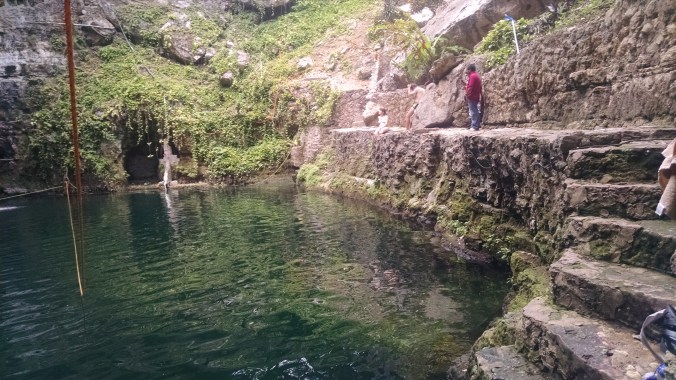
Cenotes (pronounced say-no-tays) are underground pools of deep, fresh water that are contained within large, cave-like depressions, like sinkholes.  They are lighted from above via holes of varying sizes creating interesting and often mysterious plays of light on the rocks and the water.

The Yucatan is dotted with hundreds of these cenotes which are part of the larger aquifer on which the whole peninsula sits.  Andrea and I have read about them and are anxious to see one.  We’ve toted bathing suits and towels with us to fully submerge in the experience.

It takes some asking for us to find Cenote Zaci but we’re soon upon it.  We pay our 30-peso ($2.50) entrance fee and find the changing rooms.  As we take the stone stairway down into the gorge, the breadth and beauty of the place engulf us.  Three or four people are swimming below and we’re eager to cool down ourselves.

Zaci

Descending into the cold, clear water is amazingly refreshing.  Andrea and I are finding ourselves compromised by our age with a diminishing ability to withstand high temperatures and humidity such as we’ve experienced the past two days.  Swimming in the cenote revives us, the natural beauty of the place as well as the cooler air temperature and downright cold water.  We emerge feeling alive, awake and very happy to be with one another in this special place.

Our cenote story continues the following day on our return from Chichen Itza.  We’re both sweaty and fatigued when we arrive at another public cenote in the town of Dzitnup.  This one is a little more commercialized, with vendors and food offerings lining the footpath to the cave.  But when we finally start descending into the dark, another grand, natural cave mansion opens before us.  I put on my swimming goggles this time to better view the many fish that inhabit the waters of this and most other cenotes.  The cenote magic works again and within half an hour we are both transformed into happy, vigorous old folks.

The last cenote we visited was on the morning of our departure from Valladolid.  A young woman friend of Abuela Judith had offered to take us to her favorite cenote about fifteen miles out of town.  After we packed our bags and secured our bus tickets back to Cancun for later that day, our new friend Chio drove us over back roads where the only people we saw looked decidedly Mayan.  She told us that she visited this cenote a few times per week to relax, meditate and pray.  She also said it was used by the local Mayan people for special rituals and ceremonies.

The Mayan cenote was not overtly commercialized like the other two.  We descended via a spiral staircase deeper and deeper into the dark.  A Mayan girl 6 or 7 years old led us down with a flashlight.  This was the deepest cave of the three, and the most beautiful and mysterious.  After swimming around the pool, Chio led us to a sand bar where we could stand out of the water.  The silence was awesome.  At one point, we watched a pail being dropped down into the pool by a rope, the pail submerged and then lifted to the surface hole at least 100 feet above.  I felt myself in a zen-like state of simple but profound awareness.

cenote3


Chichen Itza

Our friend Judith generously offered to lend us her car for the 30-mile drive to the legendary ruins of one of the largest Mayan cities.  She urged us to go immediately after breakfast to avoid the crowds and the full heat of the day.  I had spent the previous afternoon relaxing in the courtyard, reading up on this archeological marvel via Wikipedia.  Judith had also lent us two pictorial guides to the ruins which helped me get oriented.

The Mayan name Chichen Itza translates as “at the mouth of the well of the Itza people”.  The city was built over a large aquifer with a deep cenote now known as the “Sacred Cenote”.  Like the town of Valladolid, this ancient city was built at a place where the inhabitants were guaranteed a dependable source of fresh water.

Chichen Itza is now an active center of the Mexican tourist industry.  Even at 10am the parking lot was filing up with buses, vans, taxis and private cars like ours.  Vendors of all stripes lined the road in, actively hawking their wares.  We found a parking spot, lathered up with sunscreen, and set out to the large, modern entrance building to buy tickets and enter the site.

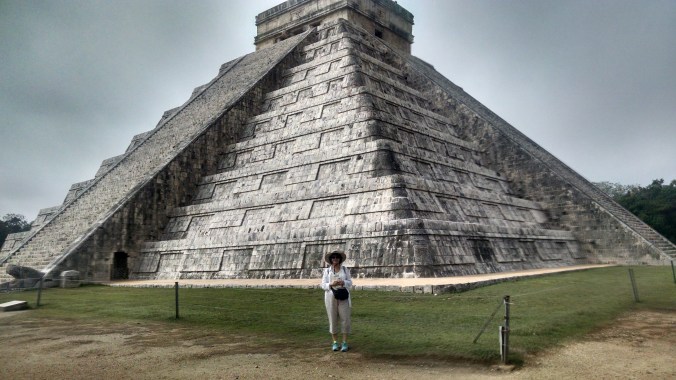
The centerpiece of the ancient city is an intact pyramid rising almost 120 feet.  The Mayans called it the Temple of Kukulkan, one of their principal gods, represented as a feathered serpent, similar to the Aztec’s Quetzal Coatl.  The pyramid/temple dates from AD 800-900, known as the Terminal Classic period of Mayan civilization.

Castillo-1

The stone edifices surrounding the pyramid are in varying states of disrepair.  Archeologists have been examining the site for over a century and a great deal of information about Mayan government, science, culture and religion has been derived from the study of artifacts uncovered in this major center of pre-Columbian civilization.

chichen-2


A Mexican Wedding

The initial impetus for our journey was a wedding invitation from a Mexican friend of Andrea’s who lives in Cancun.  We’d reserved a hotel room there for the weekend and were really looking forward to the event, having experienced an unforgettable wedding in Guanauato some years previous.

This one did not disappoint.  The reception was to be held outdoors and I was a bit concerned about wearing formal attire in the tropical heat.  Our Mexican friends had the perfect solution – purchase a guayabera, a traditional white linen Mexican-made shirt.  While in Valladolid, we found a small shop that had just what I needed – a formal (long sleeve) “presidential” guayabera.  Andrea had shopped for her lovely dress back in the DC area and Abuela Judith had given her an approving thumbs-up.

The wedding ritual was performed in a modern Catholic church in the wealthy suburbs of Cancun.  Our friends in Valladolid were attending, since both bride and groom were members of our spiritual community.  We all sat together in church as I strained a bit to follow the proceedings in Spanish.  It was a traditional Catholic wedding with Mass, a sermon, and communion.  After their vows were exchanged, the happy couple knelt in prayer before a large painting of Our Lady of Guadalupe that graced one side of the altar.

church

The reception took place in a well-appointed suburban country club nearby.  Three hundred guests attended this classy affair, with delicious seafood canapes and wine proffered as we entered the grounds.  It was a magical evening filled with camaraderie, delicious food, and vigorous dancing on a glass dance floor lit with colored lights from below.


Isla Mujeres

Our hotel in Cancun proper was not near a beach, but offered a wonderful rooftop swimming pool that we made good use of on both days of our stay.  Once again, clean, cold water was our savior from the heat and humidity.  After a final dip on Sunday morning, we re-packed and caught a cab to nearby Puerto Juarez where we would get our ferry to Isla Mujeres.

pool1

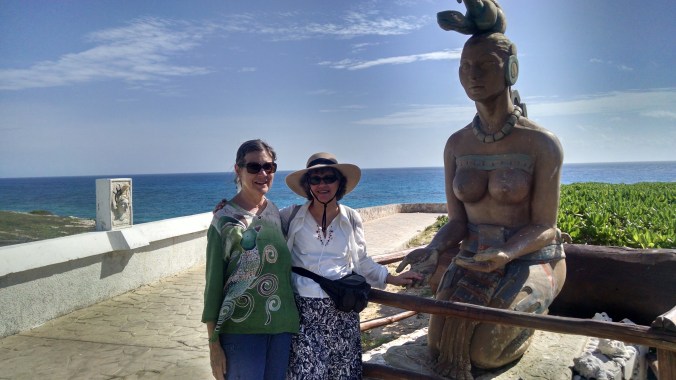
Isla Mujeres (“Women Island”) was so named by the Spanish invaders who found a plethora of sculptures representing Mayan goddesses, especially of Ixchel, goddess of fertility and childbirth.  The Island is a thin patch of land about 4 miles long that lies about 8 miles off the coast of Cancun.  Puerto Juarez had an efficient ferry service with modern, passenger-only boats carrying up to about 150 people every half hour throughout the day.

We enjoyed the half-hour boat ride, sitting out on the top deck, serenaded by a talented Mexican folk singer.  It was our first real contact this trip with the warm, aqua-green waters of the Caribbean.

We had reservations for three nights at a small beach hotel on the Caribbean side of the island.  On checking in, I was surprised when the hotel clerk presented me with a handwritten note from an old friend who was staying with his wife in another nearby hotel.  We’d known they’d been planning a trip here but didn’t know the dates.  After we got settled in our room, I walked over to my friends’ place and caught them just as they were heading out on a food shopping trip.  We celebrated our good fortune at connecting and arranged to have supper together that evening.

playa media luna-1

Our three-day stay at Playa Media Luna (“Half Moon Beach”) was a perfect ending to our trip.  We had time to rest, read, swim in the seaside pool or a nearby tidal lagoon, have meals with our friends, and shop for gifts.  A highlight was our visit to the southern end of the island with our friends one clear, sunny morning.  The remains of a temple to Ixchel are still there, memorialized now by a modern sculpture park as well.

andrea-joyce-ixchel

We had an uneventful leave-taking and arrived back home tired but happy.  Yucatan had lived up to its Aztec name.

IMG_20170531_114734751_HDR


John Bayerl,  Derwood, MD


Gaithersburg Book Festival 2017

Gaithersburg Book Festival (GBF),  Saturday May 20, 2017

The GBF is a tribal festival for those who love good books and who also love to share their passion with others.  The 100 or so invited authors ground the day in focused readings, presentations, and dialog with attendees.  The Politics and Prose enterprise from DC uses a big tent as a bookstore devoted to the specific books being presented by their creators that day.  It’s a great pleasure to purchase a book there after an author’s presentation, and then meet and talk with the author in a designated book-signing area.

This was my third year in a row attending this one-day celebration of contemporary authors and their readers. Two of my sisters drove all day Friday from western New York state to attend the festival and enjoy a comfortable weekend of family companionship with my spouse and me at our home in neighboring Derwood. They had ventured down for this occasion two years ago as well. Our ongoing involvement since then in our family book group was keeping our shared love of reading alive and well.

The experience of the GBF is akin to attending a summertime “Chautauqua” — an old-fashioned fair-like environment in which the lead attractions are current writers and their latest books.  Within this rich, creative environment, human encounters occur, discussions are entered into, and new ways of thinking and experiencing are articulated and shared.

I’m going to share a subjective account of my experience of the 2017 GBF. By way of disclosure, I’m a 67-year-old recent retiree who has taken up creative writing as a hobby.  My youngest sister, Anna, is a devoted teacher and librarian at a public grade school, and my middle sister, Marian, is a working mother who is about to retire from a career in accounting and finance.  Our family book group, conducted monthly via conference call, has brought us together in deep and beautiful ways over the past year.


Not the Cleaver Family

The three of us have each studied the Author Presentation Schedulefrom the professionally rendered GBF website.  The schedule is a full-page 10X8 grid of locations, authors, and start-times.  Our first destination is the James Michener Pavilion, consisting of a large white tent, open at the sides and front, with a speaker’s table and dais at the far end and with metal folding chairs arranged in neat rows from the entrance.  It’s just after 10 AM and a short, vivacious, middle-aged, brown-skinned woman is enthusiastically speaking about her current family life in the upscale Chevy Chase suburb of Washington, DC.

Her name is Maria Olsen and she is a “mixed race” (Filipina/Irish) mother of two Anglo-looking children.  She’s a lawyer as well an author, and also hosts a weekly FM radio show on her special topic — the radically changing demographics of the American family.  She shares personally, and painfully, about how often she is mistaken for her children’s nanny, or hired housekeeper.  She says that the challenge of being “other” is what drove her to a deeper investigation of what she calls the “beige-ing” of America.  The fruition of her work is her short, illustrated book, “Not the Cleaver Family — the New Normal in Modern American Families”.

Ms. Olsen is a dynamic, well-organized speaker and uses her half-hour to positive effect.  She speaks not only of the growing ethnic and racial mixing in families, but also of single-parent families, families led by same sex couples, the growing number of “singleton” (one child) families, and families who adopt or sponsor foster children.  She goes beyond espousing tolerance to positively endorse the rich, variegated, human environments that we are creating within this large multi-ethnic, multi-racial, multi-cultural, multi-sexual society.  She speaks with the authority of incontrovertible demographics:  in 20013, white children under 5 years old were a minority among all American 5-year-olds; by 2043, less than 50 percent of the US population will be white.

My sisters and I are taken in by this warm, smiling, intelligent woman.  My wife and I, both white, adopted Afro-Brazilian children in 1998 so this territory is already familiar to us.  We have family members and close friends who also occupy some of the “other” demographics Ms. Olsen describes.  “Leave It to Beaver” was a favorite childhood TV show for us in the 1960’s, even though our gritty working-class family life was a far cry from that of the Cleaver family on TV even then.  I leave the tent inspired by this unabashedly enthusiastic affirmation that the rich diversity of American families will continue to grow and prosper despite temporary, reactionary, fear-based attempts to ostracize and demonize “the other”.


The Good at Heart

The second author we visit is a German-born woman, Ursula Werner, a local lawyer and published poet, who has just written her first novel, “The Good at Heart”.  The title comes from Anne Frank’s diary, in which the Nazi-persecuted and pursued Jewish girl writes: “In spite of everything I still believe that people are really good at heart.”

My sibs and I are children of a 2nd generation German-American father who was a sergeant in the American army fighting the Germans in northern Africa, Sicily, and Italy during World War II.  We had many uncles and family friends who were also WW2 veterans, and our parents met at an American Legion social event in Buffalo, NY, right after the war.  War stories and lore were the lingua franca of many of our family gatherings.  Two of the books we had read together in our book club this past year — “The Boys in the Boat”, and “The Nightingale” — one non-fiction, the other a novel — were set within the wrenching history of that horrible bloodbath.  How could we not be drawn to a new novel that dealt with the author’s own German family living through that conflict as subjects of the Fuhrer?

Ms. Werner was given an eloquent introduction by a young lawyer colleague and friend, a Jewish man who testified to his friend’s deep passion for human rights.  Born in Germany, she grew up in Florida.  She maintains a relationship with her family in Germany and visits there often.  She had long been curious about her great-grandfather who was an economist who had served in the government of the Weimar republic and subsequently as an assistant cabinet member in the Nazi government.  He had been arrested by the Allies after the war but was acquitted at his trial.  No one in Ms. Werner’s family was willing to speak much about this great-grandfather and Ms. Werner herself feared the worst — that he had been an ardent Nazi.  But she persisted in her attempts to get her German family to share more information and finally, one of her cousins steered her towards a box of old documents in her Hamburg basement.  Those documents proved to be the legal papers in which her great-grandfather and his lawyer made a credible case for his having kept himself apart from the worst excesses of the Nazi atrocities.

Ms. Werner has used that basic information to construct what sounds to be a highly riveting novel.  She read from a chapter in which Franz, a son-in-law and career soldier, is part of Germany’s 1939 invasion of Poland.  Until that point, Franz has sworn allegiance to the Nazis and their call to revive German nationalism.  The brutal excesses of the Polish invasion sicken Franz and he begins turning against the Nazis, eventually joining one of the anti-Nazi resistance cells that actively plot assassination of Nazi leaders.

Having recently watched the classic film “Judgment at Nuremburg” for the third time, I had concluded that no German officials of the Nazi era were wholly innocent of the atrocities committed by the government, SS, and army.  Ms. Werner was making a case that there were many shades of gray, and that it was worth taking a deeper, harder look at the historical records.  She believes in the importance of knowing the worst of what occurred, but also of investigating those incidents in which many brave Germans attempted to thwart the monstrosities of the state.

At the end of her presentation, my sisters and I looked at one another in unspoken agreement that we definitely had a candidate for our book group.  I rushed over to buy a copy of the novel and got in line at her signing table afterwards.  I congratulated Ms. Werner on publishing her work and told her a little about our book group.  After carefully inscribing my copy, she looked at me and said that she would be happy to speak on our conference call meeting if we chose her book.  I felt a kinship with her in that moment and shared her offer with my sisters.  They had already purchased the book themselves.


Sonora

The last author event we attended had an interview format.  Hannah Lilith Assadi is a young, pretty, articulate graduate of Columbia University’s MFA program in Creative Writing.  She recently published her first novel, “Sonora”, loosely based on her own life growing up near the Sonora desert in Arizona, the daughter of a Palestinian father and an Israeli Jewish mother. She was interviewed by the Armenian-American writer, Garine Isassi, who had read “Sonora” and had many engaging questions for Ms. Assadi.

Author and interviewer established an immediate rapport from their shared sense of growing up as “the other”.  Most of Ms. Assadi’s Arizona schoolmates and family friends were white Americans, with little previous contact with either Jewish or Arabic people.  Ms. Isassi’s family were the only Armenians in their small Texas town.  Both women spoke of their confusing attempts to gain a sense of identity and place within communities which largely held them as invisible at best.

Ms. Assadi read from “Sonora” and transported us to the hot, dry, windy domain of the Southwest desert where her taxi-driving father would often take her to find a sense of home. The young heroine began having bizarre visions and nightmares from these desert forays.  One of her classmates is an Apache girl who shares her feeling of being an outsider.  They strike up a close friendship that culminates in both setting out for New York to seek their fortune as creative artists.

The interviewing format worked superbly for this presentation.  I appreciated the genuine affection and interest that Ms. Isassi exhibited to her younger colleague.  At the end, Ms. Assadi shared her own deep scholarship and love of contemporary Middle Eastern poetry — Arabic and Jewish.  My sisters and I were taken with the rich, evocative prose-poetry of “Sonora”, and even more so by the opportunity to hear both women speak so openly and honestly about their struggles to claim their identities as authors.


Connecting

Another highlight of this year’s GBF for me was connecting with other writer friends. I’m a member of the Maryland Writers’ Association (MWA) and enjoy hanging out at our organization’s table on the festival grounds. I had an inspiring connection there with Randall Luce, a local author who has written a series of mystery novels set in the Mississippi delta.  I’d met Randy at previous MWA meetings and admired his soulful expressiveness and rich facility with language.  At the MWA table, I had a chance to hear about the inspiration for his Mississippi novels – the years he had spent living there as an anthropology graduate student, working on his dissertation about the local history and culture.

I also connected with my writing buddy Mark and enjoyed a picnic lunch with him.  We shared a table with a man my age who was reading that day’s Washington Post.  The three of us had a lively discussion about the current political circus in town.

I drove home with Anna and Marian late that afternoon tired but happy.  The three of us were bubbling over with stories about what we had seen and heard.  The Gaithersburg Book Festival had exceeded our expectations once again.

John Bayerl, Derwood, MD

The Spirit of Standing Rock Lives

[I wrote this piece after participating in the Native Nations Rising march in downtown Washington, DC, on March 10, 2017]

The story of the Standing Rock people’s resistance to the Dakota Access Pipeline (DAPL) has been in and out of the national news for well over a year now. By most accounts, the story ended with Donald Trump’s presidency, and his overt pressuring of the Army Corps of Engineers to ignore the Obama administration’s last-minute commitment to conduct the necessary environmental impact study about the pipeline’s possible long-term effects. With the Army Corps reneging on their agreement and granting the necessary easement rights on Federal property, the doors were reopened for the DAPL to be completed.

So why did the recent march from the Corps of Engineers headquarters in downtown DC to Lafayette Park, across from the White House, feel so empowering? The Washington Post story​ about the march (http://wapo.st/2mt5kOP?tid=ss_mail) conveys some of this spirit, featuring short interviews with native peoples from all over the country who had made the journey to be in the Capital for this historic gathering of “Native Nations Rising”. The long, hard struggles at Standing Rock over many months had served to create a growing consciousness of indigenous rights and a uniquely indigenous world view that had entered the consciousness of many Americans, native and otherwise.

My wife Andrea and I had participated in the historic Women’s March in DC on January 21. We traveled down to this march together on Metro again, exiting at the same station where we had joined the overwhelming throngs just six weeks ago. The Native Nations Rising march was on a much smaller scale – a few thousand or so compared to an estimated half-million on 1/21. But like the Women’s March, it was a lively and inspiring affirmation of people willing to put their boots on the ground to both oppose the Trump agenda and commit to a sustained opposition movement.

I’d been downtown the day before and had visited the Standing Rock encampment on the Washington Monument grounds there. There were half a dozen white teepees and a larger food tent on the wide-open Monument grounds. It was a warm, sunny day and people were gathered in small groups, talking, singing, eating. The permit didn’t allow for overnight camping, but it was clear that a hundred people or so had succeeded in creating a welcoming environment of friendly fellowship. The months-long encampment at the Sanding Rock Reservation had reached up to 15,000 people at some points, and it felt like the sense of community created there had been transplanted to DC.

I made a special trip afterwards to get supplies for a march poster. The teepee encampment had many banners expressing “Water Is Life”, and in Lakota, “Mine Wachoni”. One of the elements of the Standing Rock story that irked me most was that the original route for the DAPL was for a Missouri River crossing near the city of Bismarck, ND. The city officials had responded to popular concern about the safety of the city’s water supply and prevailed on the drilling company to move the pipeline. The site chosen was further south towards the Standing Rock Reservation. My carefully hand-lettered sign would say:

“Water Is Life, in Standing Rock as in Bismarck”

Joining the march at its tail end on 4th Street NW, we were immediately taken in by the high spirits and positive energy. Despite a cold, slushy rain, people were chanting slogans, and proudly displaying their posters. Many native people were dressed in colorful, traditional attire. Friendly marshals kept us on our assigned half of the street as our long line of men, women and children twisted its way through the streets of downtown DC.

The march turned onto Pennsylvania Avenue just before the Old Post Office building, now the Trump International Hotel. It was a sobering moment to stand in front of one of our new business-mogul-president’s recently renovated hotel ventures just blocks from the Oval Office. The march paused in front of the hotel for a good long while. A team of Native Americans assembled a small white teepee under the four large American flags hanging in front of the hotel. They proceeded to enact a mock ritual using a life-sized cardboard effigy of Trump that was placed on the street surface near the teepee. Natives in traditional attire proceeded to jeer and poke ribboned batons at the effigy right there in the very heart of his real estate empire.

By the time the march resumed its trek down Pennsylvania Avenue to its terminus opposite the White House, the sun had begun to peak through the heavy, gray clouds and the drenching sleet stopped entirely. The sense of physical relief from the cold and wet was palpable. A small stage had been erected in the middle of Lafayette Park, surrounded by large trees in spring bud. As the main part of the march filled the park, other smaller contingents remained outside the White House gates chanting their disapproval of the new president, who had almost single-handedly upended a carefully worked out agreement to reconsider the routing of the pipeline.

The speakers at the rally included Standing Rock’s chief David Archimbaud and others who testified to their sense of being disrespected and dismissed by the new administration. But included with these grievances were strong statements of resolve that the spirit of Standing Rock would persist, fortified as it had been over the many long months of the encampment. Many younger native men and women spoke to the re-igniting of their tribal consciousness, and to the fundamental teachings of the Elders regarding the primacy of the Earth, the Air, the Water, and all the creatures of the Earth beyond any attempts to expropriate or marketize them.

The spirit of the march was positive, creative, friendly, and affirming of the unity that had emerged among the Native Nations and their many non-native allies. The prospect of ongoing resistance was evident not only in the street theater in front of Trump’s hotel, but also in the fact that eight people had engaged in a peaceful act of civil disobedience during the march, chaining themselves to the entrance of the Sun Trust bank, an institution that continued to engage in large-scale investments in the DAPL and other fossil fuel ventures.

The DAPL may well be completed, but the spirit of Standing Rock remains strong, nurturing and sustaininng the long-term resistance movement that is now taking root.

John Bayerl,  Washington, DC; March 10, 2017


Spring Sweat Lodge and Medicine Wheel Ceremony

Spring Sweat Lodge and Medicine Wheel Ceremony

Sevenoaks Retreat Center

March 21, 2017

My partner, Don Harvey, and I recently conducted a Spring Sweat Lodge at Sevenoaks as an opening ritual for day-long equinox ceremonies and workshops at the Sevenoaks Retreat Center in Madison, VA.  The theme for the day’s gathering was “Ancient Wisdom for Our Time” and featured a Medicine Wheel Ceremony in the late afternoon, led by Susan Thesenga, co-founder of Sevenoaks.

The sweat lodge is an ancient Native American ritual that we have been enacting at Sevenoaks for over three decades.  It allows for deep, intensive physical and emotional purification within a context of prayer, reverence for the Earth, and the formation of a healing community.

A medicine wheel is a sacred alignment of large stones in a circle, with the largest “Earth Stone” in the center, with other large stones serving as direction indicators — a kind of sacred compass, with additional aspects of a sacred calendar.  The medicine wheel serves as a ceremonial ground for guided, intuitive unfoldings of wisdom and energy within co-created ritual.

When performed together, the ceremonies can work synergistically to maximize inner awareness and healing.


Prolog

             I’d driven down to the Center in central Virginia from my home in the DC area the day before to help out with the preparations.  As I drove, the sun fell behind the clouds around mid-day and I could feel my spirits start to wilt from all the dire news being reported on the radio.  I decided to turn it off, and sing some of the songs and chants that I would be leading in the lodge the next day.  Singing for an hour or so as I drove definitely lifted me and I arrived at the Center inspired to get to work.

As it turned out, the Center grounds manager, Alex Comer, had just completed his last preparatory task for the lodge, splitting a large pile of dried pine, cedar, and locust logs for the lodge fire the next day.  Alex shared the work status with me before leaving for the day.  I unloaded my overnight things into my assigned room in the large Center Building and proceeded outdoors for the short walk down through the pine woods to the ceremonial lodge site, overlooking a pond at the bottom of a wooded hill.  I like to spend some time before conducting a sweat lodge within the subtle but real vibratory presence of the physical space: the woods, the pond, the lodge itself, its earth altar, and fire pit enclosed by three decades of spent rocks from previous lodge ceremonies here.

As I descended towards the pond, I was taken with the clear vistas opened by Alex’s recent landscaping project there.  Removal of many dead trees and bushes had opened the view to the pond.  The impression was like seeing an old friend with a fresh, flattering haircut.

The whole lodge site felt similarly open and fresh.  The sun had re-emerged from the clouds and even the usually murky pond waters seemed to sparkle.  Alex had reinforced some of the cedar poles of the main lodge and covered the whole with clean blankets and a new white canvas.  The freshly cut wood was neatly stacked near the fire pit.  I felt light and happy as I gathered kindling for the lodge fire, raked the lodge interior, and exterior pathways, and hung a new earth flag that my spouse had lent me for the ceremony.  I was able to hang it at eye level from two saplings standing just behind the fire pit to the east of the lodge.  When I finished my tasks, I proceeded to conduct a sacred pipe ceremony within the lodge itself, with its door opening to the lovely blue earth flag.  The tobacco smoke from the pipe helped to open my heart and mind to the beauty of this sacred place.

My partner Don arrived late that evening and we had breakfast together in the Center dining room the next morning before setting out to work around 8am.  We loaded a cart with everything we needed:  gallon water jugs, bag of fruit, towels, lodge-door, hand drums, and our own gear, consisting mostly of sacred objects and herbs used in the ritual.  As we hauled the cart through the parking area to the footpath down to the lodge site, a car pulled in and I checked in with the driver.  He was indeed here for the sweat lodge and eagerly joined us.


 Laying the Fire

It was still lightly overcast and the ground was wet from a light rain overnight.  But it looked to be clearing and the temperature was already in the mid-40’s, with a predicted high of 65 for this first day of Spring.  It was good having the new man join us in guiding the heavy cart down the narrow, twisting footpath through the pine woods.  He had just driven over the Blue Ridge from Harrisonburg to be with us for his first sweat lodge and his enthusiasm was palpable.

Conducting a sweat lodge is about a 6-hour affair, starting with about three hours for laying, lighting and tending a bonfire sufficient to bake about two dozen large stones to a red glow.  The ceremony inside the lodge lasts about two hours.  And the dismantling and closing communal meal is another hour.

But the work is all performed within ceremonial time, rather than by the clock.  Our first order of business on arriving at the lodge site was to burn sage and smudge the site, and ourselves, within its purifying smoke.  The new man knew about smudging and entered into a calm, relaxed presence with Don and me as we consciously cleansed ourselves, physically, emotionally, and spiritually, for the work ahead.

We then turned our attention to laying the fire, and carefully placed a platform of six logs to support the stones.  Three new women joined us as we turned to the stone pile.  Don proceeded to smudge the women and we each selected a head-sized stone to lay on the platform within the fire pit.  One of the women placed the Mother stone in the center of the platform, and the rest of us placed stones for the East, South, West and North around the Mother stone.  The Father stone was laid as a capstone for the essential template that grounds the energy of the stones within the fire.

We then placed the remaining eighteen stones on the platform, surrounding and on top of the six template stones.  Each of the additional stones was consciously offered and placed, with the naming of a desired quality or spiritual force.  In the lore of the lodge, each stone represents a “Tunkashila” or Grandfather Spirit, which is activated as it is heated.  The heated stones carry the energy of the fire into the lodge, where that searing heat can be tempered to serve the real needs of human beings for physical healing and spiritual renewal.

As this process continued in a deliberate manner, more people kept arriving at our ceremonial site and Don would go over to greet and smudge them.  The ritual washing in the smoke of burning herbs, like sage, is intended to encourage each entering person to step into an awareness of common commitment to what is sacred and holy on this Earth.  Sage, in particular, has a sharp, cleansing quality that can help penetrate any psychic defenses.

After the 24 stones were laid, we proceeded to place the kindling branches and sticks around the platform in a teepee shape, stuffing newspaper in between the sticks and the stones.  All 10 or so of us, men and women, joined in on this task, and followed it with laying the split logs all around the base, and then in a second vertical layer on top of the first.  Aesthetics matter in all sacred ceremonies, and we worked together to create a satisfyingly symmetrical teepee of stones, wood and paper.

New people continued to arrive as we invited everyone to form a circle around the fire pit.  I sent a pouch of tobacco around the circle and invited everyone to take a pinch of it.  We then proceeded, one at a time, to each offer a prayer of intention with our tobacco, sprinkling it on the wood-and-paper teepee.  Intention is the key to benefiting from any conscious ritual.  As each person spoke from the heart to affirm their reason for being there, I sensed a current of common spirit and purpose forming within our human circle.

With this initial prayer circle completed, Don came forward to begin lighting the fire, using a paper-torch to ignite flames in each of the four directions. The fire began to rise rapidly all around the circumference.  I’d begun a slow drumbeat and others joined in with other drums and rattles.  As the inner kindling and paper quickly ignited, we offered the first of many sacred chants together:

Oh, Great Spirit,

Earth, Sun, Sky and Sea,

You are inside

And all around me.


Inner and Outer Preparation


It takes about two hours to bake the stones to a glowing red.  It can be a rich time for all participants.  We encourage an ongoing drumbeat throughout, and sometimes a lively drum-and-dance circle is formed, with anyone free to lead chants and songs, or to move around the fire pit with simple dance-steps.

This can also be a good time to walk in the woods, to meditate or pray, or to converse consciously (not just chatting) with other participants.  I’ve learned from doing this work that, after some initial unease, most people enjoy free time outdoors, unplugged from their phones and daily responsibilities.  Learning how to just “be” in the natural world is a worthwhile practice in its own right, helping us to calm our nervous systems, bringing our focus back to simple presence.

As a “water pourer” for the lodge, I have some additional tasks to attend to during this time. These include readying the lodge structure itself, and ensuring the close proximity of water, bucket, ladle, and herbs.  In damp weather like today’s, I prefer to line the earthen floor of the lodge with cardboard, tarps, or some combination of both.  I’m also responsible for attaching a sleeping-bag-door to the only entrance, in the East.  On a good day, like this one, there are many offers to help and we make quick work of it.

The last thing I like to do before we all enter the lodge is to call everyone into a big circle in the wide-open, adjacent beach area of the pond.  Although the announced start time was 8:30, people have been arriving throughout the morning and the group as a whole hasn’t had a chance to congeal.  We start with a round of first names, with the whole group echoing back each person’s name.

I know from experience that it can be a physical challenge for many of us to just sit for two hours within a confined space.  It can really help if we allow ourselves lots of full-range bodily movements beforehand.  All the Pathwork Helpers at Sevenoaks get training to lead movement classes, and I call on that training, and on my fellow Helpers in attendance, to lead the group through some grounding, bending and stretching exercises.

I also lead a simple “trust circle” in which all 18 of us take hands in a circle.  I then invite everyone to take a step back.  This creates a tension within the connecting hands and arms that allows each person to lean slightly backwards, supporting and being supported by the people on either side.  I invite people to experiment with more or less tension, more or less leaning back, paying attention to sensations of both supporting and being supported.  This usually becomes fun and playful.  It also can induce feelings of both active participation and surrendering to the group.

The sun emerged through the clouds and I encourage everyone to turn and face “our star” on this day of Equinox.  I invite an arms-raised posture to really receive the light and warmth from this magnificent celestial furnace, and to express a “sun salutation” in whatever physical form felt right.

             I thank everyone for coming to the sweat lodge this morning and encourage everyone to stay on for the aftternoon Medicine Wheel.  About a third of the participants are here for their first lodge, and I invite the new people to bring their full attention to their experience, with a minimum of pre-conceptions or expectations.

Don and I communicate that there will be four rounds to today’s lodge ceremony, each round with a theme.  At the end of each round, the door would be opened and drinking water would be circulated.  If anyone needed to exit the lodge, it was best to do it between rounds.  T-shirts and shorts were the prescribed attire for this lodge.  Women would enter first, by order of age, to occupy the north side of the lodge.  Men would enter next, by age, and occupy the south hemisphere.  I noted the native practice of honoring the Elders by allowing them first entry into the lodge. We wished everyone a good sweat and prepared to enter.


Round One — The Powers of Creation

             As “water pourer”, I enter the lodge first, on hands and knees, putting head to ground at the entrance and offering the prescribed Lakota prayer for entering and leaving: “Mitakuye Oyasin”, translated as “All My Relations” or, “We Are All Related”.  I circle to the left around the central stonepit of the lodge as the women follow, arriving at the other side of the door, where I sit and shake my rattle at a slow, deliberate beat as people continue to enter.

I learned the protocols for the “All Nations Sweat Lodge” during a five-year informal apprenticeship I served some 25 years ago.  My teacher had a connection with a Lakota “Uncle” who had authorized use of the “All Nations” lodge by serious-minded non-native people.  Tradition and lineage are still important to me.  Following the prescribed forms helps me to stay grounded within an awareness of the Native American traditions that sweat lodge comes from.

After everyone has entered, I communicate with the two “firekeepers”, a woman and a man who have volunteered to stay outside, to begin bringing in hot stones, one at a time, on a pitchfork.  One firekeeper digs out a hot stone from the base of the fire and the other uses some lashed-together cedar boughs to brush off any ash residue.  Each stone is greeted with a “Welcome healing stone” as it is brought in and as I guide the pitchfork over the stonepit, depositing the first stone in its center. This is the “Mother Stone”, representing Earth herself, the foundation of the lodge ceremony.

Additional stones are brought in, continuing with the four direction stones, and the Wakan Tanka (“Great Spirit”) capstone.  Each stone is blessed with sacred herbs as it is placed in the pit, sweetgrass first, followed by sage, cedar or other appropriate herbs.  The sweet aroma of the burning sweetgrass and other herbs soon fills the lodge.

With the stones forming a glowing presence in the center now, I request the water bucket and dipper from a firekeeper and ask that the door be closed.  It’s a special moment when the door falls over the opening, enclosing us in a warm, dark, moist environment that is intended to evoke a feeling of our mother’s womb.

The first round of the All Nation’s Lodge brings our attention to the ongoing creative forces of the universe as expressed in the Lakota “Wakan Tanka”, which can be translated as “Great Spirit”, “Great Mystery”, “Creator”, “Divine Source”.  A translation that resonates most profoundly with me is “Great Spirit-ing”, acknowledging the ongoing activation of the Creator.

As I pour small amounts of water onto the hot stones from my dipper, heat and steam rise in the lodge and I invite everyone to take in “Grandfather’s Breath”, the healing energy of the stone-people.  It’s important to orient oneself to the healing properties of the heat and steam and to welcome its penetrating and softening energy within any stiff, hard places of body or mind.

I’ve learned over the years that the experience within the sweat lodge is often enhanced by deep and regular breathing.  After a period of silence in which we simply take in our new environment, I lead the circle in a deep breathing exercise in which everyone is encouraged to inhale deeply and vocalize an “Ahhh” on the exhale.  This is repeated four times until the “Ahhh” begins to modulate to a more harmonious sounding of voices.  Then I invite an ongoing sounding of the sacred sound “Om”.

“Om” originates in ancient Sanskrit and is the sound of creation in Tibetan Buddhism.  I encourage a visualization of the moment preceding the Big Bang, when all the creative potential of the universe was gathering itself.  I encourage people to allow their voices to express fully and openly with their “Om”, allowing the natural and spontaneous harmonies that inevitably occur.  In that spring equinox lodge, I experienced our Om-ing as a series of energetic waves emerging, growing, climaxing, and subsiding.  The co-creation of this deeply resonant chanting never fails to fill me with awe and wonder.

Physics teaches that three-dimensional Space-Time emerged out of the supreme unitive compression that preceded the Big Bang.  After the Om-ing recedes, I offer an ancient Lakota song of the sacred directions to mirror this primordial movement from One to Many.

The spirit of the Creator, Wakan Tanka, inhabits every nook and cranny of the great unfolding universe, but is seen to manifest as a more focused presence in the four cardinal directions, as the Grandfathers of the West, North, East, South, and in the above and the below.

The Lakota directions song is structured with an invocation to the Grandfather spirit of each direction, inviting its presence within the lodge, followed by a choral singing of love, appreciation, and human longing for the spirit’s presence.  The Lakota words and the melody of this chorus are simple and most participants are able to join in:

Chek-i-aye-o, chek-i-aye-o

A-hit-oo-wan yan-kay-lo.

The Lakota directions song begins by calling in “Wieoh-peyata”, the Grandfather of the West, and all the beings who manifest most strongly in the evening and in the season of autumn. They are the true Elders, the spiritual teachers, the ones who protect and disseminate the ancient ways and teachings of the ancestors.

The song moves to an invocation of “Waziya-takiya”, the Grandfather of the North.  The north is the direction of winter, night-time, old age — the looks-within place of expectant waiting and hibernation required to survive a long, cold winter.  This Grandfather also guards the pathways between material life and the great beyond, allowing the spirits of the ancestors to communicate with us.

The next invocation is to “Wieoh-iyampata”, Grandfather of the East, guardian of the dawn, of birth, of youth, and of the springtime.  Its force is strongest now, on the Spring Equinox, when new ideas, new projects, new relationships, and new beginning of all kinds are most auspicious.

The last of the cardinal directions, South, is called in as the Grandfather “Itokagata”, the guardian spirit of the fullness of summer, noontime, adult maturity.  The South is the time of fullness, power, and vitality, the time when plants grow to their fullness and adult humans tend to their loved ones and their work, building and nurturing what the family and community most need to sustain themselves.

The song then turns to what is above us, the firmament of the heavens, the place of the Creator, the essence of the Divine Masculine.  The Grandfather “Waka-takiya” is called to bring his creativity and energy and light to all the participants in the lodge.

Finally, the song acknowledges “Maka-takiya”, Grandmother Earth, the very ground on which we sit.  The essence of the Divine Feminine is the holding container of love and nurturing that planet Earth offers all her creatures.  The chorus changes here to acknowledge the Mother’s ongoing presence as the bearer and sustainer of all life on Earth.

Water is poured on the hot stones with each of the six directional invocations.  By the end of the song, we are all sweating, and we rest in silence for a while before opening the circle to some personal prayers and a closing song. As the round ends, the firekeepers are called to open the door.  Fresh air flows in to cool the lodge, drinking water is circulated, and people can exit as needed.


Round Two — “We Are All Related”

             The essence of Native American spirituality rests in its lived appreciation of the intrinsic inter-relatedness of all creatures. This spirit is expressed in the Lakota mantra “Mitakuye Oyasin”, which is the theme for our second round.

My partner Don pours water for this one.  Don is a retired Forest Ranger who served in the nearby Shenandoah National Park maintaining hiking trails for much of his career.  His knowledge and love of the natural world is readily apparent.  After more stones are brought in and the door comes down, he invites us to settle into our own personal connection with the natural world.

He then invites us to connect in spirit with a wild animal that we feel a connection with; to visualize that creature in its natural environment, moving about, making its sound.  After a bit, he suggests that we mimic the sound of our creature.  Soon a chorus of animal soundings are expressed:  growls, barks, cooing, buzzing, howls, cries.  I remember the owl soundings I heard in the woods the day before and try to mimic those throaty hoots.  In doing so, I come to connect with the raptor fierceness of the owl as it shares important hunting information with its mates.  As the soundings recede, Don leads us in a song of the hawk:

Trailing my long-tail feathers as I fly

Trailing my long-tail feathers as I fly

I circle around, I circle around

The boundaries of the Earth.

Grandmother/Mother Earth is the matriarch of the great family of earthly creatures, holding all of us in acceptance and blessing and love for the essential role each of us plays in the ecology of the planet.  The rest of the round is a paean to the Earth’s love for us and ours for her, expressed in traditional lodge songs.

The Earth is our Mother

Let us learn how to love Her


And all of Her creatures

Are our sisters and brothers


I love you, Mother Earth

Mother Earth, I love you


The Earth is our Mother

We must take care of her


This sacred ground we walk upon

With every step we take

Don’s own love and appreciation for Mother Earth is freely and openly expressed throughout this round.  I am personally moved by his sincere expressions of devotion and love, to the point of his unabashed tears and sobs as the door is opened to end the round.

Roun Three — Personal Prayer


In the “All Nations” lodge, the third round is a prayer circle.  Every spiritual path teaches that a true servant of God must find an inner channel to communicate directly with his or her Higher Power.  This inner channel must be given regular time and space to manifest.  I offer an opening prayer/song that helps to open this channel for me:

Oh Father I pray for tenderness

Oh, Father I pray for the love.

I pray for the awareness

Of my inner worth.

I open up my heart

To receive you, Father,

To know the holy Light

So I can see.

We go around our lodge circle sun-wise (clockwise), each person beginning with:

Grandfather, Grandmother,

This is _______.


The person then offers a prayer, silently or aloud, concluding it with “We are all related”, with the rest of the circle repeating it.  Water is offered to the stones and the resulting steam carries the spirit of the prayer to its intended Source.

The prayers are sincere and deep that morning, eliciting support and tears from many of us.  To close the round, we sing some verses from a traditional hymn:


Amazing Grace

How sweet the sound

That saved a wretch

Like me.

I once was lost

But now am found,

Was blind

But now I see.


When we’ve been here

Ten thousand years

Bright shining

As the sun.

We’ve no less days

To sing God’s praise

Then when

We first begun.


Round Four — The Way

The fourth and last round is meant to be an affirmation of the Way, the sacred path.  The intention is to encourage participants to engrave their spiritual experience into memory and to develop some daily practice to help keep that memory alive and active.

My sweat lodge teacher was also a student of the Tao.  He incorporated some teachings from the classic Chinese text by Lao Tze, the “Tao Te Ching” (“The Way of Things”), into the last round of the All Nations lodge.  One of those teachings is:

“Nature does not hurry, yet everything is accomplished.”

This round is usually hot and short.  All the remaining stones from the fire are brought in.  At our spring lodge, almost everyone had stayed inside for the duration.  I was especially impressed with the stamina and commitment of the 6 neophytes.

In this round I invite people to share from their own spiritual path or practice.  My friend Keith shared a Sufi chant designed to open the heart to the reality of Allah. Someone on a yoga path shares a sacred Hindu chant, in the tradition of Kirtan.  Some people go deeper with the prayer they started in the previous round.

As we approach the end of the ceremony, we thank each other for our presence and participation, thank the firekeepers and water pourers, thank the spirits of the directions, the Creator, and Mother Earth, thank the founders and the current leaders of Sevenoaks, thank the custodian of the lodge and medicine wheel.  In gratitude we affirm our work together as we exit the lodge, clockwise again, and climb out the opening into the warm rays of the full, mid-day sun.


 Breaking Bread Together

It’s traditional for participants to share in a potluck meal after a sweat lodge.  Don and I had prepared a large pot of chili con carne and a big salad.  Other participants brought hearty sandwiches, cheeses, fruit and snacks.  Food always tastes wonderful after a lodge, and the familiar faces from the ceremony can evoke a real feeling of family.

On this day, other people were arriving at the Center for the 3:30 Medicine Wheel ceremony.  Registration was in the dining hall, and there was much mixing of friends, old and new.  Many of the lodge participants were staying on, and I was looking forward to a shower and a brief rest before the ceremony.


Spring Medicine Wheel Ceremony

Susan Thesenga, a founder and matriarch of Sevenoaks, spoke to the 25 or so of us assembled in the parking area.  She welcomed and thanked us for joining her in her ongoing meditative and ceremonial work with the Sevenoaks Medicine Wheel, located at the top of a rise in the woods, beyond the pond and above the sweat lodges.  The sun was still shining, full and warm, and people were removing jackets and sweaters.  Our group consisted of women and men of all ages, including two children, and a service dog.  Susan invited us to walk in silence, single-file through the quarter-mile of woods to the ceremonial site, with a slow drumbeat sounding throughout.

At an open area near the pond, Susan had us stop and circle up again.  She said that part of the ceremony today involved each person finding a stick or twig that would represent some aspect of themselves that they were ready to let go of.  She urged us to take some time to identify a negative aspect of our thinking or behavior that we were already moving towards letting go of.  There were many sticks and twigs in the place we were standing and most of us found our object right there.

At the entrance to the Wheel, we stopped for a ritual smudging ceremony, similar to what we had conducted as people arrived at the sweat lodge early that morning.  Susan had enlisted other Sevenoaks leaders to assist her and they performed the smudging.  In addition, other helpers had prepared an outdoor firepot where we were invited to surrender the twig representing our imperfection.  A slow, steady drumbeat was held throughout, grounding the ceremony in sacred time.


Spring Equinox and the Direction East

The Sevenoaks Medicine Wheel is set in an open, partially shaded area of woodland above the pond.  It was a lovely sight to behold on that first afternoon of Spring, the grass closely mowed and raked and the pathways clearly delineated around the circle, and connecting the direction stones with the center.   Wooden benches occupied the southern and northern ends, but our ceremony was conducted mostly with everyone standing, and often moving slowly around the circle.  The sun was dropping lower towards the west, but its rays still warmed us, and a slight breeze carried fresh smells and coolness from the surrounding woods.

Susan suggested that we walk meditatively around the circle a number of times.  The metal firepot was ablaze with the burning wood at that point, placed on the Earth stone in the center.  Walking in silence, I was able to reflect more deeply on my personal “give-away” to that fire — a tendency towards impatience and unconscious hurrying.  The quiet repose of this place, coming after the emotional release of the lodge experience, was opening an internal sense of peace and ease and genuine bliss.

Susan stopped at the East stone and spoke some about the Wheel and how it can be used to re-orient ourselves to the ever-changing currents of life, external and internal.  She pointed out the cardinal direction stones and linked them to phases in the movement of a day, a month, a year, and to entire stages of life: birth, childhood, youth, young adulthood, middle age, old age, decline and death.  I thought back to the Lakota directions song we had sung in the lodge, and dropped to a deeper level of appreciation of these teachings that Susan expounded on so eloquently.

Susan ended her talk with a reflection on the meaning of Spring as a time of rebirth, renewal, and resurrection.  As the natural world came to life all around us, with the first flowering of crocus, daffodil, forsythia, and with the budding and first flowering of trees, cherry, redbud, crabapple, the sap of the life-force was rising again.  She encouraged us to consciously allow our own sap to rise again, to shake off the hibernation of winter, and allow the newness and freshness of the green life all around us to inspire our souls to venture forth into the world once more with hope and possibility.


Postscript

Driving home that evening through a magnificent dusk, I was filled with a sense of gratitude and peace and of new possibilities.  The “Ancient Wisdom” of spring advertised in the event’s flyer had truly infiltrated my psyche.  I felt the great privilege of being an Elder now in my own right, serving the ancestors and all the sacred teachers and teachings of our rich, eclectic heritage to re-consecrate ourselves to what is most holy and most precious on this our earth-walk.


Aho Mitakuye Oyasin!


John Bayerl

Rockville, MD