[Note: The Tangihanga (“Tangi” for short) is a traditional Maori funeral ritual, usually lasting three days. It is held in the communal meeting house (“marae”) to remember and honor the deceased. It is a profound, communal grieving process where the body lies in state, surrounded by family, to allow for collective mourning, sharing memories, and final spiritual farewells.
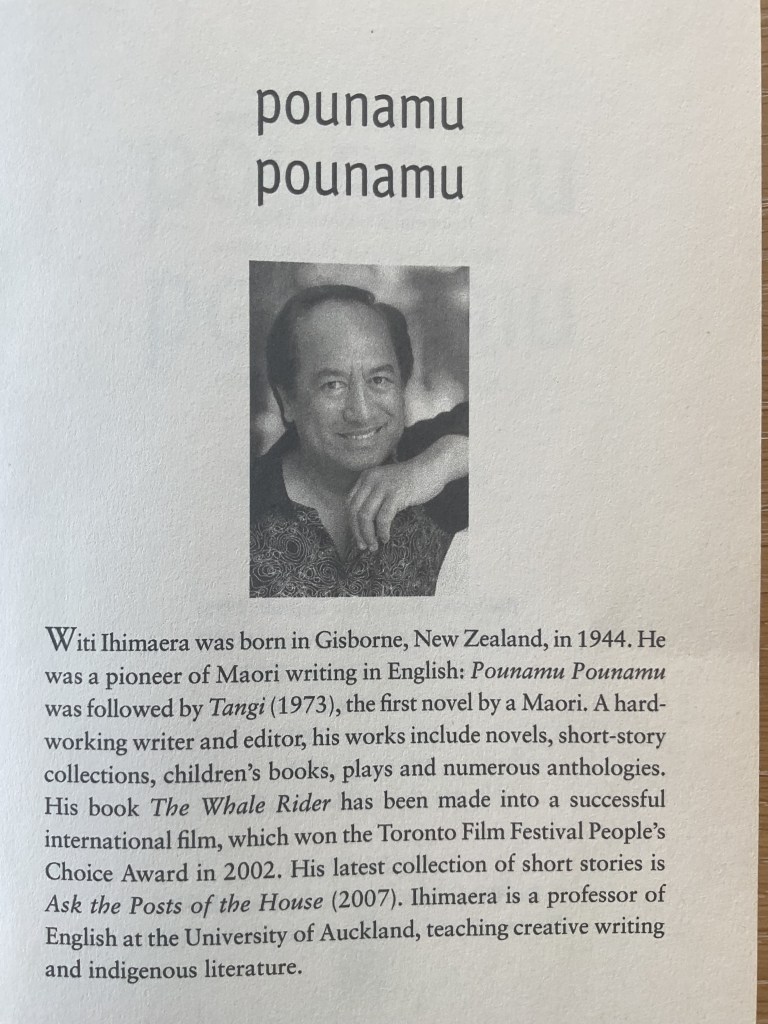
“Tangi” is the title of the last story in Witi Ihimaera’s first book, called “Pounomu Pounamu”. My previous post included my short retelling of four other stories in that volume. I’m not able to do justice to “Tangi” with any retelling so I’m including the full text here. The story contains many flashbacks and other variations in sequence. It is the deepest, most affecting description of individual and communal grieving that I’ve encountered.]
One step further now.
Do not listen to the wailing, Tama. Do not listen to the women chanting their sorrows, the soaring waiata tangi [funeral songs] which sing alone and disconsolate above the wailing. It is only the wind, Tama. Do not listen to the sorrow of the marae [meeting house].
Do not look up, Tama. The marae is strung with electric bulbs and black shadows walk within the blazing light. If you look up, you will see many faces of grief, every face pale and shrouded in the dark garments of mourning. You will see your father where he lies on the cold stone and your mother keeping vigil over him this long night. Do not look up. Else you will be lost.
‘Mr Mahana? Gisborne calling, Mrs Kingi on the line.’
‘Hello, Marama!’
‘Hello, Tama.’
My sister’s voice is calm and soft. She pauses for a moment.
‘You’ll have to come home, Tama. Dad’s dead.’
Daddy, why did my Nani Teria die?
Because she was old.
Are you old, Daddy?
No, Tama.
Don’t grow old, Daddy. Please, don’t grow old.
Step firmly, Tama. One step. Now the next. Although the earth may sway and reel under your feet, step firmly. The earth sorrows with you. Step firmly, Tama.
‘How’s Mum, Marama?’
‘She’s taking it well, Tama. She helped wash Dad’s body, got him ready, dressed him . . . he was so heavy. We took him to Rongopai this morning.’
Daddy, why did we bring our Nani here?
Because Rongopai is our meeting house, Tama. This was where she was born, where I was born, where you were born. This is our home, Tama. And on the hill next to the meeting house is where all our people are buried. I will be buried here one day.
No you won’t, Daddy.
One day, son.
The shadow of an old man advances across the light. It is your granduncle, Tama. He is welcoming you home to the funeral of your father. Listen to his words, listen. But do not look up. The old man is chanting your whakapapa, your lineage, and your links with Rongopai. His voice threads itself within the sad wailing. Listen to the words, Tama. But do not look up. Not yet. Wait until his welcome is ended and the silence falls within which every ear strains to hear your reply. Not yet, Tama.
‘Quite suddenly, about three o’clock this morning, Mum woke up and there he was, cold, lying beside her. Mum rang me up about five, you know how early Mum gets up. So me and Hana went out to her, and you know what Mum was doing? There she was, sitting beside Dad, just knitting, knitting a jersey for Dad, waiting for us, knitting, just knitting.’
‘Oh, Marama!’
When the welcome is ended, Tama, then you may look up. Look your granduncle proudly in the face and do not think of tears. The wailing will sigh away like a drifting wind. Then will be the time to speak.
‘Anything wrong, Tama?’
Mr Ralston puts his hands on my shoulders. I turn. He sees my tears.
‘My father, my father is dead, Mr Ralston. I must go home, Mr Ralston, pack my bags and go home. My father is dead.’
Daddy, why does the man throw Nani Teria’s suitcases and photographs and things in the hole?
Because that is where Nani is, Tama. And because that is our way. What do we need Nani’s things for?
Has my Nani really gone now?
Yes, Son. She’s gone now and you’ve got no Nani anymore.
She was a good Nani, wasn’t she Daddy? Why did she have to go into the earth?
Do not think of sorrow, Tama. You must make your father proud. Send your words loud and ringing that he may hear. Bear yourself with pride. Answer your granduncle’s loving words with your own. Address the assembly, Tama.
‘Was your father an old man?
‘No, Mr Ralston. About fifty-seven.’
I watch the windscreen wipers swish across the windows weeping away the rain.
‘He was a good man, Mr Ralston.’
The telephone poles bend past. And here is Wellington Airport, glistening and wet.
It always strains when a Maori dies, Tama.
Why, Daddy?
The wailing makes the sky sad, and even if it is a beautiful summer day and there are no clouds, it rains. The sky mourns for your Nani, too, Tama. She was a good woman.
Now is the time to speak, Tama. Proclaim to all who stand on the marae that you are Tama Mahana, eldest son of Rongo Mahana who was the son of Eruera Mahana. That you are of the Whanau A Kai, that your lineage is long and renowned. Proclaim that Rongopai is your family hearth, your birthright, and that you are pleased to stand before your whare tupuna [ancestral meeting house]. Let all hear that you know that you are indeed a Mahana. It is a proud name and your people are a proud people. You must be proud, Tama.
‘I’m afraid, Marama.’
The lights of Waituhi are near and already I can hear the sorrows of Rongopai marae whispering in the wind.
‘Almost there, Tama.’
The car turns into the gateway, the headlights flickering across the marae.
‘I’m afraid, Marama.’
‘Kia kana, Tama. Be strong.’
I close my eyes, tightly, tightly closed.
Where are you, Daddy?
I’m here, Son.
I cannot feel your hand, Daddy. Hold my hand so that I know that you are here with me. It is dark and I am afraid. Hold my hand.
One step. Then one step further now.
After you have completed the initial ceremonies, Tama, let your voice be small so that every person among the assembly must strain to hear your words. Tell them that the grief is in your heart, and your body is a dark and empty shell in which your thoughts gather and produce tears. Tell them that you have come home to do homage to your father.
Hush, Tama, Do not cry so much.
But she was a good Nani, she was good to me, Daddy.
Then it is right for you to weep, Tama. But never forget that the sun always rises.
When, Daddy? When?
Do not falter, Tama. Remember that you are your father’s son. You are the eldest son and the example is yours to set. Do not let your voice drift, as if it were an empty canoe adrift on the sea.
Take up the paddle, strike deep into the water. Look upon your mother where she sits weeping. She is your guiding star. Point your prow toward that star and let her know that you are here.
‘Let me speak to Mum, Marama.’
I hear my mother weeping softly, softly, and I cannot restrain my sorrow. For she is my mother and I am her son.
‘Hello, Tama.’
‘Mum, are you alright? Mum, don’t cry Mum.’
‘Come home,’ my mother says. ‘Come home, come home, come home, come home.’
Over and over again, she calls to me.
‘Mum, please don’t cry Mum, please.’
‘Come home, Son, come home and comfort me. I am alone now. Come home, come home.’
You must always look after your younger sisters and brothers, Tama. Your mother, too, if I should die. Remember, Tama, always.
Yes, Daddy.
You are the eldest. That is your duty, your obligation. I was taught that as a child. I teach you that now.
Be at peace, Tama. You spoke well and you were your father’s son. Be at peace. But do not rest. Look upon the mourners. They call me from the shadows and from the light to share their grief with you. Haere mai, mokopuna, the old people whisper. Come and rest noses with us and let us join our sorrow. Haere mai, mokopuna. Do
not be too sad for we also grieve with you.
‘We’re truly sorry, Tama.’
‘Thanks Mr Ralston. Thanks Tim. Thanks Bob.’
I must shake the hands of my friends and receive their condolences. Yet if I look into their faces they look away from me, as if death is something that should not be admitted.
‘We’re truly sorry, Tama.’
Why are they sorry, Daddy? Why are they sad?
Because your Nani Teria was a good lady. And now they are sad.
Is that why they kiss her? Must I kiss her?
You won’t see your Nani after this day.
Then one last kiss, Nani.
I bend down upon my Nani’s body. Nani does not breathe any more.
Goodbye, Nani.
Your people mourn with you, Tama. Embrace them and let them weep on your shoulder. The men weep, the women weep, the children weep because the men and women weep. This is a sad day. These are the people of your whanau [extended family]. You have lost a father. They also have lost a father, a brother, a son, a friend. This is your family. This is your home. You are their son too, Tama.
‘Aunt Mina came from Tauranga this morning,’ Marama says.
‘And Uncle Pita arrived this afternoon. Uncle Pita’s been a great help. He did all the arrangements at Rongopai. Jackie and Arapata dug the hangi [grave]. A lot of people are coming. A lot of people to feed. Don’t know where we’re going to put them all.’
‘What about the old homestead, at Nani’s place?’
‘Yes, some there. But most of them in a marquee near the meeting house. The homestead is too small.’
Don’t close the door, Daddy. Leave it open so there is light. As long as I see the light burning, I’m not afraid.
You shouldn’t be afraid, Tama. You’re a big boy now.
And it is time to get on with life. The sun always rises. You are a seed that was sown at Raiatea.
One step. Then one step further now, to where my father lies alone and lonely under the harsh light.
Listen, Tama. A lone voice sings among the soft songs of mourning. The voice of a Kaia, Auntie Ruthie. She sings an ancient lament that soars and swoops and curls above the hushed assembly. Look where she comes, slowly stepping from the darkness, her black gown threaded with green leaves, her hands outstretched, in each hand a sprig of greenery. She performs movements to her song. Slowly her hands move, with intricate precision, telling of the grief which tears at her heart. Some of the mourners join her song and perform the movements along with her. But she looks straight ahead, her face luminous with grief. She looks at you, Tama, her brother’s son. Only you.
I watch my Nani going away into the earth. The earth is soft and wet because it is raining. Daddy’s hands are tight upon my shoulders.
Nani’s belongings are thrown into the hole. I see a picture of Nani fall. The glass smashes, but she is still smiling.
Goobye, Nani.
Dirt falls upon Nani, shovel after shovel. And as she disappears, Auntie Ruihi starts a frenzied wailing.
Aunt Ruihi, please don’t cry, don’t, please.
Listen to your aunt’s lament, Tama. Listen. She opens her arms to you. Through the spray of my gushing tears, she sings, I see you, my brother’s son. Come weep with me, our anchor is gone, and we are cast adrift at the mercy of the sea.
Embrace your aunt, Tama. Weep with her. You have only lost a father. She has lost both parents and now her eldest brother. She has nobody who will look after her now. Weep with her, Tama. Kiss her once more. Aue, mokopuna [oh, nephew], she weeps. Aue, Aue, as she dissolves into the darkness.
You are alone now. Your father is on the marae. Your mother and brother and sisters wait for you to join them by their father’s side.
One step. Then one step further now.
You must always look after your brothers and sisters. And your mother too, if I should die.
‘Are you all right, Mum?
‘Come home, Tama. Come home, come home, come home.’
‘Mum just sits beside Dad, knitting, knitting, a jersey for him, knitting, just knitting.’ ‘Come home, Son. Come home, come home.’
Step firmly, Tama. Do not listen to the wailing. It is only the wind shifting, only the wind renewing. Be proud. Your father waits among the flower wreaths. His body is draped with feather cloaks. Be proud.
‘You’ll have to come home, Tama. Dad’s dead.’
We won’t need Nani’s things. That is why they are buried with her.
‘I’m afraid, Marama.’
‘Kia kaha, Tama. Be strong’.
Almost there, Tama. almost there. The long journey almost at an end. See? Your brothers and sisters raise their arms to greet you. One step. Now another. And one step further now.
Are you old, Daddy, like my Nani Teria is old?
No, Tama.
Don’t grow old, Daddy.
One day I will be old. Then I shall die.
No you won’t. I won’t let you.
One day, Tama.
Embrace your brothers and sisters, Tama, and be strong. You are the eldest. Embrace your mother, Tama. Do not listen to the wailing. Now, slowly look upon your father. Rest your arms on his casket and weep for him.
‘Daddy, where are you?’
It is dark and I can hear the wailing coming from the marae.
He was an old man, Tama. See how he sleeps. His eyes are closed and his face is pale in the blazing light. He is covered with feather cloaks. His face is cold. His hands are cold. The wind blows upon him and ruffles his grey hair.
For three days he will lie here. Then on the afternoon of the third day, his casket will be closed and you will not see him again. On that day, you will help carry him up the hill to the family graveyard.
He will be heavy, but you must be strong. It will rain. It always rains when a Maori dies. Then he will be covered by the earth.
This is the last goodbye, Tama.
Bend towards him, Tama.
One last kiss, Father. Your lips, so cold, so cold.
Goodbye, Father.
Daddy, is it always so dark?
No, son, the sun always rises. Always.
Soon, Daddy?
Soon, And never forget, Tama:
E kore au e ngaro He kakomo I ruiruia mai I Rangiatea
You are from a seed that was sown in Rangiatea [the sacred, ancestral homeland]
and you will never be lost.
 John's Blog