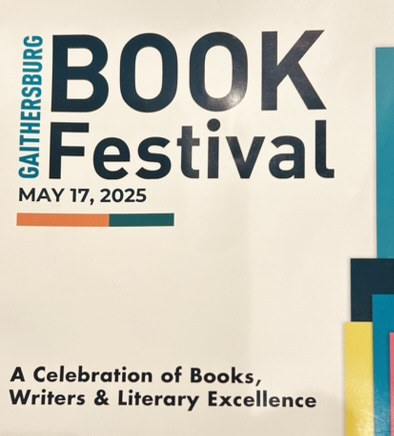
Last Saturday was the long-awaited Gaithersburg Book Festival (GBF) in this Maryland suburban city north of Washington, DC. My sisters Marian and Anna arrived from their long drive from Buffalo around 2:30p on Friday. We had all attended four of the previous festivals, the last one being in 2022.
The three of us plus two of other sibs had been participating in a family book group for ten years. Over the years, our experiences with authors at the GBF had inspired our choices of many of the books we had selected to read.
I went down to greet my sisters and help them to get settled in their Guest Suite just down the hall from my wife Andrea’s and my apartment in our comfortable retirement community in Rockville, MD. Their room was still being cleaned so they came to our place for a nice visit with Andrea and me. They had shared the driving and were tired but in good spirits. Andrea had made us a 6:30 dinner reservation at the restaurant downstairs, so we all had time to rest a bit beforehand. Both Andrea and I always feel a lot of common ground and good cheer in being with my sisters.
After a delicious meal, we treated ourselves to watching a classic 1980’s film, Alan Alda’s “The Four Seasons”, which we all thoroughly enjoyed. We went to bed early enough to get up in time for the 10am festival start at Bohrer Park in Gaithersburg. Andrea drove us the four miles there, right to the entrance (and picked us up there five hours later.) It was a beautiful early summer day, mostly clear and warm, but not oppressively hot.
A Therapeutic Writing Workshop
My sisters and I wanted to attend the 10am writing workshop, “Healing Through Writing”. We arrived just as it was getting started, finding decent seats at one of the tables set up inside a large white tent. At each seat was a nicely bound notebook, pen, and a synopsis of the principles of therapeutic writing.
The presenter was a short, elderly woman, Diane Pomerantz, a “psychologist and author” as the program noted. She spoke in a calm, self-assured way about the documented therapeutic effects of personal writing as a way to achieve perspective and self-awareness after suffering emotional trauma.
She first talked about all our lives as a sequence of stories. While the events of our lives were sometimes outside of our control, she made a compelling argument that we all had the ability to frame and contextualize those events as healing stories. Consciously intending to gain perspective from even severe trauma was a good starting point. Then writing about a trauma and our emotional response to it gave us a vehicle to stand back from it and see it in a greater context.
Ms. Pomerantz had utilized writing to help her heal from a traumatic marriage, and had made that healing experience central to her published memoir. She had a strong personal basis for urging us to consider doing the same.
To get us started, she suggested that we make use of our handsome notebooks to write a 6-word memoir. That seemed like a daunting task at first, but after reflecting for a bit, I came up with a sentence that actually seemed to describe an important theme of my 75-year-old life:
“Cross eyed vulnerability made me different and special.”
I was the second oldest of ten children and was diagnosed early on with strabismus, a condition in which the two eyes don’t look at the same place at the same time (hence, “cross eyed”). By the age of 5 I’d already had two surgeries and wore glasses with a patch covering my “good eye” so that the “lazy eye” might gain strength. None of this actually worked. By the time I started school, I was still “cross eyed” and wore glasses, though the glasses did nothing to fix the underlying condition.
Even in the early years of my family life, I felt competitive for my mother’s attention with my older brother and then my younger baby sister. My vision problem helped to garner me that attention.
One of Ms. Pomerantz’s instructions had been to find some way in which a trauma had brought us some advantage. It didn’t take me long to experience that insight from my own childhood. Both my parents took time to take me to my eye doctor’s appointments across town, and otherwise tend to my vision issues.
But I can also see now that the attention I received for my vision issue contributed to seeing myself as faulty in some way, which fed a kind of victimhood, and a sense that I deserved extra consideration. I left the workshop with a deeper understanding of an important, but largely unexplored aspect of my early life that had had lasting repercussions.
Just Us Books
The GBF is structured as hourly presentations held in small tents scattered about the 40-acre lawn of Bohrer Park. There’s no registration process (nor fees) and seating is on a first-come basis. I was heading to an 11am session with well-known local author Judith Viorst when another tent captured my attention.
Projected on a large screen inside the tent were brightly colored pictures from a children’s book. An attractive African American couple were just beginning their presentation and I was immediately drawn in.
Cheryl and Wade Hudson are a 60-ish couple who are both writers and publishers for Just Us Books, Inc., a company they founded decades ago after mainstream companies had declined to publish their African American-oriented children’s books.

As I was passing by, Cheryl Hudson was reading and singing from her latest children’s book, “When I Hear Spirituals”. It’s about a little girl describing her feelings when she hears spirituals being sung in church. Ms. Hudson took us through each of the visually projected pages of her book, stopping to sing short segments from the spirituals being described by the little girl. These included “Wade in the Waters”, “Swing Low, Sweet Chariot”, “Ring Them Bells” and many more. Her singing and the colorful illustrations really brought the book alive!
Then her husband Wade took us through the illustrations and text of a book he had penned based on the story of his mother voting for the first time in Louisiana in 1969, “The Day Madear Voted”. He beautifully conveyed the jubilation felt by his mother, her family, and other members of their church on finally being allowed to perform their constitutional right to vote.
Andrea and I had visited the civil rights “legacy sites” in Montgomery, AL, last month and the ugly reality of our country’s longstanding abridgment of basic human rights for African Americans was still fresh in my mind. I heartily concurred with Mr. Wade’s assertion that this history needed to be communicated even more at a time when the MAGA forces are attempting to whitewash essential parts of our American history.
There were three other author presentations that I attended and which I will describe in a subsequent post.
John Bayerl, 5/20/2025
 John's Blog