Authors Finding Hope within the Climate Crisis
The next event I attended was an interview with authors of two recent books that affirmed possibility and hope within the daunting climate crisis.
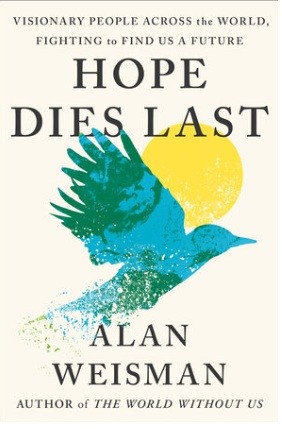
Alan Weisman is a veteran academic and long-term journalist and author on environmental topics. His latest book is Hope Dies Last. Malcolm Harris is a young writer/activist who brings a radical political perspective to his new book What’s Left. The two were introduced by Rockville Mayor, Monique Ashton, who recounted how her 12-year-old daughter had received news of her mom’s election victory by asking her: “So what are you going to do about climate?”
The interviewer for the program was the legendary journalist and activist Elizabeth McGowan who had found her passion for fighting climate change after overcoming two occurrences of serious cancers, and had ridden a bicycle across the country in sponsorship of cancer research.
Weisman was interviewed first. The subtitle of Hope Dies Last is Visionary People Across the World Fighting to Find Us a Future. The book is the fruit of Weisman’s recent worldwide travels in search of people who were on the frontlines of the climate crisis. He recounted a story about an Iraqi man who had spearheaded a successful, decades-long movement to restore an enormous wetlands area in southern Iraq that Saddam Hussein had ordered drained in order to root out his enemies, Iraqi Shias. The man had a scientific background, ecological understanding, and lifelong knowledge of the region’s water flows. He also had a wealth of personal connections to the displaced people who were eager to resume their traditional way of life. Weisman’s story is further dramatized by the fact that the wetlands in question are formed by the Tigris and Euphrates Rivers whose “fertile crescent” was among the sites of earliest civilizations in the Middle East. In reflection on the book’s title, Weisman said that “hope is an active verb” and that all of us could find a hopeful path through the climate crisis if we committed ourselves to collective action.

Malcolm Harris was a well-known leader of the “Occupy Wall Street” movement. His subsequent career as a journalist and author was formed from his experience as an on-the-ground organizer. He became an avowed Marxist and applied a Marxist analysis to the economic challenges of the Millennial and GenX generations. His book title, “What’s Left”, is a well-known political mantra for environmentalists seeking to preserve and protect the natural world as it remains for us now.
Harris identifies three necessary aspects to a successful renewal of climate health: 1) use of carbon credits to economically incentivize companies and governments to reduce fossil fuel emissions; 2) high level governmental mandates such as those enumerated in the Paris Climate Accords; and 3) a renewed commitment to the common good of humanity as a whole that he believes is best espoused in the ideals of communism. He pointed out that all the environmental success stories studied by Alan Weisman involved groups of people coming together to protect environments that their livelihood depended on. Harris urged us to question our American bugaboos about individualism and free enterprise and begin to consider how much better our environment, and our society might be if it prioritized people and the environment over profits.
Elizabeth McGowan as moderator provided an inspiring testimony to the value of finding purpose and hope even amid dreadful prognoses. She herself had received virtual death sentences from melanoma twice in her young life, and both times had miraculously lived through them. Her subsequent environmental journalism and activism was inspired by her confidence that life itself would find a way to survive and thrive. Hope Dies Last!
Two Talented Authors of World War 2 Historical Novels
As baby boomers whose Dad had fought in World War 2, our family book club was always on the lookout for engaging historical fiction set during the war. So I rejoined my sisters for a fascinating presentation by two highly successful historical novelists: Madeline Martin and Laura Morelli.
Martin’s most recent novel, The Booklover’s Library, is set in Nottingham, England during the second world war. It is a love story about a widowed mother and her young daughter, who is evacuated to the country to avoid the German air blitz. The mother carries on as best she can as a librarian, finding ways to encourage her library’s often quirky readers with books that will inspire and motivate. Martin described her novel as a story of how a mother’s love for her daughter and her dead husband led her into deeper service to her community, as well as her family.

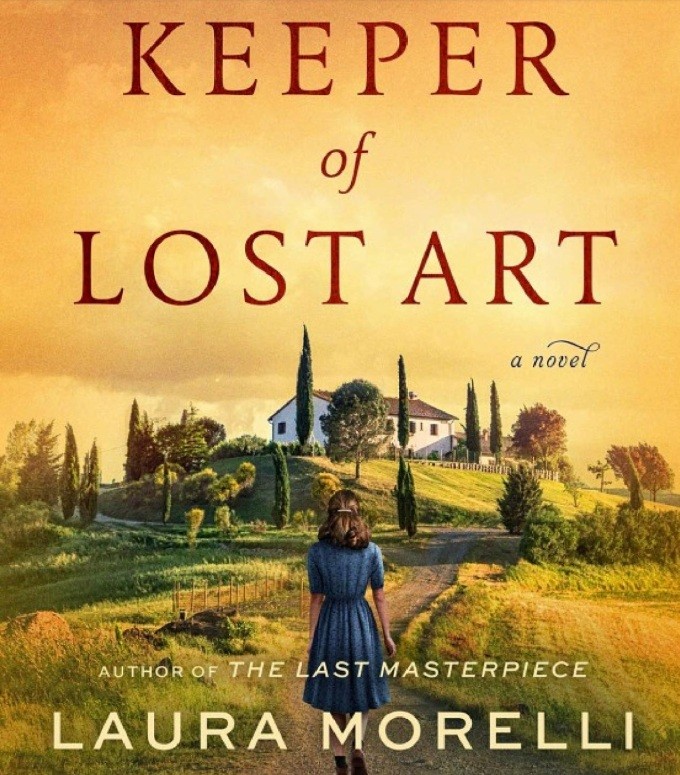
Laura Morelli is a professional art historian as well as a fiction writer. Most of her historical novels are set in Italy and involve aspects of classical Italian art. Her latest novel, The Keeper of Lost Art, is based on the true story of how the Uffizi gallery in Florence shipped all its most valued works of art to various rural locations to prevent them from being pillaged by the Germans during the second world war. Her novel centers around a young woman from Turin who has been sent to a villa in Tuscany where many of the Uffizi treasures are being kept. Ms. Morelli spoke with great eloquence and passion about her book.
What I found remarkable about the interview with these two talented, creative writers was the sense that the two were in no way in competition and that they took in and affirmed what each other was saying. I was also impressed by both writers’ stories of the long, hard research they had performed prior to sitting down to write. Both of their new books were definitely candidates for next year’s reading list!
A Local Author’s Remarkable Comeback
The last author we heard was Jeanine Cummins whose 2018 bestseller, American Dirt, we had read in our book group. It is a gripping novel about a Mexican woman and her young son as they make a perilous journey from Acapulco to the U.S. after their family has been violently targeted by a cartel there. The novel became a topic of controversy after a large group of Hispanic American writers had publicly criticized the book and its author for having expropriated Mexican culture for commercial interests. Cummins has Puerto Rican family roots, speaks Spanish, and spent a lot of time at the U.S. – Mexico border interviewing migrants. Still, the criticism stung and resulted in her withdrawal from writing for over a year. She said she had not been sure that she would ever be able to write again.
We had seen Ms. Cummins at the 2022 GBF when she had interviewed the successful Mexican American writer, Reyna Grande. Grande had signed on to the 2018 letter criticizing Cummins, but it was clear from their interaction at that GBF that the rift had been healed. Cummins was generous in her praise of Grande’s excellent historical novel set during the Mexican- American War of the 1840’s, and Grande clearly reciprocated the positive regard.
Jeanine Cummins has become something of a celebrity in Gaithersburg. She grew up here and attended Gaithersburg High School, which is right next to Bohrer Park. She was lavishly introduced by the Mayor of Gaithersburg, Jud Ashton, who has been instrumental in starting and sustaining the GBF over the past 16 years. Cummins had recently published a new novel, Speak to Me of Home, whose subject matter touches on her own Puerto Rican heritage. She was interviewed by a local Jamaican American author, Donna Hemans.
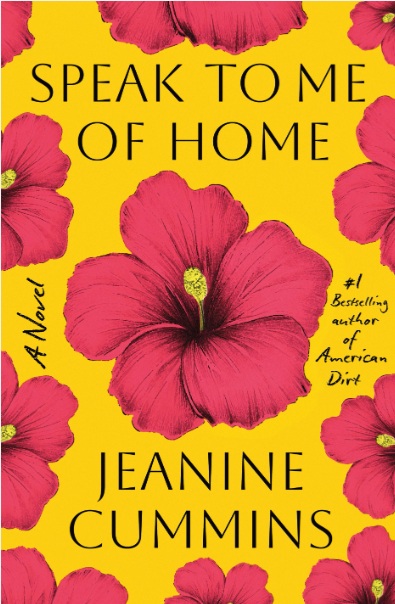
Cummins first spoke about the 2018 controversy and how it had deeply affected her. Even though she rightly claimed her integrity in writing American Dirt, the criticism opened within her questions about her own ethnic identity. This led to deeper conversations with her mother and other family members about the Puerto Rican matriarch of their family who had moved to the U.S. many decades earlier. Her latest novel was an opportunity for her to plumb the depths of her own Puerto Rican roots.
Donna Hemans entered an in-depth dialog with Cummins about current issues of ethnic diversity within our American melting pot of cultures. Cummins described her ease in navigating the large multi-ethnic cultures of Gaithersburg – a small city that is regarded as the most ethnically diverse place in the U.S., with over one hundred different languages spoken here. She said it was challenging for her when she left for college at nearby Towson State, because unlike her hometown high school, students there segregated themselves much more pervasively by race and ethnicity.
Cummins talked extensively about her Puerto Rican grandmother and her challenges in navigating American middle-class society. Those stories became an important part of her new novel. Ms. Hemans asked Cummins to read specific passages from Speak to Me of Home. The writing was perceptive and poignant, as usual for Cummins. My sisters and I came away knowing that this novel would be among our top choices for our reading list.
John Bayerl, 5/26/25











 John's Blog