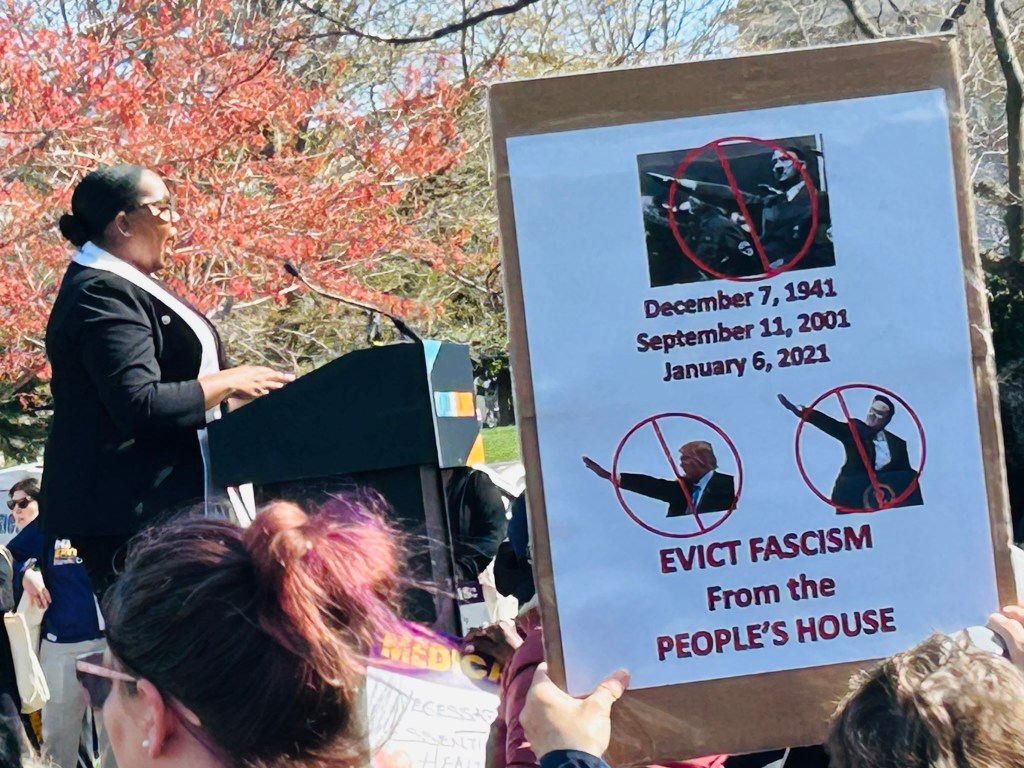
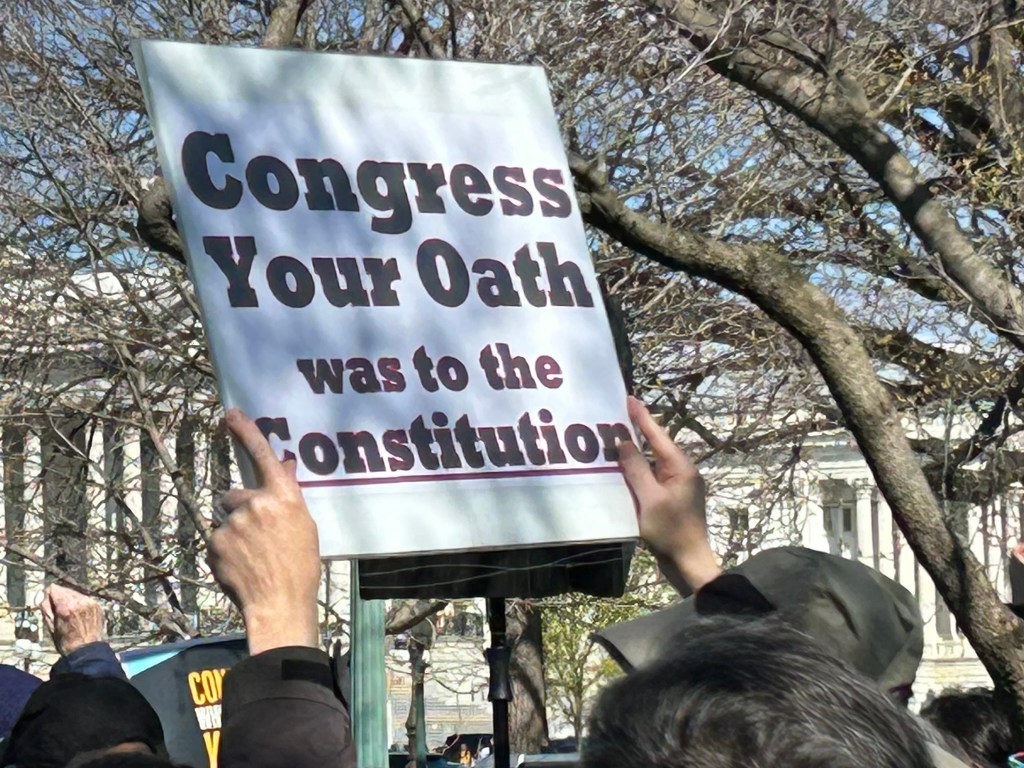
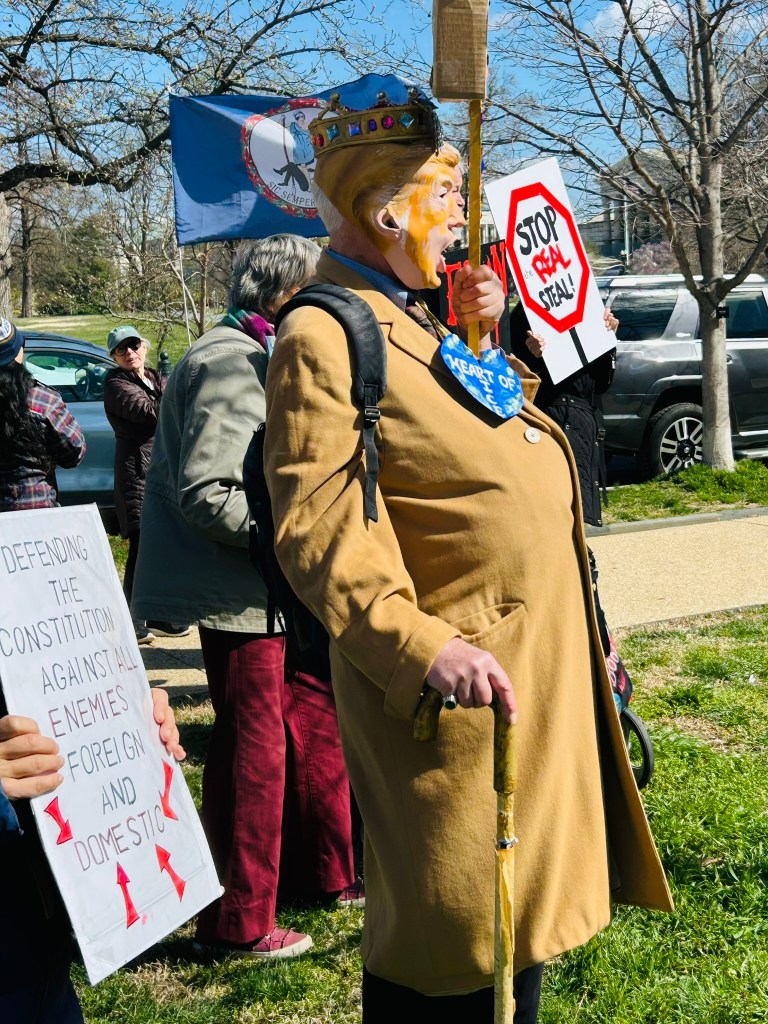
I just returned from an invigorating political rally on the U.S. Capitol grounds, attended by hundreds. It was organized by “Families Over Billionaires”, a consortium of labor unions, non-profit advocacy groups, and some elected Democratic officials. Its main targets were the current Republican economic initiatives which would give billions of dollars in tax breaks to the wealthiest Americans while making steep cuts in Medicaid, Medicare, and even Social Security. The program featured some high-ranking congresspeople as well as grass roots organizers and ordinary citizens. As usual, I took photos to help communicate some of the spirit of the gathering.
Michael Linden, head of Families Over Billionaires, served as M.C.
Rep. Hakeem Jeffries (D-NY), Democratic Minority Leader, spoke from the inspiration garnered from his recent trip to Selma, Montgomery, and other Civil Rights locales.
Rep. Steven Horford (D-NV) spoke for the 40% of his constituents who receive Medicaid.Sen. Alex Padilla (D-CA) also spoke of the need to resist G.O.P. assaults on Medicaid, Medicare, and Social Security.
I saw this poster displayed in Union Station on my way home via Metro.
[I’m posting this “Remembrance” that I wrote last summer after the death of my neighbor and friend, Al Lubran. I revisited this piece today and was especially taken with Al’s deathbed premonition of the dire effects on our government if DT were elected. Unfortunately, his premonition is proving to be all too accurate.]
Al Lubran was a new friend who lived just around the corner from my spouse Andrea and me in our retirement community – The Village At Rockville (TVAR). He moved in a few weeks after we did in March 2022. We knew that Al had moved from Colorado Springs, where he was a longtime resident. Al was a rather private person, and it took some time before we got to know him better.
We shared with Al a love for live classical music, and we frequently ran into him at the Strathmore and other concert venues. Al also attended a lot of plays around town and often had good tips for upcoming concerts and other local cultural events. He regularly rode the Metro downtown to the Kennedy Center and other venues, even with his portable oxygen device for the last few months.
Al was an avid crossword puzzle fan – a passion he shared with Andrea and another neighbor on our floor. The New York Times Magazine weekly puzzle was one they always shared – making copies of it for one another and comparing their results afterwards. Al also regularly played bridge and poker at TVAR. He was active on TVAR’s Travel Committee and initiated some bus excursions to local concerts.
Al was a master of humor, regaling many of us here with his funny stories and puns. He had a keen appreciation for political satire, and filled our email inboxes with videos and cartoons, all with a decidedly anti-Trump bent. Al was also a regular attendee of TVAR’s monthly meeting of our Democratic Club.
We got to know Al more deeply after he came over one afternoon recently to tell us that his health was quite shaky and that he wouldn’t be around for long. We had been noticing him with a portable oxygen unit from time to time, but that soon became a constant companion. Al said that he had a fatal condition called pulmonary fibrosis and that his pulmonologist advised that he get his affairs in order and contact hospice. We were taken assured him that we were available to help in any way.
We knew just a few elements of Al’s biography – that he was from Steubenville, OH, that he had served in the military and then worked for the Federal government for most of his career. We also learned that he had been an avid skier and world traveler, passions which he had shared with his wife Donna, who died in 2018. Al met Donna in Colorado, and they lived in Colorado Springs for decades. Al had moved to the DC area because he had two younger brothers (twins) who lived here. His doctor had recommended that he move somewhere with a lower elevation to facilitate his compromised breathing. Al celebrated the fact that he’d had two good years living at TVAR before his lungs started giving out.
I visited Al in his apartment a few times after he shared his dire news with us. He was remarkably sanguine about dying, accepting his fate with grace and dignity. He wanted to remain in his home to the end and contracted with the Jewish Social Services Agency for in-home hospice care. His two brothers, Bernie and Bob, supported him to the end, along with his devoted friend, Carol Stein. He died at home on the morning of June 18.
I learned from Al’s brothers a bit more about the arc of his life. He had gone to college at the Case Institute of Technology in Cleveland, OH and then enlisted in the Air Force, where he rose to the rank of Captain. Al was proud of his military service in Turkey and stateside. He then went to work for IBM but left in order to move to the place he loved, Colorado Springs. He then went to work for the Federal government as a contracting officer based in Denver. He spent the rest of his career as a devoted public servant, serving in a number of Federal agencies. He spoke proudly of the fact that he had saved American taxpayers millions of dollars with his keen procurement strategies.
My last visit with Al was the most memorable. He shared how afraid he was feeling. Given his acute breathing disability, I assumed he meant he was afraid of dying. But no, he waved that off, and said he was really afraid that all his hard work as a Federal civil servant would come to naught if Donald Trump was elected to a second term. I was taken by his pride in his accomplishments and his deep appreciation for the established system of government he had worked for in both Republican and Democratic administrations.
May Al’s spirit rest in peace. May his fear for the future of our country be alleviated.
On January 2, 2025, I posted a piece called “My Introduction to Sacred Geometry.”
My next foray into “sacred geometry” began with the fish-shaped form created by the intersection of two circles. After drawing the first circle, a second circle with the same radius as the first is drawn, using a point on the first circle’s circumference as the center. The result is shown below.
Vesica Pisces
The shaded area in the center is central to Euclid’s classic geometry. The fish-like shape was also incorporated as a symbol of Christ in the early Christian church. This lens-like form is called the “vesica pisces”, or “bladder of a fish”.
The basic form of the “vesica pisces” can be extended into a complex, repeating form called the “flower of life”. My own drawing of the “flower of life” is given below. I won’t go into the exact methodology for constructing it here, but I will say it took many days of trial-and-error drawings.
Vesica Pisces and Euclidian Geometry
The vesica pisces form was used by Euclid to illustrate some important mathematical relationships.
First, a rectangle is drawn using the vertical diameters of both circles as the two sides. Then, the top and bottom of the rectangle are drawn by connecting the intersection points of the vertical diameters on the two circles. The resulting rectangle has some interesting properties.
The Pythagorean theorem is central to Euclidian geometry. The theorem makes use of a universal property of any right-triangle (i.e., any triangle that has a “right” angle of 90 degrees). In such a triangle, the longest side is called the hypotenuse. The theorem has to do with the relative lengths of the three sides of a right triangle. It says that the length of the hypotenuse, squared, is equal to the squares of the lengths of the other two sides.
The Pythagorean theorem can be used with the rectangle around the “vesica pisces” as shown in the figure above. First a line is drawn connecting opposite corners of the rectangle. This creates a right-triangle in which we already know the lengths of the two shorter sides.
We can define the radius of each circle as a length of 1 unit. Thus, we can easily see that the vertical lines of the rectangle are exactly 2 units tall (the length of two radii). Similarly, we can see that the top and bottom lines of the rectangle are the same length as the radius: 1 unit.
Using the Pythagorean theorem, we can calculate the length of the slanted line, the hypotenuse, as the square root of the squares of 1 and 2. The square of 1 (1X1) is 1 and the square of 2 (2X2) is 4. So, the length of the slanted line is the square-root of 5. You can use a calculator to estimate the square root of 5 as: 2.2360679775…
This is regarded as an irrational number – one whose succession of decimal digits follows no known pattern. The Greeks were intrigued by irrational numbers like this. The square root of 5 became an important number in the calculation of another important irrational number, Theta.
The value of Theta is calculated as half the value of the square root of 5, plus another half unit. Half the value of the square root of 5 is: 1.1180339887… Add .5 units to this and you get: 1.618033987… which is the value of Theta.
The Golden Rectangle
Theta is the value that defines what was known to the Greeks as the Golden Rectangle. A golden rectangle is defined as one in which the lengths of the sides are in proportion to the value of Theta.
The next figure shows a golden rectangle that is divided into a square and another rectangle. The sides of the square can be identified as “a”, and the length of the whole rectangle can be given as: “a+b”.
In a golden rectangle, the following equation always holds:
a / b = (a + b) / a
This equation always yields the exact value of the irrational number Theta.
A Golden Rectangle Drawn from the Vesica Pisces
The rectangle enclosing the vesica piscis is NOT a golden rectangle. Its width is 1 radius unit, and its height is 2 such units. The proportion is simply 2 to 1, or 2.
But the hypotenuse of the right triangle drawn in Figure 2 can be used to construct a golden rectangle. Recall that the value of Theta can be expressed as the square root of 5, divided by 2, and adding .5. Looking at Figure 2, it’s easy to see that the length of the hypotenuse, the square root of 5, is exactly bisected by the midline of the circles. Therefore, the length of half of the hypotenuse is the square root of 5, divided by 2. The additional .5 units can be drawn as half the length of the radius (1 unit). Knowing that this length represents the value of Theta, we can simply add one more radius unit and we have the known value of A and B.
Once this is known, it’s easy to draw the square with each side of length Theta, and an additional rectangle whose length is 1. The combination as a whole yields a golden rectangle. And the secondary rectangle contained within is also a golden rectangle, as shown below.
The Golden Rectangle became the design model for the Greek Parthenon and many other of the classical structures of the Greco-Roman era. Many Renaissance artists, most notably Leonardo da Vinci, made extensive use of the Golden Rectangle in their paintings and architecture.
The Fibonacci Sequence and Theta
The value of Theta can also be calculated by using the arithmetic sequence known as the Fibonacci sequence: 0, 1, 1, 2, 3, 5, 8, 13, 21, 34, 55, 89, 144…. The sequence starts with 0 and 1, with each succeeding value being the sum of the previous two. Divide each number in the sequence by its predecessor and the value will approximate Theta, getting closer and closer to it as the sequence continues. For example, 89/55 = 1.61818 and 144/89 = 1.61797.
Pursuing my interest in Sacred Geometry has opened in me a deeper curiosity and respect for some of the universal design principles used in western art and architecture.








 John's Blog