I read of an intriguing idea recently: that a list of the books we read is a kind of autobiography reflecting our deepest interests. For what it’s worth, I decided to compile my list from last year and post it here. I was surprised to find that I had equal numbers of fiction and non-fiction. The seven titles with a preceding asterisk are ones I read as part of a Bayerl Family book group that is entering its ninth year.
I’ve already posted blog reviews of three of last year’s books, as follows:
“Killers of the Flower Moon” as Book and Film, book written by David Gann, film directed by Martin Scorsese, 1/22/2024
“Anything Is Possible” by Elizabeth Strout, 5/27/2024
What’s My Excuse?, a review of Viktor Frankl’s “Yes to Life in Spite of Everything”, 6/24/2024
NON-FICTION
1 *Killers of the Flower Moon, David Gann
2. The Gospel According to James Baldwin, Greg Garrett
3. Uncle Tom’s Journey from Maryland to Canada – The Life of Josiah Henson, Edna M. Troiano
4. Yes to Life, (translation of Viktor Frankl’s essays called “In Spite of Everything”). Daniel Coleman (ed,)
5. Proof of Heaven, Eben Alexander
6. *Democracy Awakening, Heather Cox Richardson
7. A Year to Live, Stephen Levine
8. * Beautiful Country, Quian Julie Wang
9. A Passionate Mind in Relentless Pursuit – the Vision of Mary McLeod Bethune, Noline Rooks
10. In Search of Stones,M. Scott Peck
11. The Road He Travelled – The Revealing Biography of M. Scott Peck, Arthur Jones
FICTION
1. *American Savior, Roland Merullo
2. *The River We Remember, William Kent Krueger
3. Anything Is Possible, Elizabeth Strout
4. *Goodnight, Irene, Luis Alberto Urea
5. Olive Kitteridge, Elizabeth Strout
6. The Little Liar, Mitch Albom
7. The Next Person You Meet in Heaven, Mitch Albom
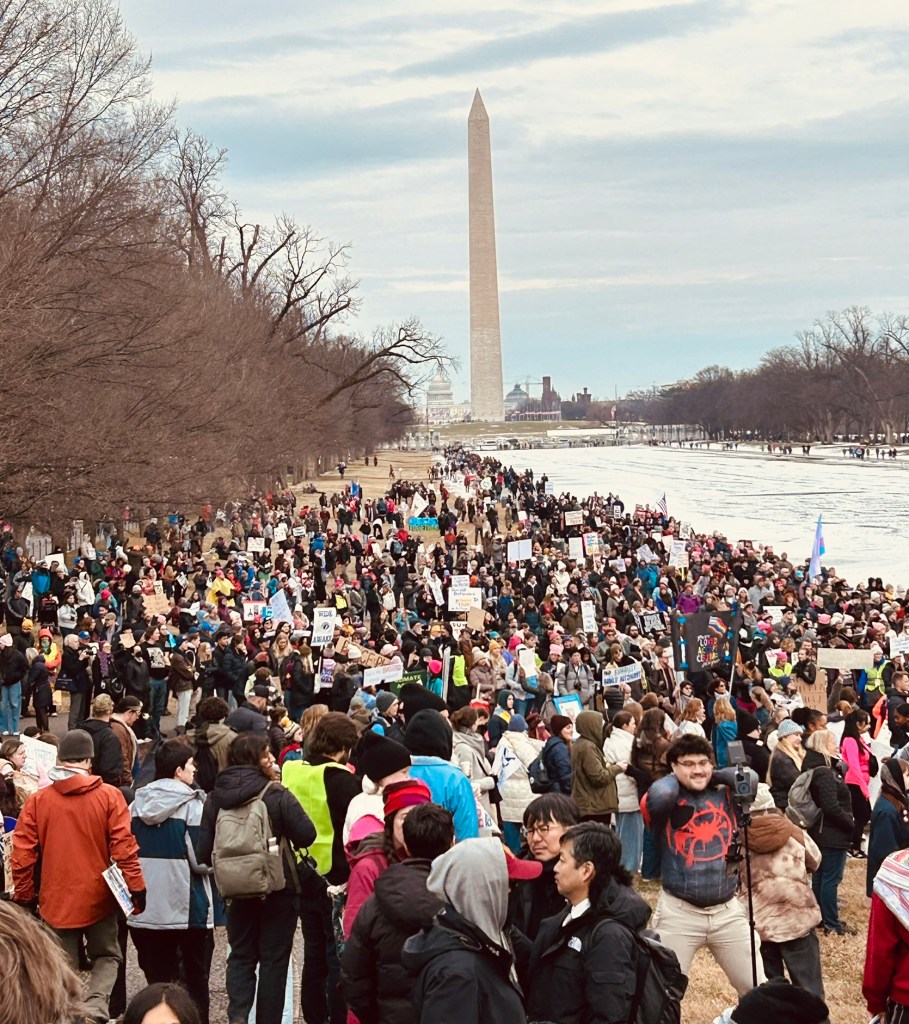
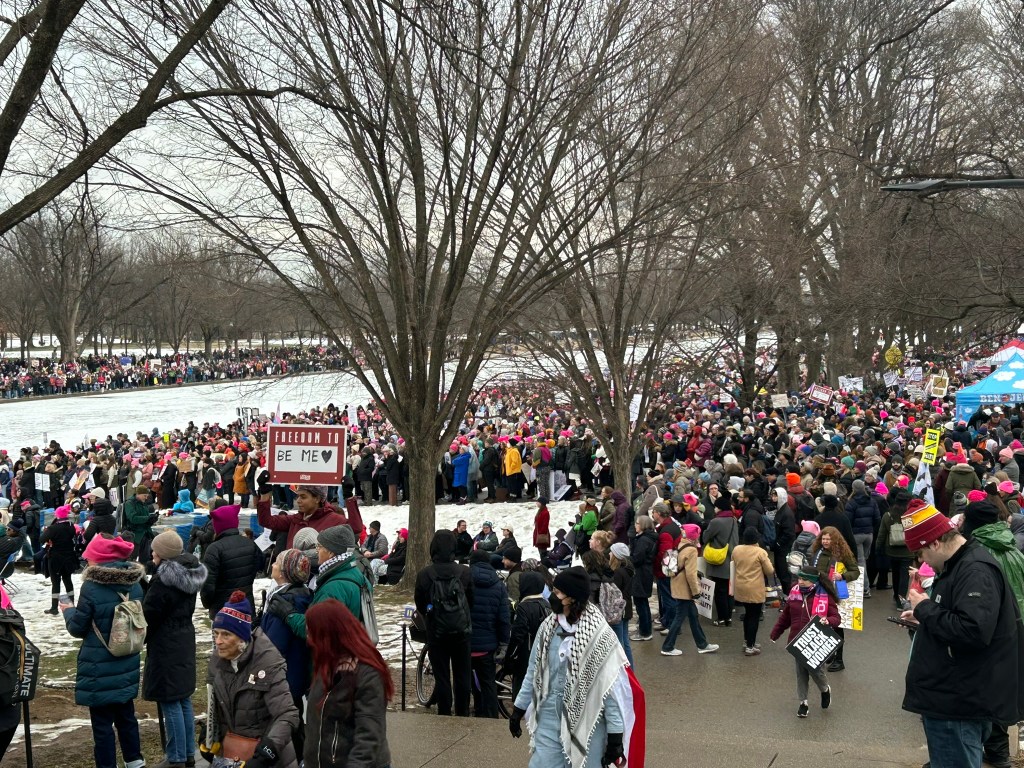
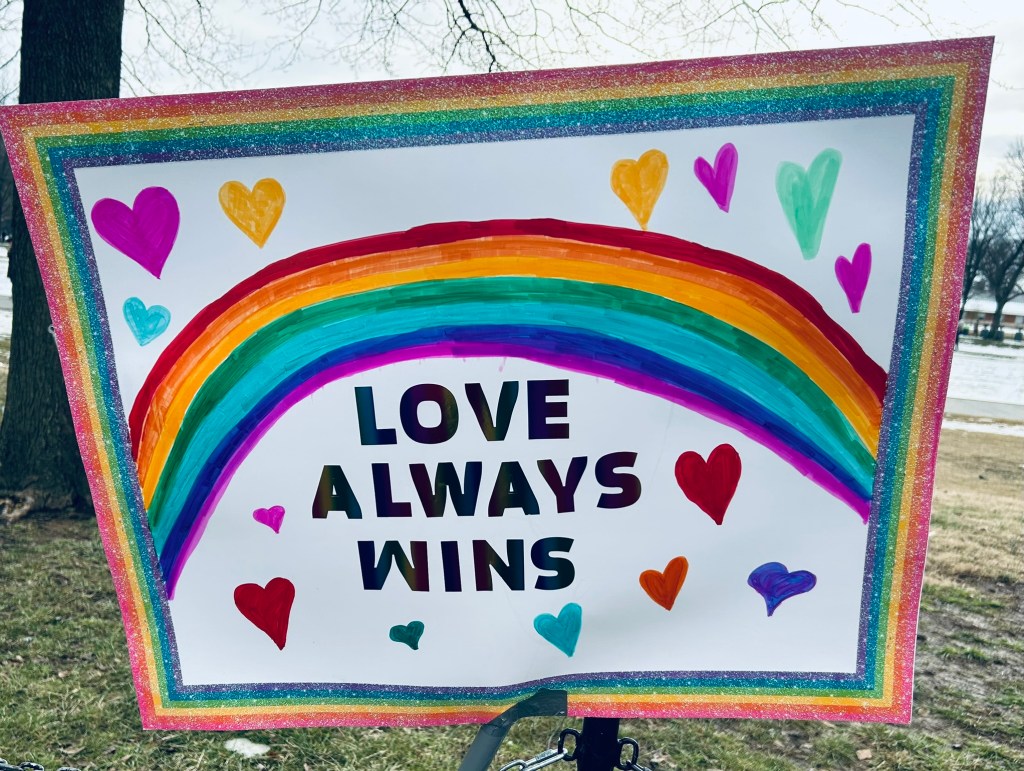
I just returned from the People’s March on Washington, an energetic affair of some tens of thousands who marched from three different sites in downtown DC to the grounds of the Lincoln Memorial for a lively rally.
Andrea and I had attended the memorable Woman’s March of January, 2017, which was a different order of magnitude, with many hundreds pf thousands showing up in DC to protest Trump’s first inauguration.
The Trump 2.0 protest was every bit as creative, energized, and lively as 8 years ago, but at a much lower volume. I took the Metro downtown from Rockville by myself this time, Andrea being down with a bug. Instead of marching, I walked directly to the Lincoln Memorial grounds from Foggy Botton Metro station, a commute I knew well from my 15 year career at the GW Medical Center there.
Some people from the rally, laden with their political signs and creative attire, were walking back up to Foggy Bottom from the rally already. There was a festive feeling in the air. The marches had started at 10am and I was only arriving at the rally after 1pm.
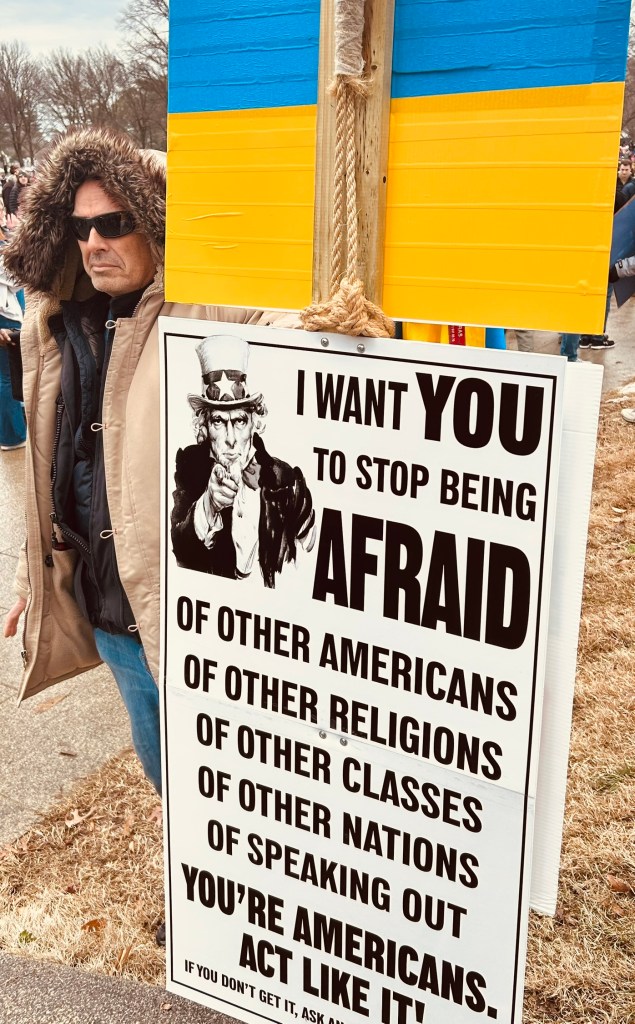
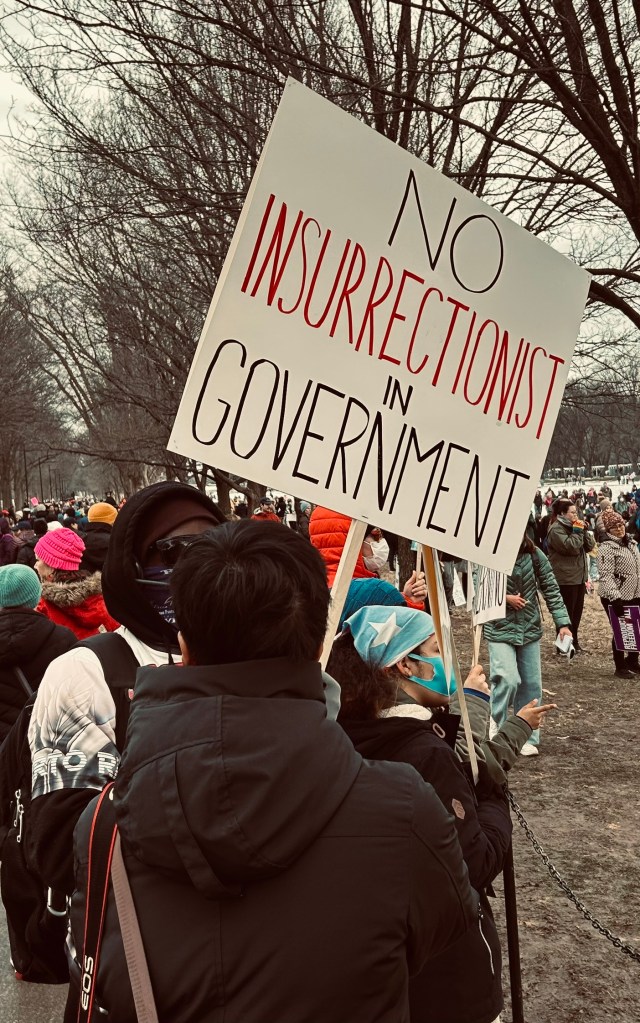
Being on my own, I was free to follow my nose, allowing me to focus on taking photos with my smart phone once I arrived after about a mile walk down 23rd Street to the Washington Mall. Without the huge crowds of 2017, I was able to relax more and really take in the sights and sounds. Below are some of the photos I took.
We made our second visit to the OMMA today on a gloriously clear autumn morning. We had visited it a year ago with our friends and hosts, Joan Jacobs and Larry Drake of neighboring Portsmouth, NH. We had fond memories of its Maine seaside locale and the charming village of Ogunquit, widely recognized for its rich arts, crafts, and theater offerings. The museum is on the edge of town fronting a dramatic seascape.
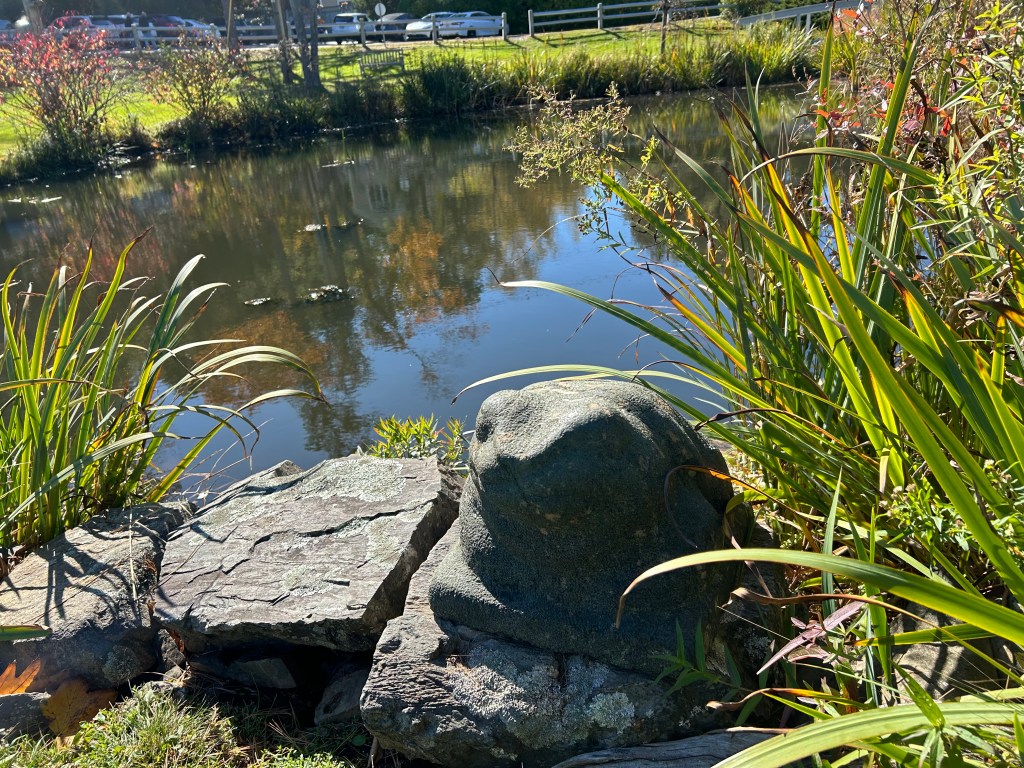
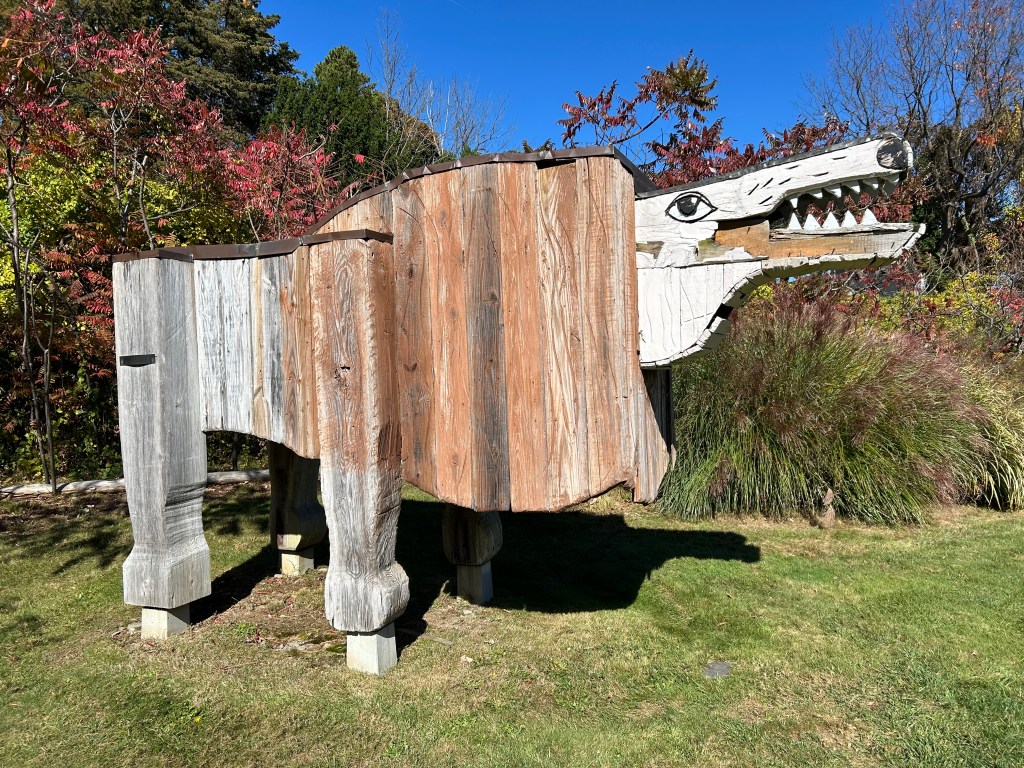
Andrea and I spent much of our time in the outdoor sculpture garden that surrounds the sleek, low to the ground, building. The garden features great natural vistas, as well as a sculpture called “Luna” in the background of the next photo, and many others tastefully arranged to reflect the natural beauty of the setting.
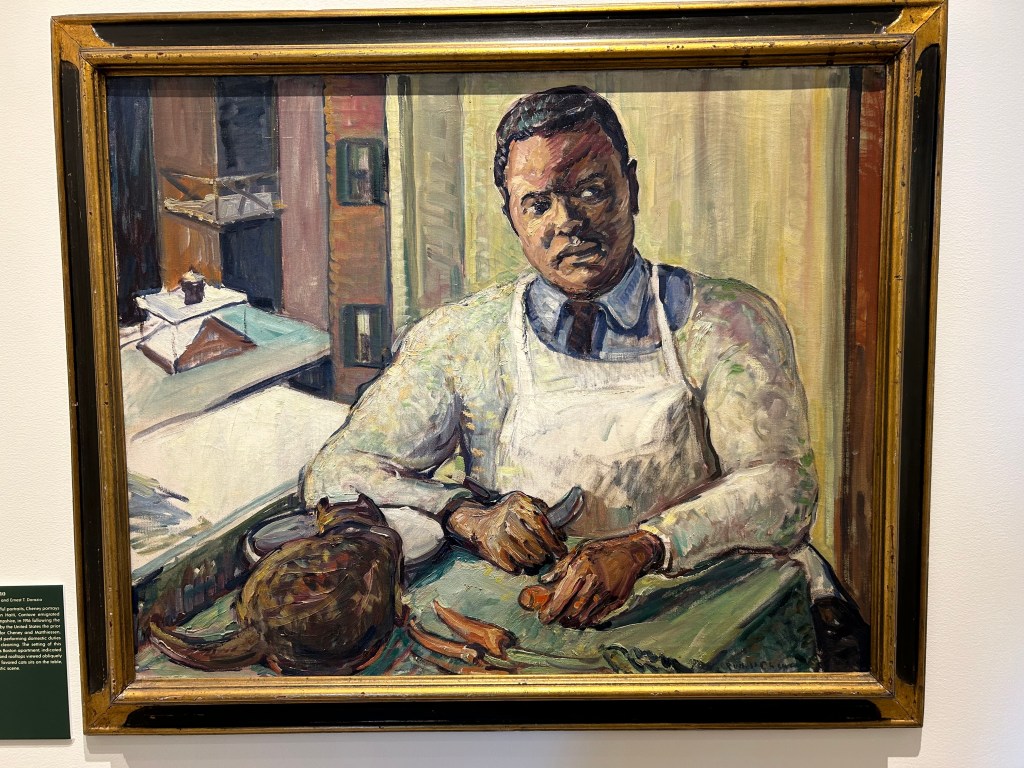
Inside the gallery, there were special showings of two mid-20th century American artists: Russell Cheney and Lee Kramer.
Cheney was a New Englander who lived and worked in Portsmouth, NH and neighboring Kittery and Ogunquit, ME. He painted in a somewhat traditional realist style with great sensitivity to the humanity of his portraits and a poetic rendering of light and space.
Cheney was a gay man who lived quietly with his life partner, the Harvard professor and author F.O. Matthiessen, for decades. He is much celebrated in Ogonquit by the large gay community there who have long lived in peace with their neighbors. The painting below is a self-portrait of Cheney (l.) and Matthiessen.
Lee Kramer is one of the important originators of an abstract movement in late 1930’s America. She was inspired by the Dutch artist Piet Mondrian’s style of precise, geometric abstractions.
Kramer was the spouse of the more celebrated artist Jackson Pollock. Personally, I much prefer her own contained, visually pleasing abstract creations to the wild expressionism of her alcoholic husband.
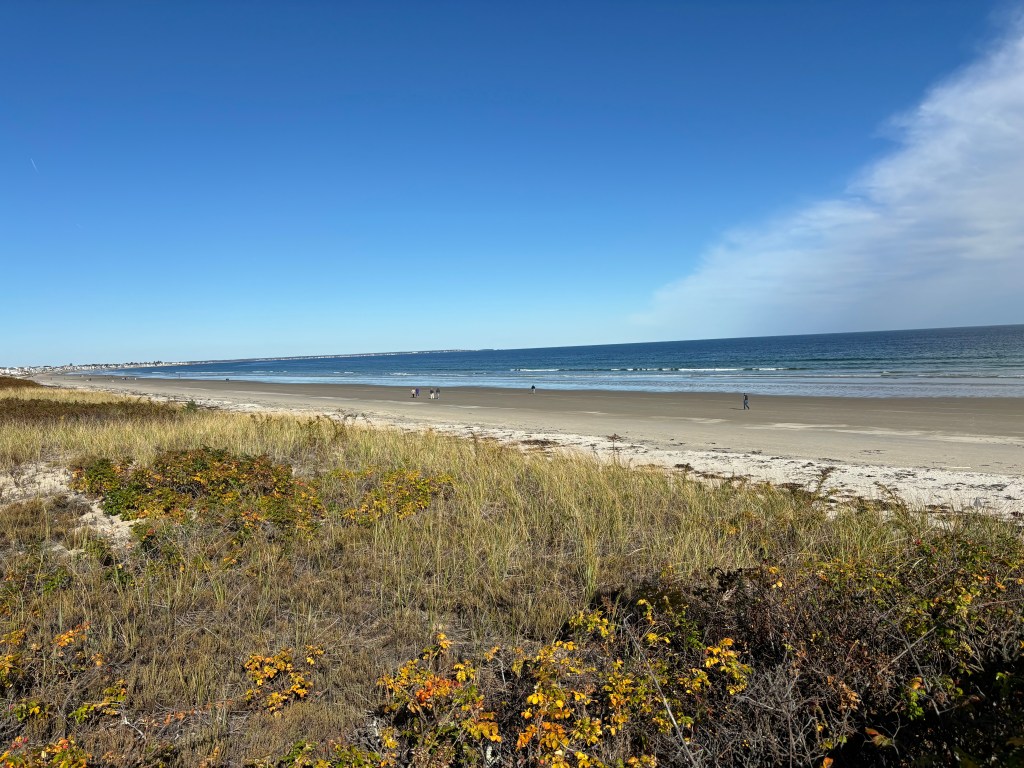
We took a second stroll into the adjoining sculpture court before driving into town for lunch and a long, energizing walk on the expansive Ogunquit Beach.
The term “sacred geometry” has become commonplace in New Age culture. According to Wikipedia, “Sacred geometry ascribes symbolic and sacred meanings to certain geometric shapes and certain geometric proportions.” It is associated with the belief in a “divine geometer/creator” from which the physical universe is unfolding in inherently coherent and orderly ways.
One form of sacred geometry that I’ve been working with for many years is the mandala. It is defined simply as a geometric configuration of symbols. Mandalas are used in many spiritual traditions as a means of focusing attention on the inherent order and beauty of the universe. They can be used as an aid to meditation and for establishing sacred space.
My own work with mandalas has primarily involved adding color to existing mandala forms as presented in adult coloring books. I’ve described this work in detail in two of my previous blog pieces:
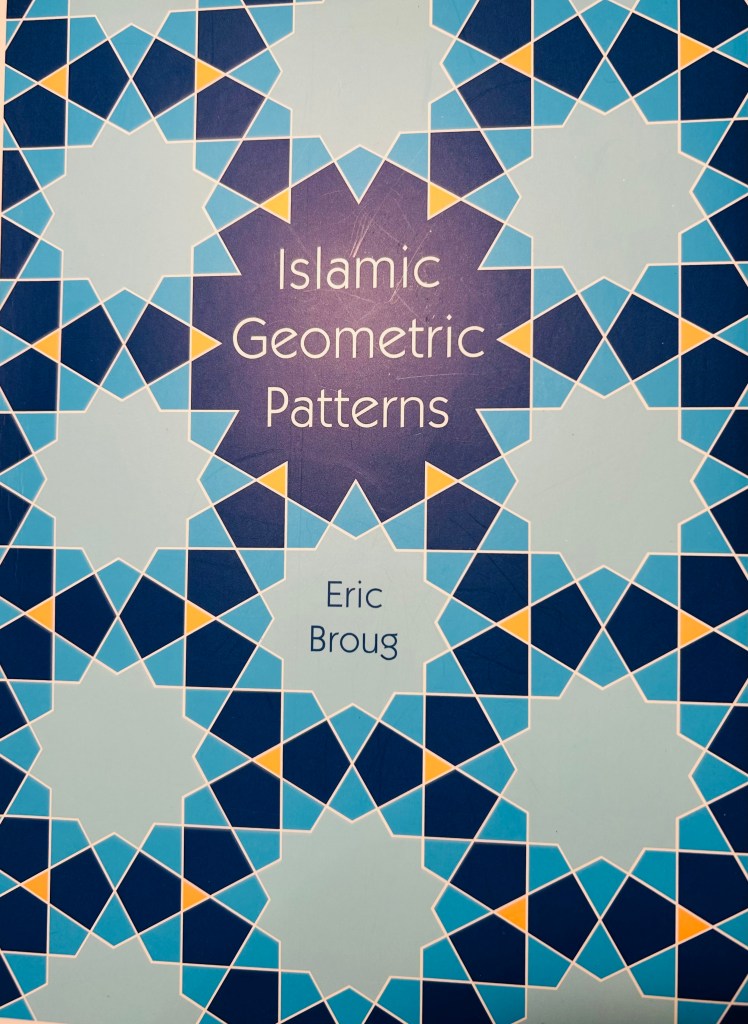
More recently, I’ve become interested in generating my own mandala templates using simple geometry. For guidance and inspiration in this process, I’m indebted to the book Islamic Geometric Patterns by Eric Broug. More than an aesthetic study of Islamic graphic motifs evident on many mosques, shrines, and other holy places, Broug’s book is an instructional guide for constructing complex Islamic-inspired designs using simply a ruler, compass, and pencils (ordinary and colored).
First Attempt
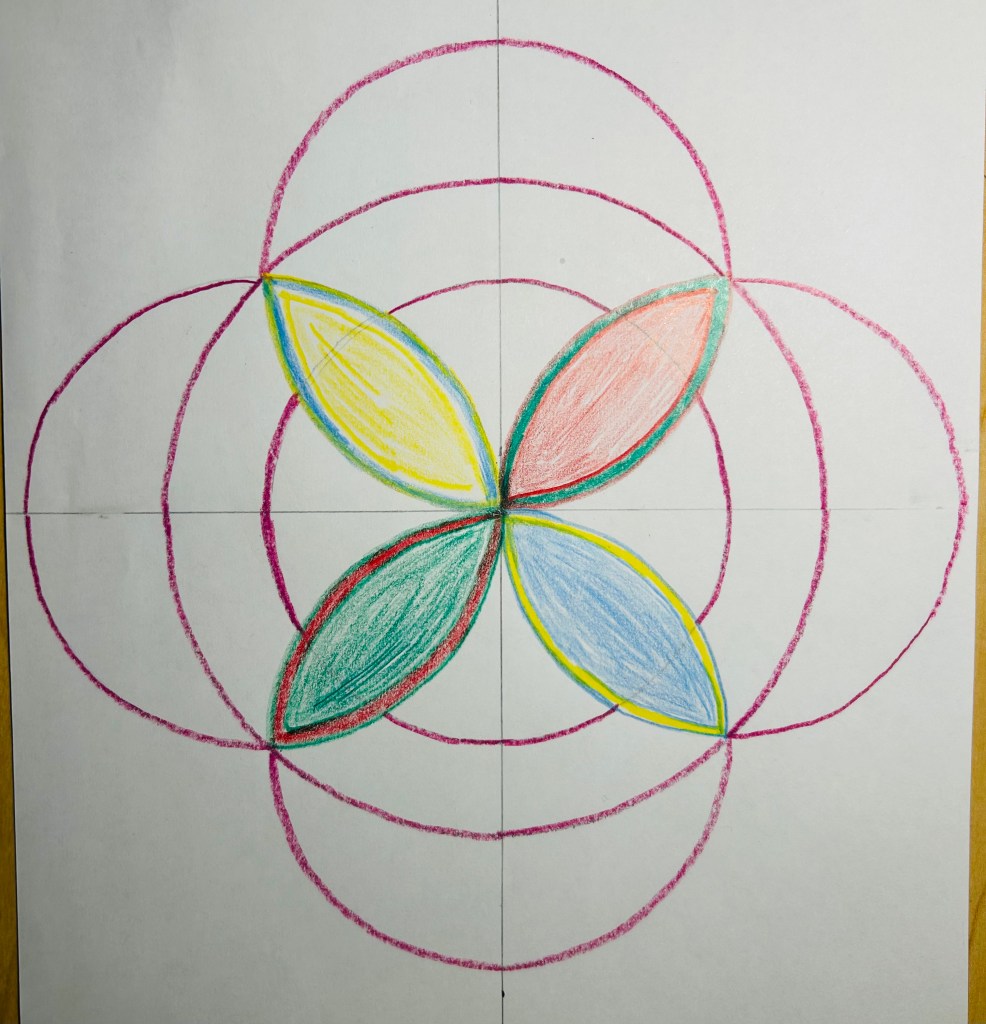
The figure below is my first attempt to create a mandala. Its geometry is relatively simple. It starts with drawing a circle with horizontal and vertical lines running through the center point. The circle intersects the vertical line above and below the center point. And the circle intersects the horizontal line to the left and right of the center point. Each of those four intersecting points then becomes the center of another circle of the same radius as the first.
A sixth circle can then be drawn using the four intersection points of the four outer circles. I used the center of the first circle and measured (with a compass) the distance to the four outer circle intersection points. This sixth circle has a larger radius than the other five circles and is concentric with the original circle.
It took me a few attempts to get a satisfying result. After meditating on it for a bit, I decided to color in a four-petal flower pattern that emerges. I also used a red pencil to highlight the circumferences of all six circles. I was pleased with this first foray into creating a mandala.
Flower of Life
My second foray was a bit more challenging. It involves 6 same-sized circles surrounding an interior circle of equal size. I’m not going to go through the geometric steps involved in creating this here. But like the first figure, it uses intersection points created by previous steps to become the center point for the next circle. All the design is done with compass and straight edge, with no linear measurement required. The finished work is shown in the figure below.
I learned later that the basic template of this figure has been used universally since the time of the ancient Egyptians (6,000BC). It is usually referred to as the “Flower of Life”. There are various interpretations of the symbol across cultures, but a common thread is that it represents “the interconnectedness of all things, the cycle of life, and universal creation”.
This symbol also provides the basis for drawing a perfect hexagon in the center of the central circle.
Concentric Hexagon Mandala
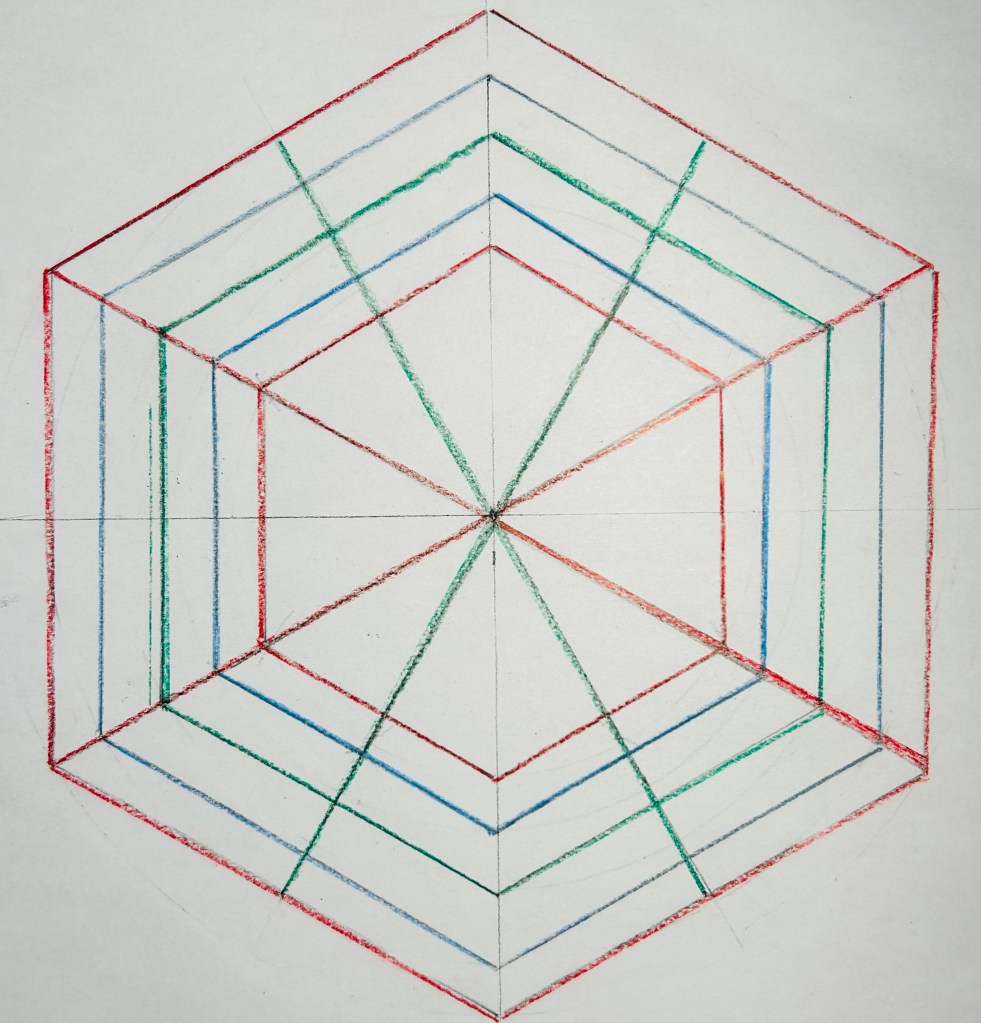
Using what I learned from creating the “Flower of Life”, I was able to easily construct a pattern of 5 concentric hexagons. It involved simply using a compass to draw four concentric circles around the central circle. Then the directional lines used to create the first internal hexagram are extended outward to intersect the concentric circles. The six intersection points on the circumference of each circle become the six points of the hexagon. I added a little color to highlight its mandala character.
The Great Mosque of Cordoba design template
The first real world example of an Islamic geometric pattern that I explored is based on the next complex figure.
The figure’s central motif is an 8-pointed star. The basis of the design is a circle within a square. Horizontal and vertical lines are drawn through the center of the circle, and then diagonal lines are drawn connecting the opposite corners of the square. The intersection points of the four lines crossing the circle become the points of connection for the rest of the pattern. Once the pattern is complete, some of the construction lines can be erased, yielding the following:
Tessellation
Eric Broug teaches that many of the ornate patterns of design used in the world-famous Great Mosque of Cordoba are simple repetitions of the figure given above. This repetitive process is called tessellation. The formal definition of the term is: “an arrangement of shapes closely fitted together, especially of polygons in a repeated pattern without gaps or overlapping.”
Per Mr. Broug’s suggestion, I made 9 photocopies of the figure above and assembled them together to witness the effect, shown below.
As you can see, the repetition of the original figure yields more interesting and complex patterns. Of course, the actual rendition of this in the Cordoba mosque is much more ornate.
I’m obviously still a novice at this, but I wanted to share my initial enthusiasm at discovering the fascinating realm of sacred geometry.
















 John's Blog