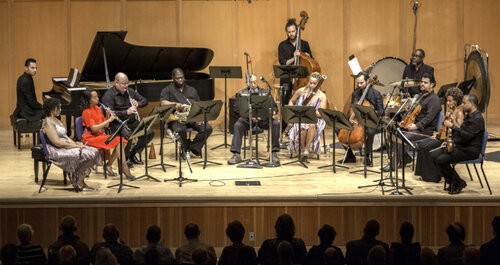
I attended a memorable concert this week in the intimate Terrace Theater of the Kennedy Center in DC. It was given by two primarily classical music chamber groups, the Imani Winds and the Harlem Quarter, joined by three talented jazz musicians and an “orator”, the well-known jazz music critic and prolific poet, A. B. Spellman.
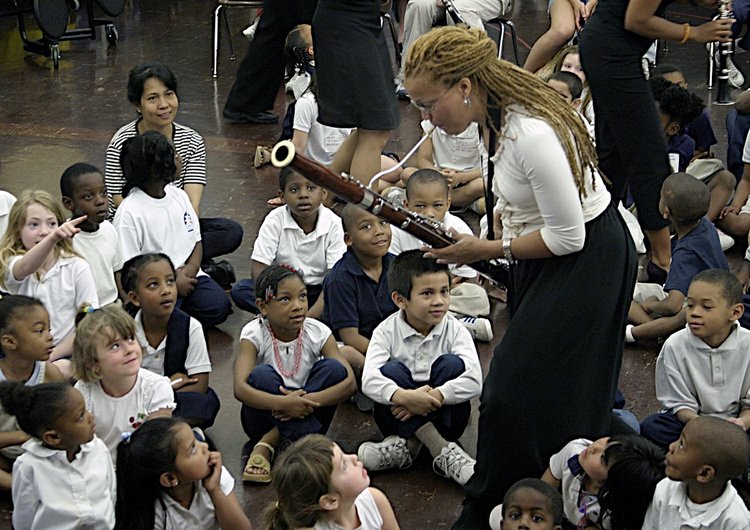
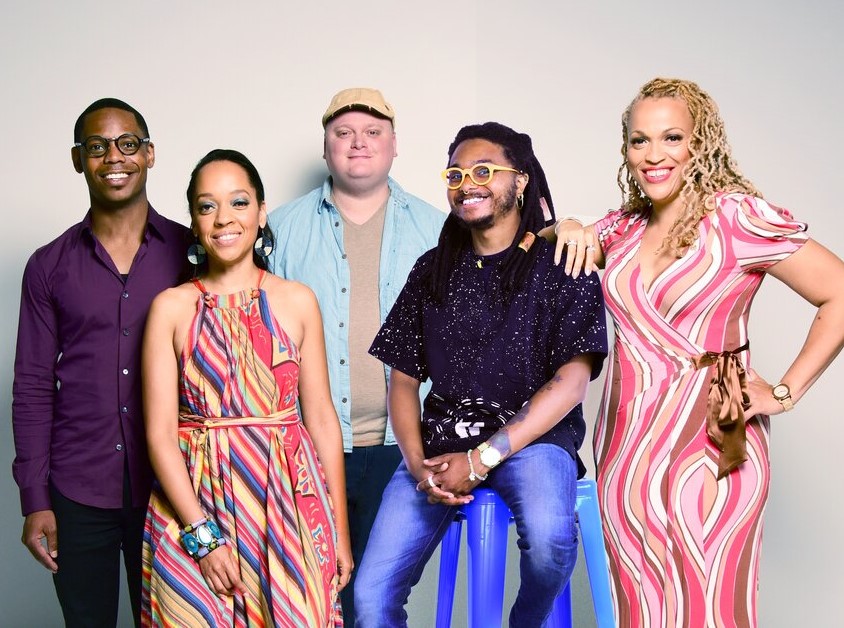
My spouse, Andrea Dilorenzo, had encountered the Imani Winds while she was working as a school therapist at a local public school many years ago. They are a classical woodwind quintet who were bringing their music to kids in disadvantaged communities in the DC area. Andrea introduced herself to the musicians back then and happily discovered that they were graduates of Oberlin College where she had graduated. When she read about their upcoming performance at the Kennedy Center, she was quick to buy us tickets.
Little did we anticipate the sublime experience ahead of us.
The concert consisted of one extended musical work, “Passion for Bach and Coltrane”, by the Oberlin music professor and composer Jeff Scott. The composition was inspired by a collection of poetry, “Things I Must Have Known”, by A. B. Spellman, the father of Mekhi Gladden, who is the oboist of Imani Winds.
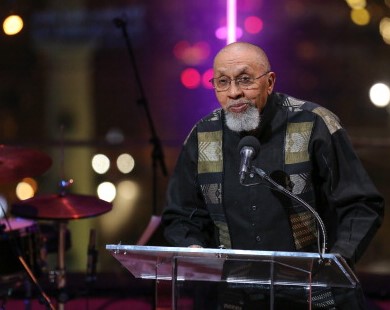
Scott’s work is a brilliant integration of Spellman’s spoken poetry together with classical and jazz music. Both the 5-piece Imani Winds (flute, oboe, clarinet, French horn, bassoon) and the Harlem Quartet (two violins, viola and cello) have outstanding reputations in the classical arena. They were joined by a talented jazz trio on piano, bass, and drums. A. B. Spellman himself, now 89 years old, was the “orator” for selected poems from “Things I Must Have Known”.
Another draw for us was the Harlem Quartet which we had traveled to Winchester, VA to hear in concert about 5 years ago at Shenandoah University. The lead violinist of the quarter is Ilmar Gavilan, a Cuban native who has a brother, Aldo, still living in Cuba, who is a first rate classical pianist. Andrea had seen a TV documentary about the two brothers and their cherished musical reunions both in Cuba and here. Aldo had joined the Harlem Quarter for an unforgettable performance of Schumann’s Piano Quintet at Shenandoah U.

Thursday’s concert was the second musical event that Andrea and I had attended at the Kennedy Center within the week after not having gone to one there in some years. We were pleased to be among the younger, racially mixed audience at the Terrace Theater after our usual experience of older, white audiences. We’d invited a younger friend to join us for the concert as well.
Over the years, I have written a number of concert reviews for my blog. Although I love music of all genres, I always find it challenging to attempt conveying the felt quality of a live musical experience. Part of my inspiration to write this came from the first poem recited by Spellman, “Dear John Coltrane”. In it, the poet describes a musical reverie induced by listening to diverse radio broadcasts in a hotel room late at night. Specifically, he writes of a sublime feeling while listening to the slow movement of a Bach keyboard concerto. Switching stations, he later hears a recording of the jazz legend John Coltrane playing solo saxophone on his own composition, “Slow Blues”. Again, the poet is transported to a transcendent inner state. He reflects on the commonality of feeling evoked by the two radically different musical forms used within the 17th-century baroque tradition and the free jazz form of the 1960’s. I’m including the full text of “Dear John Coltrane” as an appendix.)
The piece starts with Spellman reciting the first stanza of “Dear John Coltrane”. The musicians then come in with the melody and variations of Bach’s F minor concerto. The arrangement is such that each of the woodwind players has a chance to solo. The piano then comes in, followed by the quartet of strings. It was as interesting and beautiful arrangement and rendition of Bach’s well known melody as I’ve heard. Spellman then comes back in, reciting the second stanza of the poem, this one about listening to Coltrane’s “Slow Blues” and experiencing the same kind of fluid transcendence as he’d experienced listening to Bach. The words help to guide the audience into the ensuing musical piece in a languid way.
The next session is entitled “Psalm” and begins with Spellman reciting the poem “After Vallejo” (the Peruvian writer Cesar Vallejo is regarded as a tragic giant of 20th century poetry). It includes the poignant lines:
i’ll be writing when i go, revising another
hopeful survey of my life. i will die of nothing
that i did but of all that i did not do
i promised myself a better self
than I could make & i will not forgive
J. S.Bach composed two large choral works about the passion and death of Jesus Christ – the Saint John Passion and the Saint Mathew Passion. Composer Jeff Scott uses the double meaning of “passion” in his “Passion for Bach and Coltrane”, referring to Bach’s works as well as to the musical passion expressed by A.B. Spellman in his poetry. Two sections of Scott’s work use Spellman’s poems “Out of Nazareth, Pt. 1” and “Out of Nazareth, Pt. 2: Manual for a Crucifixion”. In the latter one, Spellman references a Roman manual on how best to enact the gruesome torture of a crucifixion. Spellman’s portrait of Jesus is as a highly compassionate and selfless man of God. The musical sections here reflect that spiritual purity and integrity, as well as the cynical barbarity perpetrated on him by the Romans.
The entire concert was about 90 minutes long, and the last third consisted of some high powered, driving jazz. The jazz trio provided the rhythmic framework for each of the musicians on stage to showcase their extraordinary improvisational skills. I sat in utter amazement at the sophisticated jazz riffs played by each of the classically trained musicians of the Imani Winds and the Harlem Quartet.
When the musical intensity became a bit challenging for me to stay with, a slower, bluesy interval brought in a welcome lyrical calm. Spellman read from his poem “Groovin’ Low” at that point:
my swing is more mellow
these days: not the hardbop drive
i used to roll but more of a cool
foxtrot. my eyes still close
when the rhythm locks; i’ve learned
to boogie with my feet on the floor
i’m still movin’, still groovin’
still fallin’ in love, but
i bop to the bass line now.
I happen to be 75 and do most of my bopping to the base line, too. My real amazement was that Spellman, at 89, could still speak with such passion, expression and volume.
The last section of the concert, “Acknowledgment”, is an extended recapitulation of major themes from John Coltrane’s magnum opus, “A Love Supreme”. It begins will Spellman reading his inspired lines of meditation on the nature of life, death and love: that the highest purpose of living is to love and be loved. he concert ends with everyone on stage chanting the words “A Love Supreme” over and over again, tapering off to a whisper.
There was a rousing standing ovation as the concert ended, and many rounds of applause for the individual musicians and for the whole ensemble. Jeff Scott was in the audience and was invited to come on stage to partake in the well deserved acclaim for these consummate musicians.
John Bayerl,11/24/2024
APPENDIX:
Dear John Coltrane
by A. B. Spellman

dead night has me writing poetry
in another hotel room. j.s. bach
is on the radio. the keyboard concerto
in f minor: the one you also hear
on oboe or violin, the largo
second movement begins
& the book in my hand drops
the room fades
& I put my reason down
to trail the bach of endless line
along this earthless path, each note full
& bright, a brilliant footprint on the dark
through beauty, past knowledge, into
the state that shines too much
to be wisdom, is too transparent
to be art. i catch a fear of that place
where he will lower me when
this transporting melody closes
then it closes on itself & here I am
dear john, back at the beginning, better

later, different station, cold room dimming
it’s you, john, trane’s slow blues
now it’s your line that opens, & opens
& opens, & i’m flying that way again
same sky, different moon, this midnight
globe that toned those now lost blue rooms
where things like jazz float the mind
this motion the still & airless propulsion
i know as inner flight. this view
the one I cannot see with my eyes
open. i hear the beginning approach, &
i know the line i traveled was a horizon
the circle of the world, another freedom
flight to another starting place
if I believed in heaven I would ask
if you & bach ever swap infinite fours
& jam the sound that light makes
going & coming, & if you exchange maps
to those exclusive clouds you travel thru
& do you give them names?
 John's Blog