
I recently finished reading David Gann’s masterful, yet shocking historical account of a barely remembered American tragedy that occurred in northeastern Oklahoma in the early 1920’s. It’s about the scores, if not hundreds, of murders perpetrated on the Osage Indians after oil was discovered on their reservation in the early 20th century. By law, the Osage had full financial rights to the profits from all oil extracted from their land. Within a decade, those profits had made the Osage among the wealthiest people in the country. Gann’s book documents the brutal and systematic murders that mostly local, white Oklahomans committed against the Osage in order to get title to their oil “headrights”.
The Osage Indian people, repeatedly uprooted from their traditional homelands in Missouri, Kansas, and Arkansas during the 19th century, were finally given a mostly barren piece of land in the Oklahoma Territory as a reservation. They were able to eke out a subsistence living there and maintained their native cultural and spiritual practices mostly in peace and harmony. After oil was discovered there, their traditional way of life was seriously upended. Many of them became almost instantly wealthy, and this bred a sense of envy and contempt from many of their non-Indian neighbors. In addition, their wealth led to a breakdown of many of the cultural and spiritual beliefs and practices that had sustained them through their long history.
After reading Gann’s carefully researched book, I decided to watch the new Martin Scorsese film adaptation. The film is a whopping three and a half hours long, and I was happy to break up the viewing in digestible portions via a streaming service.
The film has its main dramatic focus on the relationships between Ernest Burkhart (Leonardo DiCaprio) and his Osage wife Mollie (Lily Gladstone) and with Ernest’s rapacious uncle, William Hale (Robert De Niro). It ignores large sections of Grann’s book dealing with the corrupt and chaotic state of policing in 1920’s Oklahoma and with the backstory of the creation of the FBI. Scorsese co-wrote the screenplay with veteran screenplay adaptor Eric Roth.
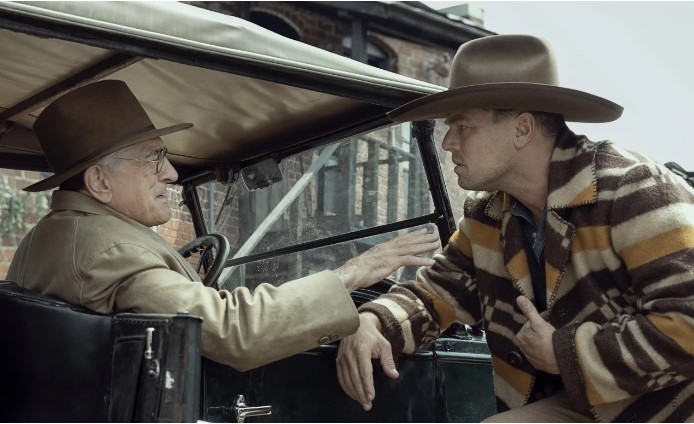
I was completely taken by the film from beginning to end. Scorsese took pains to visit the Osage territory and made significant connections with Osage tribal people there. He incorporated a lot of Osage language, customs, and spiritual beliefs as a major thread in the complex tapestry of his cinematic narrative. He humanized the Osage in ways that made the numerous killings by white perpetrators feel even more brutal and inhuman.
The liberties that Scorsese took with the narrative in Gann’s well-documented, nonfiction book made a lot of sense to me. He alters the background of Ernest by portraying him as a WW1 army veteran trying to find his way after witnessing the horrors of early 20th century warfare. This adds a bit more gravitas to the ostensibly naive young man who has come to Osage country seeking his fortune. The film also shows a public parade of Indian war veterans, reminding us that Native Americans have long served in the U.S. armed forces in percentages far greater than that of the white population.
Another plot invention in the film involves a newsreel being shown in a reservation movie theater. The newsreel depicts the destruction of the wealthy African American area of Tulsa in 1921 in what used to be called a “Negro riot” but is now historically understood as an unprovoked aggression by the white population of Tulsa. The “Killers” book and film describe events that occurred just a few years after the white attacks in Tulsa. The Indian people watching the newsreel are horrified, fearing that a similar aggressive violence is being perpetrated on themselves. William Hale, sitting in the back of the theater, admires the white power structure of Tulsa for having succeeded in perpetrating their false, self-serving narrative.
But the biggest liberty that Scorsese takes is his full-fledged dramatic focus on the marital relationship between Ernest and his wealthy Osage wife, Mollie. That relationship is a relatively minor element in the book, but much more so in the film.
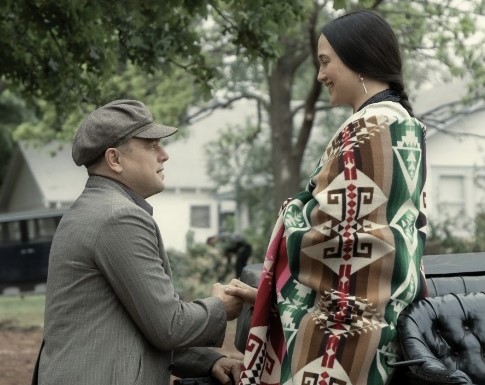
Ernest wants to marry Mollie after a brief courtship occurring mostly while he takes her around town in his cab. They have genuine affection and sexual attraction for one another. Ernest’s uncle strongly encourages him to pursue marriage, knowing that he would stand to inherit Mollie’s considerable oil fortune. Mollie is not naïve about Ernest’s financial motivation and even kids him about it. Ernest is naïve enough at that time to assume he could have a happy marriage and raise a family with Mollie independent of his uncle’s ulterior motives. They have a traditional Osage ceremony for their wedding, and William Hale, still regarded as a friend and patron of the Osage people, is an honored guest.
Mollie Burkhart becomes the heart and soul of Scorsese’s film. She is understatedly played by the experienced Native American actress, Lily Gladstone, who grew up on a Blackfoot reservation in Montana. Her performance even eclipses those of DiCaprio and De Niro. Mollie suffers horribly through the course of the story, ultimately losing all three of her sisters in the cynical campaign to steal the oil headrights of the Osage. One of the first murders shown is of her sister Anna in a plot that her husband Ernest was aware of. Earlier, she had lost her sister Minnie to the “wasting disease” – likely the victim of intentional poisoning. In perhaps the most crushing murder, her neighboring sister Reta’s home is dynamited while Reta and her husband are asleep in bed. This time Mollie’s husband Ernest had a more direct hand in the murders, convinced by Hale that it was necessary to ensure that Reta’s fortune would eventually come to him.
Mollie suffers from diabetes. Due to her wealth, she is able to become one of the first people in the country to receive insulin injections. Little does she know that the two doctors treating her (the Shoun brothers) are conspiring with William Hale to keep her incapacitated. The doctors insist that Ernest include another “medicine” in Molly’s daily insulin injections. The result is that Mollie feels more tired and lethargic than ever. It later comes out that Ernest has been unknowingly injecting her with daily heroin.
Throughout her travails, Mollie maintains a loving relationship with her three young children and her mother, Lizzie, who lives with Mollie during Lizzie’s dying days. As Mollie begins having doubts about her husband’s loyalties, Ernest continually reassures her and stays home to nurse her through the worst of her illness. Mollie is somehow able to maintain affection for Ernest even as his part in the growing conspiracy becomes more and more evident.
Scorsese’s screenplay has Mollie make the long train trip to Washington, DC with a small group of other Osage. There she is able to briefly speak with President Calvin Coolidge and plead for help with the horrendous murders occurring in Osage territory, already a major national news story. The film implies that it was Mollie’s plea that initiated the full-fledged FBI investigation that was to ensue. (In Ganns book, Mollie never goes to Washington and the FBI investigation is initiated by a young J. Edgar Hoover, intent on making a name for himself.)

In subsequent interviews, Scorsese freely admits his deviations from the historical record. He says that he was not inspired to create a film along the lines of the extensive criminal investigation that Gann describes in such intricate detail. Instead, he shaped his film around what he does best – penetrating psychological examinations of criminals and their nefarious plots.
The long first part of Gann’s book reads like a nonfiction whodunit. It’s written from the point of view of a criminal investigator charged with gathering information and making assessments as to what is going on within a massive conspiracy that has been unfolding for many years. The criminals include some of those regarded as the most upstanding pillars of the northeastern Oklahoma area.
Scorsese takes a different tack. There is no suspense around who the bad guys are. They are fully revealed for all their dark evil from the beginning. Robert De Nero’s portrayal of William Hale has to rank among the darkest, oiliest portrayals of any American villain. The man is a brilliant sociopath, with no conscience, and therefore able to feign friendship with the Osage and penetrate their most intimate social gatherings and tribal meetings.
David Gann and Martin Scorsese both end their narratives, literary and cinematic, with understated critiques of a society in which such egregious horrors could be perpetrated in such a systematic way for so long a period. Gann returns to Osage territory long after his initial fact-finding tour in order to survey the contemporary state of Osage society. He is sobered as he interviews surviving family members of the victims, but is also buoyed by his encounters with Osage elders and leaders who continue to carry on the spiritual and cultural traditions of their people.
Scorsese’s film ends with two telling artistic statements. First is a brilliant enactment of a late 1920’s radio show, fictionally produced by J. Edgar Hoover, to tout the accomplishments of his newly created agency. In the radio show, Osage murders are only a backdrop to show off the supreme investigative powers of FBI agents. At the end of the radio broadcast, Martin Scorsese himself comes to the microphone. We’re expecting him to speak as Hoover, but instead he simply reads the brief obituary of Mollie Burkhart in which there’s no mention of the murder of her family members. He then mentions the early release from prison of both William Hale and Ernest Burkhart. The audience is left to come to their own assessment.
The very last scene in Scorsese’s film is a moving video portrayal of a contemporary Osage dance ceremony. As the drums beat and the people chant and dance, a drone camera films from above. As the drone moves higher and higher, the full extent of the outdoor dance circle becomes evident. Hundreds of Osage, many in traditional attire, are singing and dancing in unison. As the credits are displayed, the video leaves the audience with a sense that the Osage have somehow managed to survive, and even thrive, despite a wholesale attempt to eliminate them.
John Bayerl, 1/22/2024
 John's Blog