I was saddened to hear (via a Facebook posting) of the passing of an old friend and teacher from my Buffalo days. Tom Trosey taught English at the boys’ Catholic high school I attended there from 1963-1967. He was fresh out of college when he arrived as an enthusiastic young teacher whose specialty was creative writing. I never had Tom as a classroom teacher, encountering him in his role as moderator of a fledgling literary magazine and of the yearbook, for which I was the editor in my senior year. Tom became good friends with my English teacher for all four years, Father Claude Bicheler. In my senior year, I began attending plays and concerts with both, and through their influence, decided to become an English major in college.
Tom helped me to come up with a theme for the 1967 yearbook. It was “Men of our Times”, and featured short prose and photo essays about William Faulkner, Dag Hammarskjold, Pope John XXIII, and John F. Kennedy. Both Tom and Father Claude gave me a lot of time and encouragement back then and helped me through my many doubts and fears.
I encountered Tom in a different context in my senior year at Fordham University in New York City. There he was in graduate school at NYU, and I remember many rich visits with him then, discussing our favorite writers, and attending a number of plays together.
After college I experienced a severe depression. I had returned to Buffalo to take care of my draft status and was very grateful to get a 4F deferment owing to my compromised vision. I started a full-time job at the Buffalo Evening News, still living at home on the working-class East Side of town.
Life was going well enough, and I even had a new girlfriend, a young woman who I’d met attending a Buffalo Philharmonic concert one sunny October Sunday afternoon. The relationship started with a lot of promise, but soon devolved into heartache after we got pregnant, and she had an abortion. We ended up breaking up. I was torn by grief and guilt.
Tom was back in Buffalo at the time, and I was able to confide in him. He was very sympathetic and helped me to find a good group therapist. It was my first exposure to therapy, and I credit it with saving me at a time when I felt sucked down into a terrible black hole of hopelessness.
Tom and I remained friends through the two years of my recovery work in therapy. We lost touch when I left Buffalo in the late 1970’s, but occasionally reached out by phone and pen.
I remember Tom as a kind, caring person with a wicked sense of humor and fine tastes in books, music and theater. He went out of his way to help me during a number of challenging times in my life, for which I am eternally grateful. It’s been wonderful reading the soulful postings about Tom from other former students on Facebook and the Legacy site. I can picture him smiling down as those who knew and loved him share their written appreciations of him now.
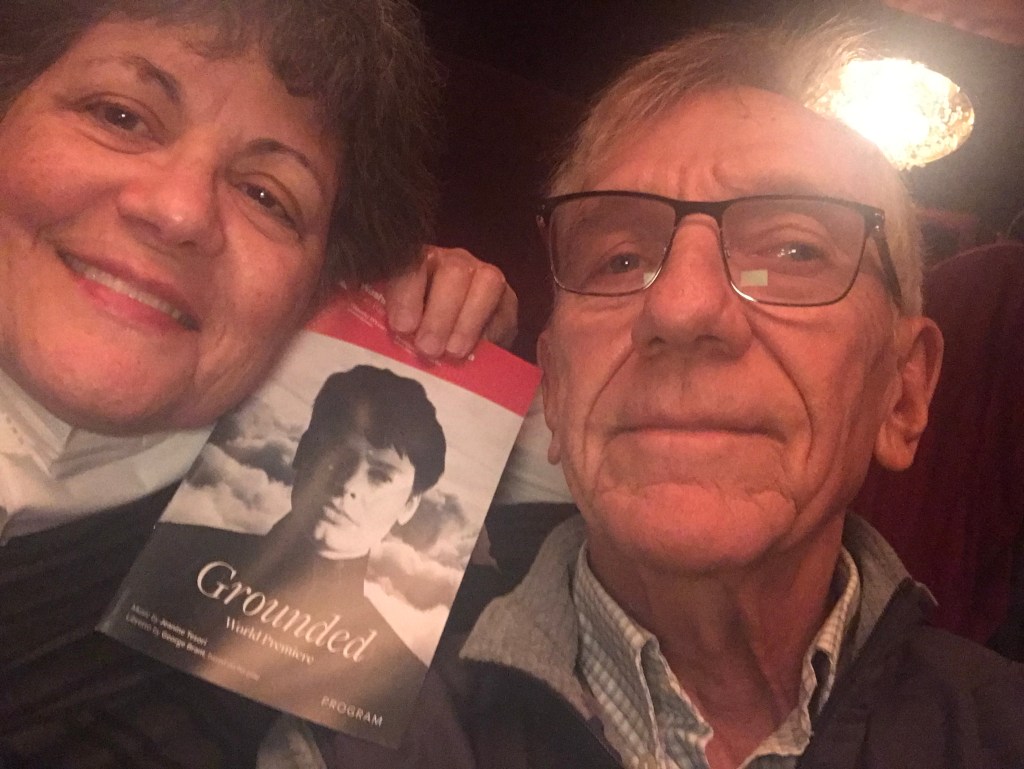
Andrea and I attended a compelling performance of a new opera on Sunday at the Kennedy Center Opera House. We were both deeply affected by this contemporary musical drama about the psychological debilitation suffered by a young, female Air Force pilot. “Jess” is demoted from flying F-16 fighter jets to guiding unmanned drones. She is tasked with killing selected human “targets” over desert terrain somewhere in the Middle East. The subject matter felt all too relevant as guided bombs and missiles continued to fall daily over civilian populations in both Gaza and Israel.
“Grounded” originated as a one-person play written by George Brant after he had made a deep study into the phenomenon of drone warfare and the personnel who directed the drones. The play found an audience and culminated with an off-Broadway production starring Ann Hathaway in 2015. The opera came about owing to the Metropolitan Opera’s current zeal for commissioning new works to attract new audiences. The Met commissioned playwright Brant to work with the established composer Jeanine Tesori to refashion “Grounded” as a full-blown opera and gave the Washington Opera an opportunity to give it a trial run.
Ms. Tesori had created two successful operas already after a celebrated career as a composer of Broadway musicals. Working closely with Brant, they soon realized that the original one-character script needed to be fleshed out with the other characters described in the “Pilot’s” monologs. They realized that the opera genre requires a full expression of human passion by multiple voice ranges for it to succeed. The result is a full opera cast of twelve individual characters and a large chorus.
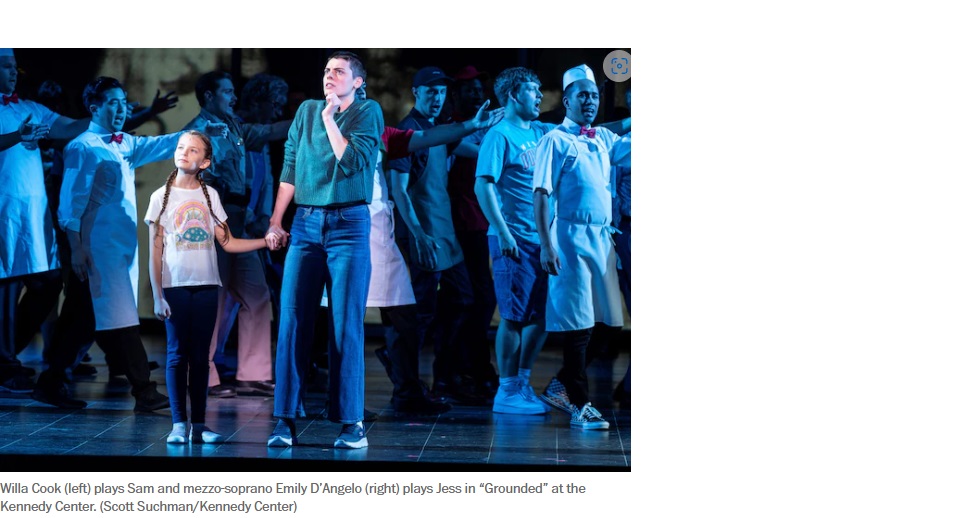
In the opera, the Pilot is named “Jess” and is acted and sung by the consummate young mezzo soprano, Emily D’Angelo. We meet Jess as an Air Force F-16 fighter pilot flying combat missions over Iraq. Jess has trained long and hard to earn her wings flying the most sophisticated fighter jet in the modern arsenal. She has a deep love for flying into the immense “Blue” of enemy skies, thrilling to her missions by avoiding enemy fire and destroying her targets (power stations, factories, enemy bases). She has truly found her place among the elite pilots of the U.S. Air Force Blue and revels in it.
While Jess is on leave stateside, she meets a man with whom she shares a strong sexual and emotional connection. Her leave is at an Air Force base in Cheyenne, WY, where she joins her male cohorts for rowdy nights of drinking and gambling. A handsome local rancher and card-shark, Eric, soon takes his large share of the card game winnings and encounters the half-drunk Jess, who is immediately attracted to his cowboy manliness. Eric invites Jess to spend the night with him at his nearby ranch-house. Eric and Jess experience genuine passion for one another, and when Jess soon discovers her pregnancy, Eric is eager to marry her. Jess of course “loses her wings” but is happy to settle in with Eric to have and raise their child, and to partake of the natural beauty of rural Wyoming.
Jess gives birth to a girl, Sam, and learns to become a good wife and mother. But after eight years of domestic life, she begins yearning to fly planes again. She approaches the Air Force only to learn that she has lost her place as a fighter pilot but is recruited to serve as a drone “pilot” at an Air Force base outside of Las Vegas. She is put off at first, but then reluctantly agrees to take the assignment. Eric agrees to join her there with Sam, quickly picking up work as a blackjack dealer for a gambling casino.
Jess is initially appalled at her new duties, confined for daily 12-hour shifts in a small trailer where the drone operation is directed. Her yearning to fly again is harshly curtailed by her new duties, but she feels trapped and obliged to fulfill her commanding officer’s stark order: “This is where we need you now.”
The second half of the opera is set almost entirely within the confines of a trailer in the Las Vegas desert where Jess, her boyish technology assistant, and two uniformed officers work 12-hour shifts, every day of the week. Their job is to surveil specified areas of a Middle Eastern desert in search of “suspicious activity.” When such activity is located, they may be ordered to obliterate the “target” via a cruise missile fired from the drone plane that they are operating.
The whole opera makes use of state-of-the-art, totally immersive technology. It employs a panoply of colored LED lights and projections to establish a sense of place, adding to the emotional weight of the story unfolding through music. The Co-Production Directors, Jason Thompson and Keitlyn Pietras, say that they “see a common thread in the use of advanced video technology to tell a story about state-of-the-art advancements in military technology.”
The second act shows the slow emotional and psychological degradation suffered by Jess as she pursues her daily 12-hour shifts as a drone pilot. The Air Force employs premium rewards for pilots who successfully find and destroy designated human targets. The work awakens Jess’ killer instinct, which had gone underground during her eight years of domesticity and motherhood. She is very skilled technically and has a keen sense of where her targets might be hiding. She takes genuine joy at each of her kills, like an adolescent playing violent video games, though here the human lives taken are all too real.
We begin to see Jess’ psychological breakdown in her time at home with her daughter and husband. She has become addicted to caffeinated beverages and her sleep patterns become very disrupted. Both her husband and daughter notice Jess’ strange behavior and try to make the best of it. Eric realizes that it is time for him to step up to confront Jess and yet hold on to his commitment to her. But Jess becomes unreachable, and their family life a living nightmare. Jess becomes paranoid about being spied on, and in one lively scene set in a shopping mall, she becomes convinced that someone is trying to sabotage her shopping trip with Sam to buy her a new dress.
The climax of the story occurs after a day’s long tracking of a suspicious car in a Middle Eastern desert. Regulations require a visual identification of their human “target,” but it’s as if the driver knows that he must not get out of his car during daylight. After hour upon hour of excruciating boredom, Jess notices the car slowing down as it approaches a house. She sees a young girl come running out of the house to greet the car. A man then emerges from the car and runs to embrace the girl and take her to safety. The order is given to destroy the target, but Jess has become deeply moved by the man’s apparent love for his daughter, for whom he would risk his own life. She hallucinates the girl as her own daughter, Sam. In her upset, she refuses to comply with the command and, instead of releasing a cruise missile, purposely crashes the drone.
The last scene is of Jess in solitary confinement after having been court-martialed by the Air Force. She is unrepentant for her actions and has gained back some of her human feelings for her daughter and husband. In this way, “Grounded” differs from another opera on a similar theme called “Wozzeck” by Alban Berg, first performed in 1925. In that one, a former soldier is driven to alcoholism and psychosis by his ill treatment in the military, murdering his girlfriend and ending his own life in desperation. “Grounded” ends on a dark note for sure, but also on a note of heroic human defiance against technological murder.
Although “Grounded” does not outrightly criticize technological warfare, it certainly points to the degrading nature of using that technology to purposely murder. Our country has experienced many of the ill effects of our recent wars in Iraq and Afghanistan via the large numbers of returning veterans committing suicide or suffering from addictions and acute PTSD. A strong anti-war argument is that even the “victors” will suffer emotional damage from human killing, especially when it is done at a distance, but with full human knowledge that another human being’s life is being taken.



 John's Blog